



A choppy bob is the ultimate move when you’ve got curls and you want them to work for you instead of against you. Layered cuts strategically remove bulk, reduce frizz, and let your natural curl pattern shine through with way more dimension and movement than a blunt, uniform length ever could. The choppy texture creates pockets of air throughout the cut, which means your curls have the space to spring up and out, giving you that enviable bounce and volume without needing to blow-dry aggressively or use a ton of product. This is why curly-haired people who get the right choppy bob almost always stick with the style—it works with your hair, not against it.
What makes a choppy bob different from a regular layered cut is the intention behind the layers. Instead of subtle, graduated layers that blend seamlessly, a choppy cut deliberately creates visible texture and separation, especially at the ends. Some pieces stick out slightly longer, others hit shorter—and that staggered, piecy effect is what gives curls that volume and bounce. The layers are usually more pronounced at the crown (where you need the lift) and sometimes shorter and choppier on the sides (to create that dimension and remove weight). When your stylist cuts into the curl with choppy layers, you’re not just shortening the hair—you’re actually changing how the curl falls and bounces.
The best part? A choppy curly bob works on almost every curl type, from loose waves to tight coils, and it flatters most face shapes. Fine, thin curls need choppy layers to avoid looking flat and heavy. Thick, dense curls need them to prevent a blocky, cotton-candy appearance. Even wavy hair benefits from a choppy cut because it gives the waves more definition and movement. Let me walk you through 15 different choppy curly bob styles, each with its own vibe, styling method, and the specific curl situations it works best for.
1. Textured Choppy Curly Bob with Side-Swept Bangs

This is the classic choppy curly bob that works for almost everyone—think short, textured layers throughout with a longer front section that sweeps across one side of the face. The side-swept bangs create an asymmetrical feel that’s effortlessly cool, and they frame your cheekbones beautifully while still showing off your curls. The back and crown are noticeably shorter and choppier, which builds volume right where you need it, while the front pieces are longer—sometimes grazing the jawline or collar—which gives you movement and flow.
Why This Cut Maximizes Bounce
The combination of short, choppy layers in the back with longer front sections creates natural movement because your curls don’t all spring up at the same height. Instead, you get this cascading effect where shorter pieces at the crown pop up with volume, while longer pieces in the front curl down and swing. The side-swept bangs don’t sit flat—they curl and bounce just like the rest of your hair, so they add visual interest without weighing you down. This staggered length is the secret to how choppy bobs create that signature bounce; every curl has a different lift point, so the overall effect is fuller and more dynamic.
How to Style It
- Apply curl cream or gel to damp hair, starting at the roots
- Diffuse with your hands gently cupping curls upward, or air-dry while flipping your head side to side
- The side-swept bangs will naturally curl and fall—let them do their thing rather than pinning them flat
- Scrunch the sides gently to encourage side-curl definition
- For extra bounce, use a light hairspray on the underside of the crown once curls are dry
Pro tip: This cut looks best when you get it refreshed every 4-6 weeks because the choppiness starts to blend as your hair grows out. The choppy texture is what creates the bounce, so maintaining that texture is key.
2. Voluminous Choppy Curly Bob with Lots of Layers

If you want maximum volume and movement, this is the cut for you. This version has layers throughout—not just at the back and sides, but layered all over the head so that almost every strand has somewhere to move independently. The shorter layers at the crown are very pronounced, sometimes only 2-3 inches long, creating serious height. The mid-lengths are choppy and textured, and the longer pieces frame the face. This cut basically eliminates any sense of a uniform line because the layers are so varied.
Why Volume Reaches Peak Height
When your stylist creates layers throughout the entire head like this, they’re essentially giving each section of your curls permission to move in its own direction. The shorter pieces at the crown get gravity working for you—they naturally lift up and away from the scalp. The mid-length layers underneath create a framework that supports that height and prevents gravity from pulling everything flat. The longer front pieces add drama without weighing down the crown because they curl away from the face rather than down onto it. Basically, no single section of hair is heavy enough to pull the whole style down.
Best For Which Curls
- Thick, dense curls that need aggressive thinning to avoid a cotton-candy effect
- Straight hair that waves slightly but could use serious texture
- Anyone who’s willing to style daily (this cut requires some effort, but it pays off big)
Styling Steps
- Rake product through damp curls using curl cream, leave-in conditioner, or gel
- Use a microfiber towel or cotton t-shirt to remove excess water without roughing up cuticles
- Diffuse on medium heat, cupping curls upward and allowing the dryer to build volume from underneath
- If air-drying, flip your head upside down periodically to encourage lift
- Once dry, use a curl refresher spray or light mist to revive any pieces that fell flat
3. Shorter Choppy Curly Bob for Thin Hair

Thin, fine curls can look limp and lifeless in a heavy cut, but a short, choppy bob with strategic layering completely transforms thin hair. This version sits right at the earlobe or even shorter, with lots of choppy texture packed into a compact length. Because there’s less hair overall, the choppy layers create maximum definition without the hair feeling sparse. Each piece has room to breathe, and your curls look fuller and bouncier because they’re not weighed down by length.
How Choppiness Helps Fine Curls
Fine hair needs two things to look full: density (which you get by cutting away length so more curl pattern shows) and texture (which choppy layers provide). When a stylist chops into fine curls, they’re not removing too much weight—they’re creating separation between pieces so that light can travel between strands, making the overall style read as thicker. Additionally, shorter hair = shorter curl means tighter, springier curls that bounce more visibly. Fine curls that are long can stretch out from their own weight, but fine curls that are short and choppy stay springy and full.
Styling for Fine Curls
- Use lightweight products only—creams and gels that are designed for fine hair
- Squeeze product into wet curls rather than raking; this distributes it without making hair feel heavy
- Air-dry or use a very gentle diffuse method (cool heat only)
- Avoid scrunching too aggressively; fine curls break easily
- A light curl cream works better than a heavy gel for fine curls
Worth knowing: Fine curls straighten faster than coarser curls, so consistency with your wash and style routine will have a bigger impact on how long your curls hold their shape.
4. Choppy Shag Curly Bob Hybrid

This is what happens when a shag and a bob make a baby—and it’s glorious. It has the textured, piece-y aesthetic of a classic shag, with choppy, disconnected layers throughout, but the overall length and shape are bob-ish. The crown is very short and voluminous, the mid-lengths are shaggy and layered, and the longer pieces create movement. There’s almost a rocker energy to this cut; it’s undeniably choppy and a bit wild, but in a way that’s totally intentional and effortlessly cool.
The Shag-Meets-Bob Appeal
A shag is all about disconnection and movement—it’s anti-blended and celebrates the texture and irregularity of your hair. When you apply that philosophy to a bob, you get a cut that’s still relatively short and manageable but with way more personality and edge than a traditional bob. The shaggy, choppy layers in the mid-lengths create tons of visual texture, and the short crown layers give you volume. Because the layers are so pronounced and piece-y, curls look incredibly defined and bouncy—nothing blends into a uniform line.
Who Should Get This Cut
- Anyone with an edgy, alternative personal style who wants their hair to match their vibe
- Curly hair that’s medium to thick in density
- People who like a more rock-and-roll aesthetic and don’t mind styling daily
Styling Tips
- This cut works beautifully with a slightly tousled, undone look
- Use a medium-hold gel or cream and scrunch curls as they dry
- Flip your head and let curls dry in whatever direction feels natural
- Refresh with a curl spray and your hands the next day; you don’t always need to wash out completely
- Embrace the piece-y, textured vibe—don’t try to make every curl uniform
5. Choppy Curly Bob with Curtain Bangs

Curtain bangs parting down the middle and flowing away from the face have a retro-cool vibe that pairs beautifully with a choppy curly bob. This version combines soft, choppy texture throughout with bangs that are shorter in the center and longer as they move toward the sides, creating that iconic parted curtain effect. When your bangs are cut into your curls rather than sitting flat on top, they become part of the texture and movement rather than a separate element.
Why Curtain Bangs Work with Choppy Bobs
Curtain bangs don’t sit flat against your forehead—they part and flow, which means they move with your curls instead of against them. This is crucial for curly hair. When curtain bangs are properly cut, they actually add to the movement and volume of your style because they create additional directional flow. The longer sides of the bangs curl away from the face, and the shorter center adds depth. Because the bangs are choppy (cut into texture rather than blunt), they blend seamlessly with the rest of your chopped, layered bob instead of looking like a separate element.
Getting the Cut Right
- Ask your stylist to cut the bangs into the curl pattern, not against it
- The center should be short enough to show your forehead but long enough to curl back slightly
- The sides should be long enough to tuck behind your ears if you want, creating that dramatic swing
- The bangs should have the same choppy, textured quality as the rest of your bob
Styling the Bangs Specifically
- Let them air-dry in their natural direction—don’t try to blow them flat
- Use a lightweight curl cream on the bang section specifically to encourage definition
- If they feel heavy or too thick, ask your stylist to thin them; bangs that are too dense won’t move properly
6. Tapered Choppy Curly Bob for Fine Texture

A tapered cut removes more length gradually as it moves down the back of the head, creating a shape where the back is very short and choppy, and the front is longer and more piece-y. Unlike a blunt bob where the back sits at one length, a tapered bob has no clean line—instead, it’s all choppy layers that get progressively shorter as you move toward the nape. This creates serious volume at the crown and a flowy, textured appearance as you move down.
How Tapering Changes the Silhouette
A tapered choppy bob creates an almost triangular silhouette—very short and voluminous at the back, gradually getting longer and more textured as you move toward the face. This shape is incredibly flattering because it creates lift at the crown without any weight, and the longer front pieces frame the face beautifully. The taper also means that gravity is constantly working to lift your curls upward at the back, which is why this cut naturally has amazing bounce. You’re not fighting the shape; you’re working with it.
Best for These Curl Types
- Curly hair that tends to flatten at the back when wet
- Medium to thick density curls
- Anyone who wants maximum volume without having to style aggressively
Styling Approach
- Focus your product application on the roots and mid-lengths, not just soaking every curl
- Diffuse the back and crown with your head upright, letting gravity help create lift
- Use a gel or cream with light hold so curls can move freely
- Refresh with a mist bottle the next day; this cut holds its shape well overnight
7. Choppy Curly Bob with Undercut Detail

An undercut incorporates much shorter, clippered sides (sometimes as short as a 2 or even a 1 on the clipper guard) combined with longer, choppy curly layers on top. This creates serious contrast and edge. The undercut sides might be hidden entirely when your hair is dry and your curls are voluminous, or they might peek through slightly depending on your cut’s design. This style is bold and modern, and it gives you a ton of dimension.
The Visual Impact of an Undercut
An undercut on the sides removes all the weight and density that usually pulls hair flat, so the longer curls on top have maximum freedom to bounce and expand. You’re basically eliminating the part of your hair that typically causes flatness, which means the curls on top can reach their full potential. The contrast between short sides and longer, choppy top also creates visual interest and a sense of movement even when your hair is in its resting state. It’s a cut that says you’re not playing it safe.
Important Styling Considerations
- Undercuts require maintenance; you’ll need a touch-up every 3-4 weeks as the sides grow in
- If you have a particularly round face, ask your stylist how to position the undercut so it doesn’t emphasize width
- The longer top needs to be choppy enough to blend with the undercut when your curls expand; otherwise, there’s too much visual disconnect
- When styling, make sure to direct your curls away from your face so the undercut remains visible
Who Pulls This Off Best
- People with thick, voluminous curls that expand enough to cover the undercut when dry
- Anyone with a longer face shape that can handle the contrast
- Curly-haired people who are confident and want a show-stopping style
8. Bouncy Choppy Curly Bob with Face-Framing Pieces

This is the choppy curly bob specifically designed to frame the face beautifully while maintaining tons of volume and bounce. The front pieces are intentionally longer and choppy, sometimes longer than the back, creating a shape where the curl frames the jawline and cheekbones. The back and crown are noticeably shorter and more voluminous, but the emphasis is on those front-facing pieces that move and swing around the face.
How Face-Framing Creates Movement
When your longest pieces are in the front, they have more length to curl and move through before hitting your shoulder or face. That extra length means more space for your curl pattern to express itself, which creates bouncy, visible movement. Additionally, face-framing pieces that are choppy catch light differently depending on how they fall, creating dimension and visual interest right where people look when they’re talking to you. The shorter back creates the volume and lift, but the longer front pieces create the movement.
Styling This Specific Cut
- Use product on damp hair, focusing on mid-lengths and ends of the longer front pieces
- Scrunch upward as you dry to encourage the front pieces to curve away from the face
- Flip your head occasionally as you dry to build overall volume
- Consider using a curl-defining gel or cream with medium hold on the front pieces specifically
- The goal is bouncy, swinging curls in front with volume at the crown in back
Pro tip: Face-framing choppy pieces look best when they’re refreshed every 5-6 weeks, because as they grow longer, they can start to feel heavy and lose that bouncy quality. Regular trims keep them snappy and full of movement.
9. Choppy Micro Curly Bob for Defined Coils

If you have very tight, defined curls or coils, a choppy bob works differently than it does on looser waves. With micro curls, the choppiness is less about creating movement through varied lengths and more about defining each individual coil and creating separation. This version has choppy layers that allow each coil to sit independently rather than clustering with other coils. The result is a super-defined, textured look where you can actually see the individual curl pattern.
How Choppy Cuts Transform Micro Curls
With very tight curls, length can actually make them look denser because coils stack on top of each other. A short, choppy cut removes that stacking effect and lets each coil have its own space. When your stylist chops into coils, they’re not just shortening them—they’re reducing the number of coils stacked vertically, which makes the overall style look less heavy and more defined. Additionally, the choppiness creates visual texture and movement on a micro level, so even though your individual curl strands aren’t traveling through space dramatically, the overall style has tons of dimension.
Styling Tight, Coily Hair in This Cut
- Use a curl cream or moisturizing gel designed for coily hair
- Apply to damp hair and gently smooth through rather than scrunching
- Air-dry or use a diffuser with very light pressure; high heat can cause frizz
- Refresh without washing by using a misting bottle and scrunching
- This cut works beautifully with braided or twisted styles the night before; the coils will be even more defined when you unravel
Product Recommendations for This Texture
- A heavier, more moisturizing cream works better than a light gel for coily hair
- Curl-defining gels work too, but look for ones formulated for tight curls specifically
- Avoid products with silicones, which can build up and weigh down coils
10. Choppy Curly Bob with Soft Waves and Volume at Crown

This version skews softer and more romantic than some of the edgier choppy bobs. It has choppy layers that encourage soft, beachy-looking waves rather than tight coils, and the crown is intentionally very short to create a bubble of volume right at the top. The overall effect is less rock-and-roll and more undone-glam—your curls look effortless and soft, but there’s clearly a lot of intentional structure creating that effect.
Creating Soft Waves Through Choppy Cuts
Choppy layers work for soft waves by interrupting the hair’s length at intervals so that waves don’t stack on top of each other and flatten out. Each chopped section has room to curve independently, which creates that soft, cascading wave effect. The very short crown layers build volume because there’s literally more air space at the top of your head. When waves are supported from underneath by short layers, they sit away from the scalp and look fuller. When waves are long and heavy, they can fall flat to the head even if you’ve got lots of strands.
Achieving the Soft-Wave Look
- Use a lightweight curl cream or waves cream formulated for looser curl patterns
- Apply to damp hair and scrunch gently upward
- Diffuse with your head upright, allowing curls to form naturally
- Don’t scrunch too aggressively; you want soft waves, not defined coils
- Finish with a light hairspray for hold without crunchiness
Daily Styling Routine
- Refresh with water and product, then either air-dry or diffuse gently
- You don’t need to wash this cut frequently; refresh every 2-3 days
- This cut looks better slightly undone than perfectly sculpted, so embrace a little frizz and texture
11. Asymmetrical Choppy Curly Bob

An asymmetrical cut has one side noticeably longer or shorter than the other, creating an unbalanced silhouette that’s totally intentional and visually striking. On a choppy curly bob, this might mean one side is cut much shorter with dramatic choppiness, while the other side is longer and more textured. The asymmetry creates movement and personality—it’s impossible to look boring or blah in an asymmetrical cut.
Why Asymmetry Enhances Choppy Texture
An asymmetrical cut draws the eye to the variation and movement in your hair rather than to an imaginary center line. Because there’s no center balance point, your eye travels around the style looking at all the different textures and layers. The choppy elements read as even more exaggerated because they’re set against the asymmetrical structure. This is why asymmetrical cuts are often described as “dynamic”—they literally create more visual movement.
Face Shape Considerations
- Asymmetrical cuts with the shorter side on the smaller face area work best for round faces (cutting away length on the round side creates visual narrowing)
- For oval faces, you can go either direction
- For heart-shaped faces with wider foreheads, consider keeping the longer side toward the face to balance the forehead width
- Always show your stylist a picture of exactly which side you want longer
Styling an Asymmetrical Choppy Bob
- Direct your curl product toward the longer side to enhance that movement
- The shorter side should still be choppy but can be slightly fluffier
- Flip your head as you dry to encourage volume on both sides, but direct your curls intentionally as they’re drying
- This cut actually looks better slightly undone because the asymmetry is more visible when hair is texture and piece-y
12. Choppy Curly Bob with Wispy Layers and Feathering

This version emphasizes fine, feathery layers rather than blunt, chunky choppiness. Instead of obvious, dramatic choppy pieces, the layers are fine and wispy, creating a softer texture and a lighter feel. The feathering technique cuts into the mid-lengths and ends with a specific tool and angle to create a feathered, almost feathery appearance where the hair naturally separates into fine pieces.
Feathering vs. Blunt Choppiness
Feathering is a technical cutting method that creates very fine layers and a softer overall appearance compared to blunt, dramatic choppy cuts. While both create texture and movement, feathering feels more delicate. It works beautifully on fine curls or wavy hair that doesn’t need aggressive thinning. The wispy layers create definition and movement without the heavier, more pronounced separation of a chunkier choppy cut.
Curl Types That Benefit Most
- Fine, delicate curls that would look wispy in blunt chop cuts
- Wavy hair that has some curl pattern but isn’t densely coiled
- Anyone who prefers a softer, more romantic aesthetic to an edgy one
- Curls that tend toward frizz—finer, shorter layers can actually reduce frizz by removing damaged ends more frequently
Styling Wispy, Feathered Layers
- Use a lightweight product; these fine layers can feel heavy with too much gel
- Apply product and scrunch very gently to avoid roughing up cuticles
- Air-dry whenever possible; even gentle diffusing can disrupt fine layers
- Refresh by misting and gently scrunching the next day
- A curl-enhancing spray helps define layers between wash days
13. Choppy Curly Bob with Peaked Crown and Shorter Sides

This cut prioritizes height and drama at the crown by creating a peaked, almost mohawk-like silhouette where the center-top is cut very short and choppy, while the sides (around the temples and ears) are cut slightly longer but still choppy. The overall shape is wider at the crown and narrower at the sides, which is the opposite of many traditional bobs. It’s a bold, dramatic cut that absolutely maximizes volume.
The Architecture of a Peaked Crown
The peak happens because you’ve got very short, choppy layers right down the center-top of your head. These layers jump straight up when your curls dry, creating height. The sides are slightly longer, which softens the peak and prevents it from looking like a literal point on your head. Instead, you get this rounded, voluminous crown with natural fullness. It’s an intentional architectural choice that creates maximum visual height.
Face Shapes That Work Best
- Longer face shapes benefit from the width this cut creates at the crown
- Narrow face shapes are well-served by the broader silhouette
- Round faces might want to balance this cut with longer pieces in front to avoid too much roundness at the top
- Oval faces can wear this confidently in any direction
Styling for Maximum Crown Height
- Use a volumizing product (a mousse or volumizing cream) directly at the roots
- Apply product and blow-dry your head upright, using your fingers to direct curls upward at the crown
- Once the crown is set, you can flip your head and finish drying the rest
- The sides should dry away from the face, falling toward your ears
- This cut requires more active styling than some others, but the height payoff is worth it
Worth knowing: This cut works best with regular trims every 4-6 weeks because the peaked shape is created by the proportion of very-short layers to slightly-longer sides. As your hair grows, that proportion changes.
14. Wet Look Choppy Curly Bob

A wet-look style uses a heavier gel or a curl-defining cream specifically formulated to give a shiny, wet appearance even when the hair is totally dry. On a choppy curly bob, this creates a sleek, defined look where each curl is clearly visible and separated from its neighbors, with lots of shine. The wet-look aesthetic is bold and modern, and it makes the choppy texture extremely pronounced.
Why Wet Look Works on Choppy Cuts
When your curls are defined with a wet-look product, the individual chops and layers become incredibly visible because each curl sits separately and you can see light reflecting off each piece. A wet-look product essentially coats each strand slightly, which increases shine and definition simultaneously. On a choppy bob, this means every single layer pops visually—you can see exactly where your stylist cut and chopped because the product-enhanced shine makes dimension obvious.
Products for Wet Look
- Use a curl-defining gel formulated for shine (many brands make these specifically)
- Alternatively, a curl cream with a heavier hold and wet-look finish works
- Some people use a light oil or shine spray over a regular gel to enhance the wet appearance
- The product should enhance shine without making hair feel sticky or overly crunchy
Styling Wet-Look Choppy Bob
- Apply product to damp hair and use your hands to manipulate curls into the exact position you want them
- Because wet-look products set relatively firmly, you want curls positioned correctly before they dry
- Scrunch and hold each section in place as it dries, or use a light blow-dry to speed the process
- Once dry, the style should hold well for 2-3 days
- Refresh by misting with water and re-applying product, then scrunch again
When to Go for Wet Look
- Date night or special occasions when you want maximum drama and definition
- Professional settings where you want a polished, intentional appearance
- Any time you want your curl definition and choppiness to be the star of the show
15. Choppy Curly Bob with Color Dimension
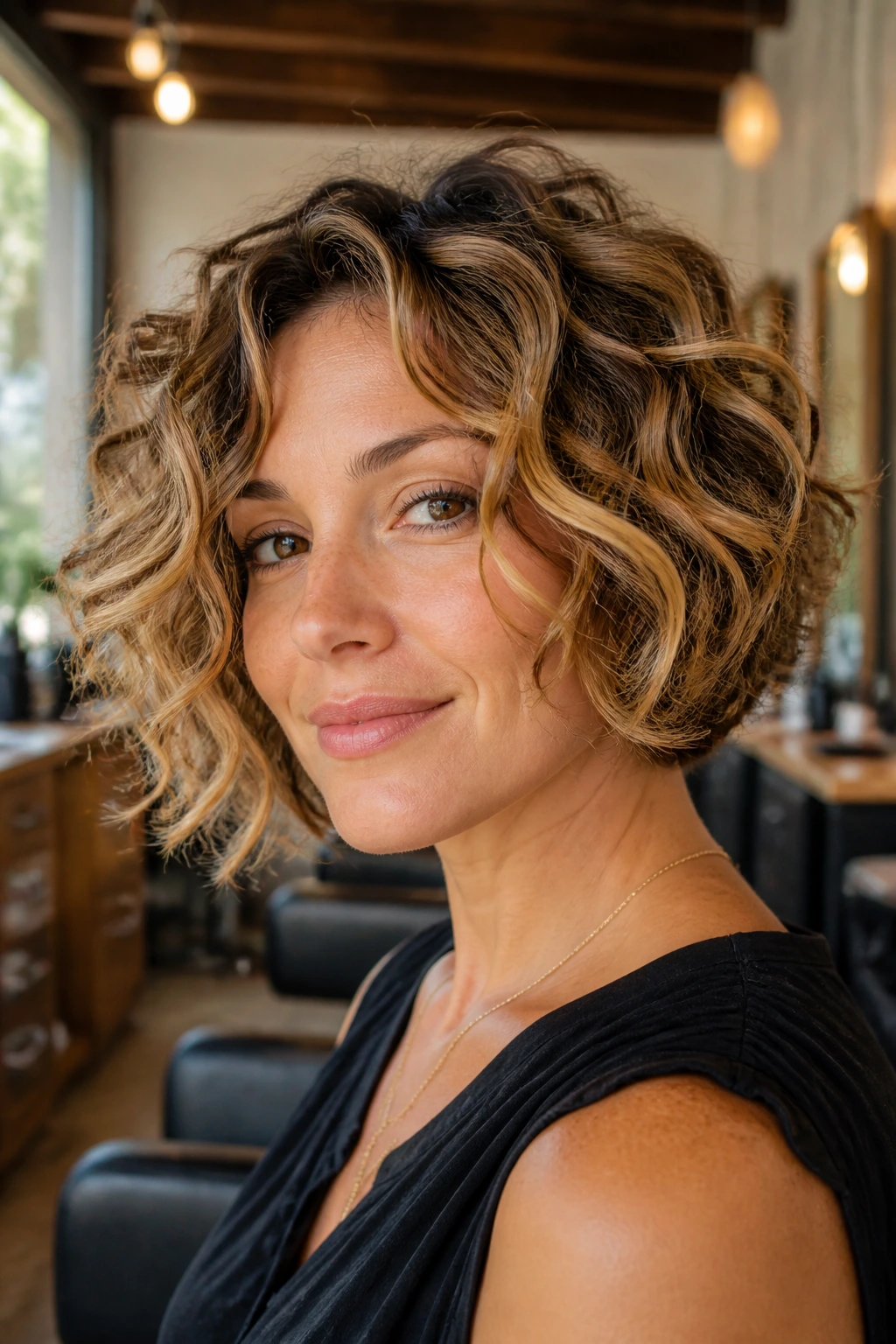
The final style emphasizes how color dimension can transform a choppy curly bob by adding visual depth, movement, and complexity. This cut pairs a choppy texture with strategic color placement—highlights, lowlights, balayage, or dimensional color—so that light and shadow dance across your curls as they move. The choppiness creates the actual movement, and the color creates visual movement even when your hair is stationary.
How Color Interacts with Choppy Texture
A monochromatic color on a choppy bob is beautiful, but dimensional color essentially multiplies the visual effect of the choppiness. When you have lighter highlights mixed with darker lowlights throughout choppy layers, your eye follows the color variation as it moves around your head. Lighter pieces appear to jump forward and move, while darker pieces recede. This color interplay makes the choppiness feel even more pronounced and dynamic.
Color Techniques That Work Best
- Balayage (hand-painted, freehand highlights) pairs beautifully with choppy texture because the irregular placement mirrors the irregular cut
- Dimensional highlights or babylights placed throughout the layers add tons of movement
- Lowlights added beneath the surface create depth without changing your overall tone
- Lived-in color with slightly brassy or browned-out tones feels editorial with choppy texture
- Two-tone color (like a darker root with lighter lengths) creates intentional contrast that enhances choppiness
Maintaining Color-Dimensional Choppy Bob
- Use color-safe shampoo and conditioner formulated to prevent fading
- Deeper lowlights stay longer; lighter highlights fade faster, so plan touch-ups accordingly
- Refresh your chop every 5-6 weeks and your color every 6-8 weeks, or adjust depending on how quickly your specific color fades
- A toning treatment between salon visits helps keep dimension fresh
- The choppiness of your cut means shorter ends, so color placement might need adjustment as the cut grows out
Finding the Right Color Combo
- Bring multiple reference photos showing color placement you love
- Discuss how often you’re willing to come in for touch-ups
- Warm-toned, dimensional color often looks most editorial on choppy bobs
- Cool-toned or ash color works beautifully too, especially with a very short, voluminous cut
Final Thoughts

A choppy curly bob isn’t just a hairstyle—it’s basically a game-changer if you’ve got waves, curls, or any texture in your hair at all. The whole point of this cut is working with your curl pattern instead of against it, and that’s when your hair looks and feels best. Whether you go for the edgy shag-bob hybrid or the softer, feathery version, you’re committing to a cut that celebrates texture and movement rather than trying to smooth it into submission.
The key to making any of these styles work long-term is getting regular trims to maintain the choppy structure—somewhere between 4 to 6 weeks depending on how fast your hair grows and how quickly the layers start to blend. The choppiness is what creates all that volume and bounce, so once it starts growing out and smoothing down, you’re losing the magic. Finding a stylist who actually understands choppy cuts on curly hair is also essential; not every stylist knows how to cut into curls properly, so don’t settle for someone who just hacks away without considering how your specific curl pattern will react.
Most importantly, have fun with this. A choppy curly bob is supposed to feel confident, textured, and a little bit bold. Whether you style it sleek with a wet-look gel, soft and undone with a light cream, or with lots of volume and bounce, you’re choosing a cut that’s fundamentally about celebrating what your hair naturally does. That’s the whole appeal—and why, once you go choppy, you usually never look back.
