



The bob cut might be the most democratically flattering hairstyle ever created — yet somehow, most people still choose the wrong variation for their specific face shape and hair texture. You’ve probably seen this happen: a friend gets a sleek, chin-length bob that looks magazine-perfect on the stylist’s Instagram, but when they get it cut, it somehow emphasizes the exact features they wanted to soften. The difference between a bob that makes you look radiant and one that feels “off” usually comes down to a handful of specific choices about length, layers, texture, and angle.
The secret isn’t that some bobs are universally flattering while others aren’t. The secret is that every face shape and hair type responds differently to how a bob is constructed. A blunt, straight-across bob that looks stunning on someone with a round face and straight hair might make a heart-shaped face look even more top-heavy. Meanwhile, that same person with wavy hair and an oval face might find the blunt edge looks rigid and unflattering against their natural texture. Get the variables right, though, and a bob doesn’t just look good — it actually reshapes how your proportions read.
This guide walks through 25 distinct bob variations, mapped to the specific face shapes and hair types where each one genuinely shines. Rather than guessing, you’ll be able to pinpoint exactly which cut aligns with your face shape, understand why it works, and know how to ask your stylist for it with total clarity. Whether you have thick, wavy hair and a square jaw, fine, straight hair and a long face, or curly texture and a heart-shaped face, you’ll find multiple cuts that work with what you’ve actually got — not against it.
1. The Textured Pixie-Bob for Round Faces with Fine Hair

This hybrid cut sits somewhere between a pixie and a bob, typically ending just below the ear with significant texture throughout. The shorter layers in the crown create lift that prevents the overall silhouette from appearing too heavy at the sides, which is the main visual challenge with round faces. Fine hair benefits dramatically from this approach because the texture and shorter length prevent the ends from looking stringy or limp.
Best Face Shapes and Hair Types
Round faces need vertical lines and movement to counteract the natural width across the cheekbones and jawline. This cut delivers both through its tapered sides and textured crown. Fine hair responds best when cut into layers no longer than shoulder-length — anything heavier weighs down delicate strands and makes them cling to the head.
Why This Works
The key is asymmetry. One side typically sits slightly shorter than the other, creating an optical line that lengthens the face. The texture breaks up any heavy density at the jawline, and the cropped crown naturally draws the eye upward.
How to achieve this look:
- Ask for heavily textured, choppy layers throughout
- Request shorter sides (approximately ear-length) with longer pieces in the front
- Specify one side slightly longer than the other for asymmetry
- Use a texture spray or dry shampoo to emphasize movement
- Style with fingers rather than a brush to maintain texture definition Pro tip: This cut needs trimming every 4 weeks because the texture reads visibly as it grows out.
2. The Blunt French Bob for Oval Faces with Straight Hair

The French bob is exactly what it sounds like — a blunt, straight-across cut that hits right at the jawline, often paired with a deep side part and minimal layers. Oval faces are the luckiest when it comes to bob options because balanced proportions work with virtually any variation, but the French bob’s architectural precision especially flatters when you have naturally straight hair.
Best Face Shapes and Hair Types
Oval faces are mathematically balanced — the forehead, cheekbones, and jawline are all roughly proportionate — which means they can pull off graphic, geometric cuts without needing corrective proportions. Straight hair holds a blunt edge beautifully and doesn’t require extensive styling to maintain the cut’s intended silhouette.
Why This Works
The blunt line creates a decisive frame that emphasizes cheekbones and adds definition to the jawline. The simplicity reads modern and intentional, not accidental. A deep side part adds extra dimension and prevents the cut from feeling too severe or one-dimensional.
How to achieve this look:
- Ask for a blunt, straight-across line at the jawline (typically 1-2 inches below)
- Keep internal layers minimal — this cut relies on the clean edge, not texture
- Request a deep side part that moves away from your face
- Plan to flat-iron before styling to maintain the blunt edge
- Consider a subtle contour cut underneath if you want minimal internal texture Worth knowing: This cut demands regular trims (every 3-4 weeks) because any grown-out ends immediately read as messy rather than intentional.
3. The Layered Shag Bob for Long Faces with Wavy Hair

A shag-inspired bob trades the blunt edge for multiple layers of varying lengths, creating an overall silhouette that’s textured, voluminous, and visually shorter than a traditional bob. Long faces need width and horizontal movement, and this cut delivers both through its intentional texture and side-swept layers.
Best Face Shapes and Hair Types
Long faces benefit from cuts that add width at the cheekbones and jaw rather than drawing the eye further down the face. The shag bob’s layered texture creates visual width through movement and doesn’t require perfectly straight hair to look intentional. Wavy hair naturally embraces this texture and looks effortlessly cool without excessive styling.
Why This Works
The multiple layers create horizontal lines that optically widen the face. The side-swept bang-like layers in front draw attention to the cheekbones rather than down to the jawline. Wavy texture in the mid-lengths and ends reads as intentional movement rather than damage or frizz.
How to achieve this look:
- Ask for a shag-inspired bob with layers starting around mid-ear
- Request longer, face-framing pieces in front that sweep to the side
- Specify layers throughout to create texture and movement
- Use a texturizing product (salt spray, texture paste) to enhance waves
- Dry with a round brush to piece out the layers, or air-dry for a more relaxed finish Real talk: Wavy hair needs a good leave-in conditioner and texture cream to prevent this cut from looking frizzy rather than intentionally layered.
4. The Rounded Bob for Square Faces with Curly Hair

This variation softens angles through a curved, almost bowl-like shape, typically longer in the front and slightly shorter in the back, with enough length to hit around the shoulders. Square faces have prominent jawlines and equally strong foreheads — the goal is to soften both, which rounded bobs accomplish naturally. Curly hair works beautifully here because the curl pattern itself creates the rounded silhouette without requiring heat styling.
Best Face Shapes and Hair Types
Square faces need visual softness at the jawline and forehead. A rounded bob creates a gentle curve that counteracts angular features. Curly hair’s natural texture means this cut reads as intentionally soft and romantic, not just like you couldn’t get the hair to cooperate.
Why This Works
The curve is the entire strategy. Rather than hitting the sharpest point of your jawline straight-on, a rounded bob curves around it, creating an optical softening. The longer front pieces frame the face gently, and curls add texture that breaks up any angular severity.
How to achieve this look:
- Ask for a rounded, curved cut (not blunt or layered)
- Request longer pieces in front (typically 1-2 inches longer than the back)
- Specify you want the back slightly shorter for shape, not layers
- Cut curly hair when it’s clean and dry, or at least in its natural state
- Use a curl-defining gel or cream to maintain definition Pro tip: This cut actually looks better when your curls are properly hydrated and defined — neglecting your curl routine will make it look intentionally unkempt rather than charmingly textured.
5. The Choppy Textured Bob for Heart-Shaped Faces with Fine Hair

Heavy texture and choppy layers throughout create a cut with significant movement and visual lightness, working especially well for heart-shaped faces that tend to be wider at the forehead and narrower at the jawline. Fine hair benefits because choppy layers prevent density and allow strands to move rather than cling together.
Best Face Shapes and Hair Types
Heart-shaped faces need visual balance — specifically, they need width at the jaw and chin to counteract the wider forehead. Choppy texture and movement in the lower half of the bob creates that illusion of width. Fine hair can’t support heavy, blunt bobs because the weight collapses the strands, so texture is a necessity, not just an option.
Why This Works
The choppy layers create multiple points of texture that catch light and add dimension, making fine hair appear thicker and fuller. Placing heavier choppy sections around the jawline adds visual weight and width exactly where a heart-shaped face needs it most.
How to achieve this look:
- Ask for choppy, textured layers throughout, with emphasis on the lower half
- Request slightly shorter sides and more substantial layers around the jaw
- Specify you want visual texture and movement, not bluntness
- Use a texturizing spray or dry shampoo to emphasize chop
- Style with a round brush to create piecey, textured movement Worth knowing: This cut looks best when you style it with texture; it’ll appear thinner and less intentional if you brush it out smooth.
6. The Chin-Length Sleek Bob for Oblong Faces with Straight Hair

A precise, blunt-edged cut that hits right at the chin, partnered with a center or near-center part. Oblong faces are elongated and need horizontal lines to break up the vertical length — a chin-length bob hits the widest part of the face when cut straight across, creating exactly that visual break.
Best Face Shapes and Hair Types
Oblong and long faces sometimes get confused, but oblong faces are wider too — they’re not just long but also have width that needs to be emphasized rather than hidden. A chin-length cut captures the face at its widest point and creates a clean horizontal line that reads as intentional proportion-balancing.
Why This Works
The width of the cut at chin-length means it optically widens the face. A center part adds additional vertical interest without creating the downward pull that a severe side part would cause on an already-elongated face. Straight hair’s natural sleekness makes the geometry of this cut absolutely shine.
How to achieve this look:
- Request a blunt cut at the chin, with minimal to no layers
- Ask for a center or near-center part
- Keep the internal texture to a minimum to maintain the clean geometry
- Flat-iron before styling to emphasize the blunt line
- Consider a subtle contour underneath if you want any texture at all Pro tip: This cut reads expensive and intentional. Maintain it with trims every 3-4 weeks because even slightly grown-out ends look less polished.
7. The Textured Chin-Length Bob for Rectangle Faces with Wavy Hair

Similar length to the sleek version but with internal texture and movement, this cut works for rectangle faces (essentially oblong but with a more squared jawline) and does beautifully with wavy hair that naturally embraces the texture.
Best Face Shapes and Hair Types
Rectangle faces have a pronounced jawline and forehead, and wavy hair’s natural movement softens both. The texture breaks up any severity while the length still sits at the widest point of the face, creating needed horizontal balance.
Why This Works
Waves create a softer, less graphic version of the chin-length bob. The internal texture prevents the cut from appearing too severe or architectural, which matters more on a rectangle face that already has angular features. Wavy hair’s movement adds dimension without requiring heat styling every day.
How to achieve this look:
- Ask for a chin-length cut with internal texture and waves
- Request choppy or point-cut layers rather than blunt edges
- Specify you want movement and softness, not graphic geometry
- Use a texture spray or sea salt spray to enhance natural waves
- Dry with fingers or a diffuser to encourage natural wave pattern Real talk: This cut works best when you embrace your natural wave pattern; fighting it with a flat iron defeats the entire purpose.
8. The Short Textured Bob for Round Faces with Thick Hair

A cropped, heavily textured cut that sits above the ears and chin, typically 2-3 inches long with choppy layers throughout. Thick hair naturally reads heavy, so removing length and adding texture prevents that heaviness from visually widening the already-round face.
Best Face Shapes and Hair Types
Round faces need vertical lines and lightness. Short bobs with choppy texture create both — the shorter length eliminates weight, and the layers create multiple vertical lines through the texture. Thick hair actually needs shorter cuts because the density requires room to breathe, literally and visually.
Why This Works
The radical shortness immediately reduces visual weight at the sides of the face. The choppy, irregular layers create a jagged silhouette that counteracts the soft roundness of the face. Thick hair’s natural density becomes an asset rather than a liability because you have enough texture to maintain shape and movement even with significant layers.
How to achieve this look:
- Ask for a short, cropped bob with choppy, textured layers throughout
- Specify shorter sides (just above or at ear) with slightly longer pieces in front
- Request texture throughout, not a blunt edge
- Use a texturizing product to define and separate the layers
- Dry with a round brush or diffuser for movement Pro tip: This cut grows out visibly, so plan for trims every 4-5 weeks to maintain the cropped, textured silhouette.
9. The Curved Bob with Subtle Layers for Diamond-Shaped Faces with Wavy Hair

A bob with a subtle curve in the shape (longer in front, slightly shorter in back) paired with minimal, strategic layers rather than heavy choppy texture. Diamond-shaped faces are wider at the cheekbones and narrower at the forehead and jawline — the strategy is to add width at the chin while softening the prominent cheekbones.
Best Face Shapes and Hair Types
Diamond faces benefit from visual width at the jaw and softness at the cheekbones. A curved bob with slightly longer front pieces addresses the first concern, while wavy hair’s natural texture softens the cheekbone prominence. Subtle layers maintain movement without creating visual weight at the cheekbones.
Why This Works
The curved shape puts the widest part of the bob at the jawline, adding needed width. The longer front pieces frame the face and create softness that counteracts sharp cheekbones. Wavy hair embraces the subtle texture without requiring heavy, choppy layers that would add bulk where the face doesn’t need it.
How to achieve this look:
- Ask for a curved bob, longer in front by about 1-2 inches
- Request subtle, minimal layers rather than choppy texture
- Specify you want softness and movement, not density
- Use a texture cream or wave enhancer to emphasize waves
- Dry with minimal heat, allowing waves to develop naturally Worth knowing: This cut walks a fine line between “has movement” and “looks undone” — it needs to be intentional, so discuss styling expectations with your stylist.
10. The Micro Bob for Long Faces with Straight Hair

Extremely short (typically ear-length or shorter), blunt-edged, and geometric — this is a commitment cut that works on long faces because the radical shortness and width of the cut optically compress the face’s length.
Best Face Shapes and Hair Types
Long faces desperately need width and horizontal lines. A micro bob creates both through its inherent width and short length. Straight hair is essential here because this cut’s geometry demands a clean edge and precise line — any wave or curl disrupts the intentional shape.
Why This Works
The extreme shortness means the widest part of the head (at ear-level) becomes the focal point rather than the length of the face. The blunt edge creates architectural precision that reads intentional and modern. There’s nowhere for a long face to visually extend when a micro bob sits right at ear-level.
How to achieve this look:
- Ask for a micro bob, typically ear-length or just below
- Request a blunt edge with minimal internal layers
- Specify geometric precision — this cut needs to be exact
- Flat-iron before styling to maintain the blunt geometry
- Consider a side-swept bang element to add dimension Real talk: This is a statement cut. You need straight hair, a high pain tolerance for frequent trims (every 2-3 weeks), and genuine commitment to the aesthetic.
11. The Layered Bob with Side-Swept Bangs for Heart-Shaped Faces with Curly Hair

Layered throughout for movement, with longer pieces in front and a pronounced side-swept bang element. Heart-shaped faces need width at the jaw and softness overall, and curly hair’s natural volume supports layering beautifully without requiring heat styling to maintain shape.
Best Face Shapes and Hair Types
Heart faces need width and softness at the bottom. Layers create movement that feels soft and romantic, and the longer front pieces add width at the jawline. Side-swept bangs soften the forehead (the widest part of a heart face) while drawing attention to the cheekbones. Curly hair’s texture reads as intentionally beautiful layering rather than frizz when properly cut and cared for.
Why This Works
The combination of layers plus side-swept bangs addresses both concerns: the bangs soften the forehead, and the longer, layered sides add width at the jaw. Curly hair naturally embraces layers, creating movement that enhances the softness rather than fighting it.
How to achieve this look:
- Ask for textured, layered throughout with longer pieces in front
- Request a pronounced side-swept bang element
- Specify you want softness and movement from the layers
- Cut curly hair in its natural state (clean, dry, or close to it)
- Use curl-defining cream and possibly a light gel to maintain definition Pro tip: Get trims every 6-8 weeks; curly hair’s texture means the shape can read different lengths very differently, and you want to maintain intent.
12. The Blunt Bob with Internal Texture for Square Faces with Straight Hair

A cut that maintains a blunt outer edge (the silhouette reads clean and geometric from a distance) but incorporates internal choppy layers that add movement when you move your head. This solves the square face’s challenge of needing softness while still maintaining the modern, architectural appeal of a blunt bob.
Best Face Shapes and Hair Types
Square faces need softness at the jawline and forehead, but many people with square faces love the graphic aesthetic of a blunt bob. This hybrid approach gives you both: the clean line of a blunt cut with the internal softness of texture. Straight hair maintains the outer edge’s precision while clearly showing the internal layers.
Why This Works
The internal texture creates softness and movement that counteracts the square face’s angular severity, while the blunt outer edge maintains that modern, intentional aesthetic. When you move or turn your head, the internal layers create dimension that prevents the cut from reading as too severe.
How to achieve this look:
- Ask for a blunt outer edge with choppy internal layers
- Specify you want the clean silhouette but movement within
- Request layers that create texture without disrupting the outer line
- Use a texturizing product to emphasize the internal layers
- Flat-iron the outer edge while allowing internal texture to stay choppy Worth knowing: This cut needs clarity when communicating with your stylist — bring a photo showing blunt edge plus internal texture to avoid miscommunication.
13. The Shoulder-Length Bob for Oblong Faces with Wavy Hair

A bob that extends to approximately shoulder-length, longer than traditional chin-length, with subtle waves and minimal layers. Oblong faces sometimes need more vertical break than a chin-length cut provides, and extending to the shoulders paired with soft waves creates that break without adding heaviness.
Best Face Shapes and Hair Types
While shorter bobs create horizontal lines at the face, a shoulder-length bob extends the vertical range but creates horizontal breaks through its waves. Oblong faces benefit from this approach if they prefer more length. Wavy hair paired with the right length creates that horizontal break naturally without requiring blunt edges or aggressive texture.
Why This Works
Waves create visual interruption to the vertical length that an oblong face carries. Extending to the shoulders adds visual width and a natural break from the face. Wavy texture prevents the length from reading as too severe or elongating — instead, it softens the overall silhouette.
How to achieve this look:
- Ask for a shoulder-length bob with subtle waves throughout
- Request minimal layers, focusing more on shape than texture
- Specify you want soft movement, not choppy layers
- Use a texture spray or wave-enhancing product
- Dry with a round brush or diffuser, or air-dry for maximum softness Pro tip: This length gives you flexibility — you can wear it straight if you want graphic lines, or wavy for soft movement, depending on your mood and face shape goals that day.
14. The Disconnected Undercut Bob for Long Faces with Straight Hair

The undercut approach means the sides are cut significantly shorter than the top length, creating a dramatic contrast and visual separation. The top section remains bob-length (typically chin-length or slightly longer), while the undercut (the underneath layers) sit much closer to the head or scalp.
Best Face Shapes and Hair Types
Long faces need as much horizontal interruption as possible, and an undercut delivers this through contrast. The shorter undercut adds visual width (because the shaved or very short sides push the perception of the top outward), while the longer top maintains the bob aesthetic. Straight hair shows this contrast clearly and maintains the shape with minimal styling.
Why This Works
The visual contrast between the short undercut and the longer bob length creates optical width that long faces desperately need. The undercut also reduces overall visual bulk, preventing the cut from appearing to add length. Straight hair maintains the contrast and the geometric precision that makes this cut visually striking.
How to achieve this look:
- Ask for a disconnected undercut with the top section at bob-length
- Specify how short you want the undercut (fade, crew cut length, or even shorter)
- Request minimal texture on top to maintain the contrast
- Plan regular maintenance trims for the undercut (every 3-4 weeks)
- Flat-iron the top section to maintain precise geometry Real talk: This is a bold, edgy cut. Make sure this aesthetic aligns with your personal style before committing, because the contrast is obvious and intentional.
15. The Tousled Texture Bob for Round Faces with Thick Wavy Hair

A longer bob (usually jaw-length or slightly past) with substantial choppy layers throughout, designed to look deliberately tousled and undone. Thick wavy hair naturally creates this texture, and the longer length with choppy layers adds visual length and breaks up roundness.
Best Face Shapes and Hair Types
Round faces need vertical lines and elongation. A longer bob paired with choppy layers creates both. Thick hair requires layers to prevent it from appearing heavy and bulky, and wavy texture naturally embraces layers without needing heat styling. The tousled aesthetic hides styling effort while looking intentionally cool.
Why This Works
The combination of length plus choppy layers creates vertical lines that optically lengthen a round face. Thick wavy hair’s natural movement fills those layers beautifully, and the deliberate tousle aesthetic prevents the cut from reading as just undone rather than intentional. The layers allow the thickness to move rather than clump.
How to achieve this look:
- Ask for choppy, textured layers throughout with overall length to jaw or slightly past
- Specify you want a deliberately tousled, undone aesthetic
- Request layers that enhance thickness, not fight it
- Use a texture spray, sea salt spray, or curl cream to enhance waves
- Dry with fingers or a diffuser, scrunching for texture Pro tip: This cut benefits from regular deep conditioning because the choppy ends need moisture to avoid looking dry rather than intentionally textured.
16. The Geometric Bob for Diamond-Shaped Faces with Straight Hair

A precisely cut bob with clean lines and minimal layers, but constructed with a specific geometric shape that’s typically longer in front and significantly shorter in back (almost a subtle wolf-cut-inspired shape). Diamond faces need width management and specific line placement.
Best Face Shapes and Hair Types
Diamond faces are widest at the cheekbones and narrow at the forehead and jaw. A geometric bob that’s longer in front (widening the jawline) and shorter in back (keeping volume away from the widest part of the cheekbones) strategically places width and space exactly where needed. Straight hair’s clean lines show the geometric intent without distraction.
Why This Works
The longer front pieces add width at the narrower jawline, while the shorter back keeps the widest part of the face (cheekbones) from being visually widened further. The geometric precision reads modern and intentional. Straight hair maintains all the geometric lines without blurring them.
How to achieve this look:
- Ask for a geometric bob with longer front pieces and significantly shorter back
- Specify clean lines and minimal texture to show the geometry
- Request specific measurements so the front-to-back length difference is obvious
- Flat-iron before styling to maintain geometric precision
- Consider a subtle side part to add further dimension Worth knowing: This cut requires good hair anatomy knowledge from your stylist; discuss the specific proportions you want before the cut begins.
17. The Wispy Textured Bob for Heart-Shaped Faces with Fine Hair

Choppy, wispy texture throughout with an emphasis on lighter, airier layers rather than blunt choppiness. Heart faces need width at the jaw and softness overall, and fine hair needs texture to avoid looking thin or limp.
Best Face Shapes and Hair Types
Heart faces need width, and wispy layers at the jaw create that illusion without adding bulk (which fine hair can’t support). The airy texture prevents fine hair from looking thin — instead, it reads as deliberately textured and intentionally soft. The wispy quality adds femininity while solving the structural challenge of fine hair looking flat or sparse.
Why This Works
Wispy layers create the visual impression of density and movement without actual weight. Fine hair benefits because light, airy texture reads as full and intentional rather than thin. Placing that texture around the jawline adds visual width exactly where heart faces need it. The overall aesthetic reads soft and romantic without requiring heat styling every day.
How to achieve this look:
- Ask for wispy, choppy layers with emphasis on light, airy texture
- Specify you want the texture to feel soft and romantic, not severe
- Request layers that create fullness without weight
- Use a texturizing spray or lightweight texture cream
- Dry with a round brush to piece out the wispy layers Real talk: This cut requires styling; fine hair left completely unstyled may look thinner than intended, so plan for regular use of texture products.
18. The Sleek One-Length Bob for Oval Faces with Straight Hair

A longer bob (typically chin-length to collarbone) with one consistent length throughout and an absolutely blunt, blunt-blunt edge. Oval faces can pull off almost anything, and the one-length bob’s simplicity and precision creates an especially striking aesthetic on already-balanced proportions.
Best Face Shapes and Hair Types
Oval faces are mathematically perfect for virtually any bob, but the one-length bob’s architectural simplicity looks especially clean on faces where no corrective proportions are needed. Straight hair is essential because this cut’s entire impact depends on a perfect, precise edge.
Why This Works
The one-length creates a simple, powerful line. There’s no texture or layers to distract from the geometry — the cut is its geometry. The blunt edge reads expensive, modern, and intentional. On an oval face, this simplicity doesn’t need corrective angling; the clean line speaks for itself.
How to achieve this look:
- Ask for a one-length bob with a perfectly blunt, straight edge
- Specify the exact length you want (typically chin-length or slightly longer)
- Request zero layers and zero texture — pure one-length geometry
- Flat-iron before styling every time to maintain the blunt edge
- Consider a side part or center part based on your preference Pro tip: Book frequent trims (every 3-4 weeks); even slightly grown-out ends disrupt the intentional perfection of this cut.
19. The Layered Pixie-Bob Hybrid for Round Faces with Fine Hair

A longer pixie (longer than a traditional pixie but shorter than a conventional bob) with textured, choppy layers throughout, creating a cut that reads almost like a textured bob but with more visual lift in the crown. Round faces need that lift, and fine hair needs layers to avoid appearing limp.
Best Face Shapes and Hair Types
This hybrid approach gives round faces the vertical lift they need through the shorter crown, while fine hair gets the textured layers it needs to appear fuller and more dimensional. The overall length (typically ear-length to jaw-length) is longer than a true pixie, which appeals to people who want an edgier vibe than a traditional bob but aren’t ready for the commitment of a true pixie cut.
Why This Works
The textured layers create movement and dimension that prevent fine hair from looking thin. The shorter crown naturally draws the eye upward, visually lengthening a round face. The hybrid length works for people who want something between a pixie’s edge and a bob’s femininity.
How to achieve this look:
- Ask for a pixie-bob hybrid with choppy, textured layers throughout
- Specify shorter crown (for lift) with longer sides (for softness)
- Request texture and movement rather than blunt edges
- Use a texturizing spray or product to emphasize layers
- Style with fingers rather than a brush to maintain texture separation Worth knowing: This cut requires styling to look intentional; without product and texture emphasis, it might read as “growing out weirdly” rather than intentional.
20. The Curved Choppy Bob for Square Faces with Wavy Hair

A bob with a curved silhouette (longer in front, shorter in back) paired with substantial choppy layers throughout. Square faces need softness, and wavy hair paired with choppy layers creates exactly that without requiring excessive styling effort.
Best Face Shapes and Hair Types
Square faces need to soften their angular jawline and forehead. A curved shape with choppy layers addresses both: the curve is softening, and the choppiness creates movement that breaks up severity. Wavy hair naturally embraces choppy layers, and the wave pattern makes the choppiness read as intentional texture rather than damage.
Why This Works
The curve is inherently soft, and adding choppy layers makes it even softer. Wavy hair’s natural movement fills those choppy layers beautifully, creating dimension that prevents the cut from reading as too intentional or severe. The longer front pieces frame the face softly while the shorter back adds shape.
How to achieve this look:
- Ask for a curved bob with longer front pieces and choppy layers throughout
- Specify you want softness and movement, not geometric precision
- Request layers that work with your wave pattern
- Use a texture spray or wave cream to enhance natural waves
- Dry with minimal heat, allowing waves to develop naturally Pro tip: Wavy hair’s texture means this cut can go longer between trims (6-8 weeks) because the shape reads different lengths beautifully when waves are involved.
21. The Sharp Angled Bob for Rectangle Faces with Straight Hair

An angled bob that’s significantly longer in front (typically chin-length or longer) and very short in back (often ear-level or shorter), creating a dramatic diagonal line from back to front. Rectangle faces have strong jawlines and foreheads, and the sharp angle adds visual interest and movement that softens severity.
Best Face Shapes and Hair Types
Rectangle faces need softness and visual interruption. A sharp angle creates both: the diagonal line is visually interesting and prevents the face from reading as too blocky, and the longer front pieces frame and soften the strong jawline. Straight hair maintains the angle’s precision and shows the intentional geometry clearly.
Why This Works
The dramatic angle creates movement and visual interest that a blunt bob doesn’t provide. The longer front pieces frame the jawline softly while drawing attention to the face rather than down to the neck. The shorter back adds visual width through contrast while preventing the cut from adding length where a rectangle face doesn’t need it.
How to achieve this look:
- Ask for a sharp, angled bob with significant front-to-back length variation
- Specify the exact angle and length difference you want (bring a photo)
- Request clean lines that show the angle clearly
- Flat-iron to maintain the angle’s precision
- Consider side-swept styling to enhance the angled aesthetic Real talk: This cut requires regular maintenance trims (every 4-5 weeks) because the angle grows out visibly and quickly loses intention.
22. The Shaggy Bob for Long Faces with Curly Hair

Multiple layers of varying lengths throughout, creating a full, voluminous, shaggy texture that reads as intentionally layered rather than uniform. Long faces need width and horizontal interruption, and a shaggy bob’s multiple layers create that through texture and dimension.
Best Face Shapes and Hair Types
Long faces need as much horizontal interruption as possible. A shaggy bob’s multiple layers create that through multiple internal texture lines. Curly hair’s natural volume and texture make the shaggy aesthetic look intentional and beautiful rather than undone or frizzy (when properly cared for). The curl pattern itself creates horizontal lines that a long face desperately needs.
Why This Works
The multiple layers of varying lengths create numerous horizontal lines throughout the cut that optically interrupt a long face’s vertical length. Curly hair’s natural movement and volume fill those layers beautifully, and the shaggy aesthetic prevents the cut from reading as too precise or severe. The overall vibe is romantic and textured, not geometric.
How to achieve this look:
- Ask for a shaggy bob with multiple layers of varying lengths
- Specify you want texture and movement throughout
- Request layers that enhance your curl pattern rather than fight it
- Cut curly hair in its natural state (clean and dry, ideally)
- Use curl cream and possibly a light gel for definition Pro tip: This cut actually improves with hydration and proper curl care; neglecting your curly hair routine will make this cut read as frizzy rather than intentionally textured.
23. The Blunt Micro Bob for Oval Faces with Straight Hair

Extremely short (often just 1-2 inches long), blunt-edged, and geometric. This is a radical departure from a traditional bob, but oval faces can pull off virtually anything, and the geometric precision of a blunt micro bob looks especially striking on balanced proportions.
Best Face Shapes and Hair Types
Oval faces are the only ones where you can truly get away with a cut this short and geometric without needing to correct proportions. Straight hair is essential because this cut is entirely geometry; any wave or texture disrupts the intentional shape.
Why This Works
The extreme shortness and blunt edge create maximum visual impact with minimum material. The cut reads modern, edgy, and requires zero styling beyond maybe running your fingers through it. On an oval face, there’s no proportion correction needed, so the geometry speaks entirely for itself.
How to achieve this look:
- Ask for a blunt, geometric micro bob, typically 1-2 inches long
- Specify the exact length you want and how blunt you want the edge
- Request zero texture — this cut is pure geometry
- Flat-iron before styling to maintain the blunt edge (though minimal styling is needed)
- Plan for very frequent trims (every 2-3 weeks) to maintain the shape Worth knowing: This is a commitment cut. It’s a statement, it’s edgy, and it requires consistent maintenance. Make sure the aesthetic aligns with your lifestyle and personal style.
24. The Textured Layered Bob for Round Faces with Medium-Thickness Hair

A bob with multiple choppy, textured layers throughout, typically jaw-length or slightly longer, with emphasis on creating movement and visual length. Round faces need vertical lines and length, and textured layers create both while medium-thick hair can support the layers without appearing overly bulky.
Best Face Shapes and Hair Types
Round faces need length and vertical lines to counteract natural width. Textured, choppy layers create vertical lines through the texture and movement, while the overall length adds needed vertical proportions. Medium-thick hair can support layers beautifully without collapsing or appearing thin.
Why This Works
The combination of texture plus length creates visual length for a round face. The choppy layers create multiple vertical lines that optically lengthen the face. Medium-thick hair supports this styling without requiring daily heat styling — the texture spray or texture cream is enough to define the layers and create movement.
How to achieve this look:
- Ask for choppy, textured layers throughout, typically jaw-length or slightly longer
- Specify you want vertical lines and movement from the texture
- Request layers that add length visually without adding bulk
- Use a texture spray or dry shampoo to emphasize layers
- Dry with a round brush to create movement in the layers Pro tip: This cut benefits from products; regular use of texture spray or texture cream keeps the layers looking intentional and defined.
25. The Romantic Wavy Bob for Heart-Shaped Faces with Medium Hair
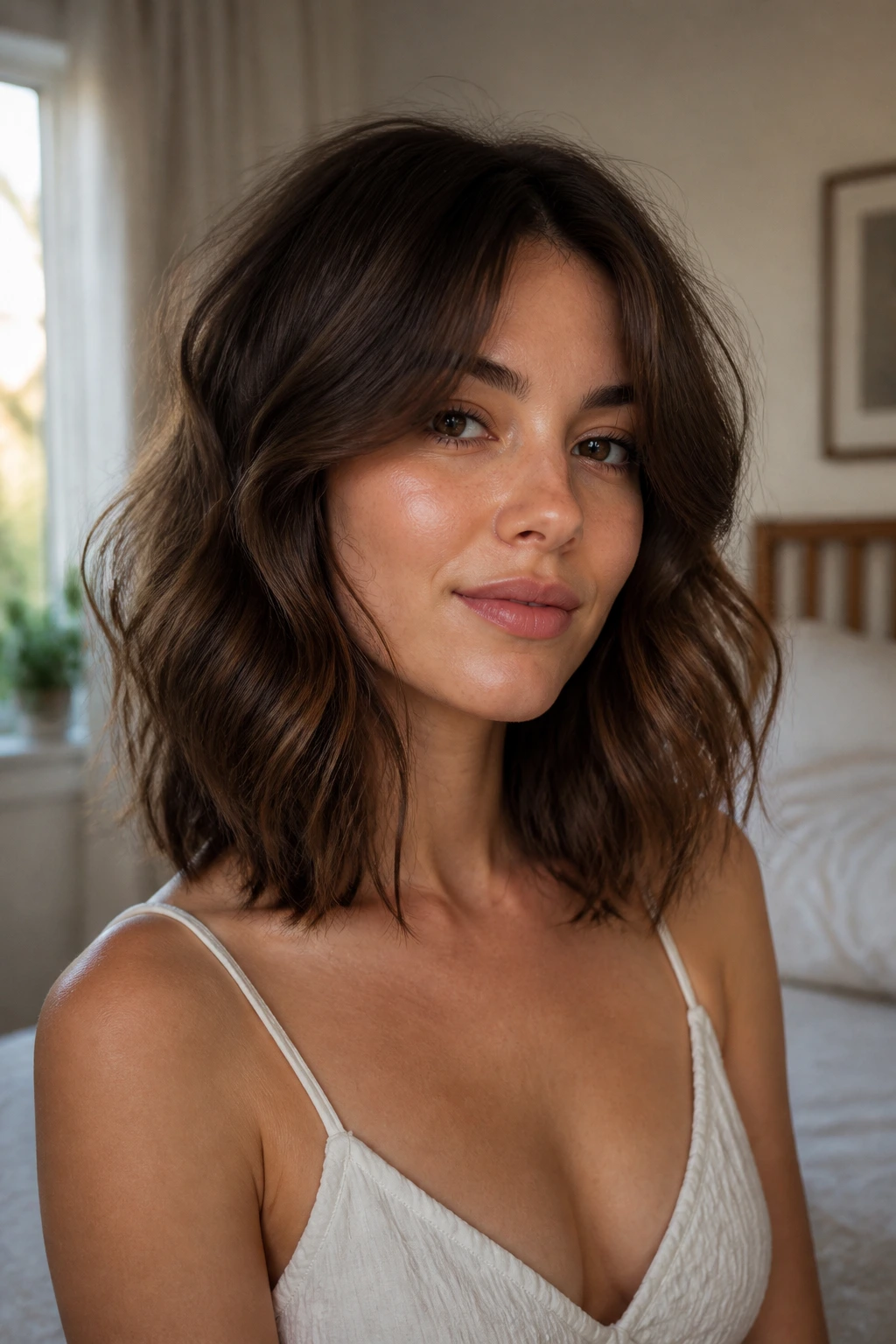
A longer bob (typically collarbone-length or longer) with soft waves and minimal to no choppy layers, instead relying on the wave pattern to create movement and softness. Heart faces need width at the jaw and overall softness, and this approach delivers both with a more romantic, less edgy aesthetic than a heavily layered cut.
Best Face Shapes and Hair Types
Heart faces need width and softness. A longer bob with soft waves adds width at the jawline while the gentle wave pattern creates softness that counteracts the narrow, pointed chin that heart faces often have. Medium hair (not too fine, not too thick) supports soft waves beautifully without requiring tight curls or limp texture.
Why This Works
The soft wave pattern creates the impression of movement and softness without choppy layers that might read as too trendy or edgy for the romantic aesthetic. The longer length adds width at the jawline while extending downward, framing a heart-shaped face beautifully. Waves create horizontal interest that prevents the face from reading as too top-heavy.
How to achieve this look:
- Ask for a longer bob (collarbone-length or longer) with soft waves throughout
- Request minimal layers if any; let the wave pattern create movement
- Specify a romantic, soft aesthetic rather than choppy texture
- Use a wave cream or texture spray to enhance natural waves
- Dry with a round brush or diffuser, or air-dry for natural waves Real talk: This cut requires some styling; waves don’t happen on their own without at least a wave-enhancing product or some heat styling. Budget time for maintenance.
Finding Your Perfect Bob

The disconnect between the bob you see on Instagram and the bob that actually looks amazing on your face boils down to one fact: there’s no such thing as a universally flattering bob. There’s only the bob that’s specifically designed for your exact combination of face shape, hair texture, and personal style — and that’s the one worth waiting for.
The 25 variations here cover the major combinations, but the real power comes from recognizing your face shape honestly and understanding what your hair naturally does. If you have straight hair but fall in love with a cut designed for curly texture, talk to your stylist about adapting it with layers and styling rather than expecting your hair to cooperate with an incompatible design. Conversely, if you have round face and love the idea of a short cut, explore the textured shorter options rather than fighting a blunt short bob that will emphasize the very roundness you want to minimize.
Go into your stylist consultation with a clear description of your face shape, honest information about your hair’s natural texture and thickness, and specific photos of cuts you love. The best bob isn’t the trendy one everyone’s getting — it’s the one that works with your actual features and hair, not against them. That’s what makes it look expensive, intentional, and like it was designed specifically for you.
