



Finding the right short hairstyle after 50 can feel like solving a puzzle—especially when you have a rounder face shape that seems to work against every trendy cut you see on social media. The truth is, round faces have incredible potential for gorgeous short styles, but it takes understanding the fundamentals of face shape, proportion, and styling technique to get it right. The goal isn’t to hide your face shape; it’s to enhance it with strategic cuts that add definition, create angles, and bring out your best features.
A round face is characterized by soft, curved lines with width roughly equal to length, and a gentle jawline rather than a sharp one. This isn’t a limitation—it’s actually an advantage when you work with it rather than against it. The key is choosing short hairstyles that create vertical lines, add texture and movement, and frame your face in ways that elongate and define. Over 50, your hair may have changed in texture, density, or color, which means your styling needs have evolved too. A cut that worked beautifully at 35 might not deliver the same impact now, and that’s completely normal.
The styles that work best for round faces over 50 share certain characteristics: they typically feature longer lengths on top to create height, texture and layers to add dimension rather than mass, and strategic side-sweeping or angled cuts that draw the eye vertically. They also tend to avoid blunt horizontal lines across the cheek area, as these emphasize width. The beauty of short hair at this stage of life is that it’s low-maintenance, allows your facial features to shine, and sends a powerful message of confidence and intentionality.
Why Round Faces Benefit From Specific Short Haircut Strategies
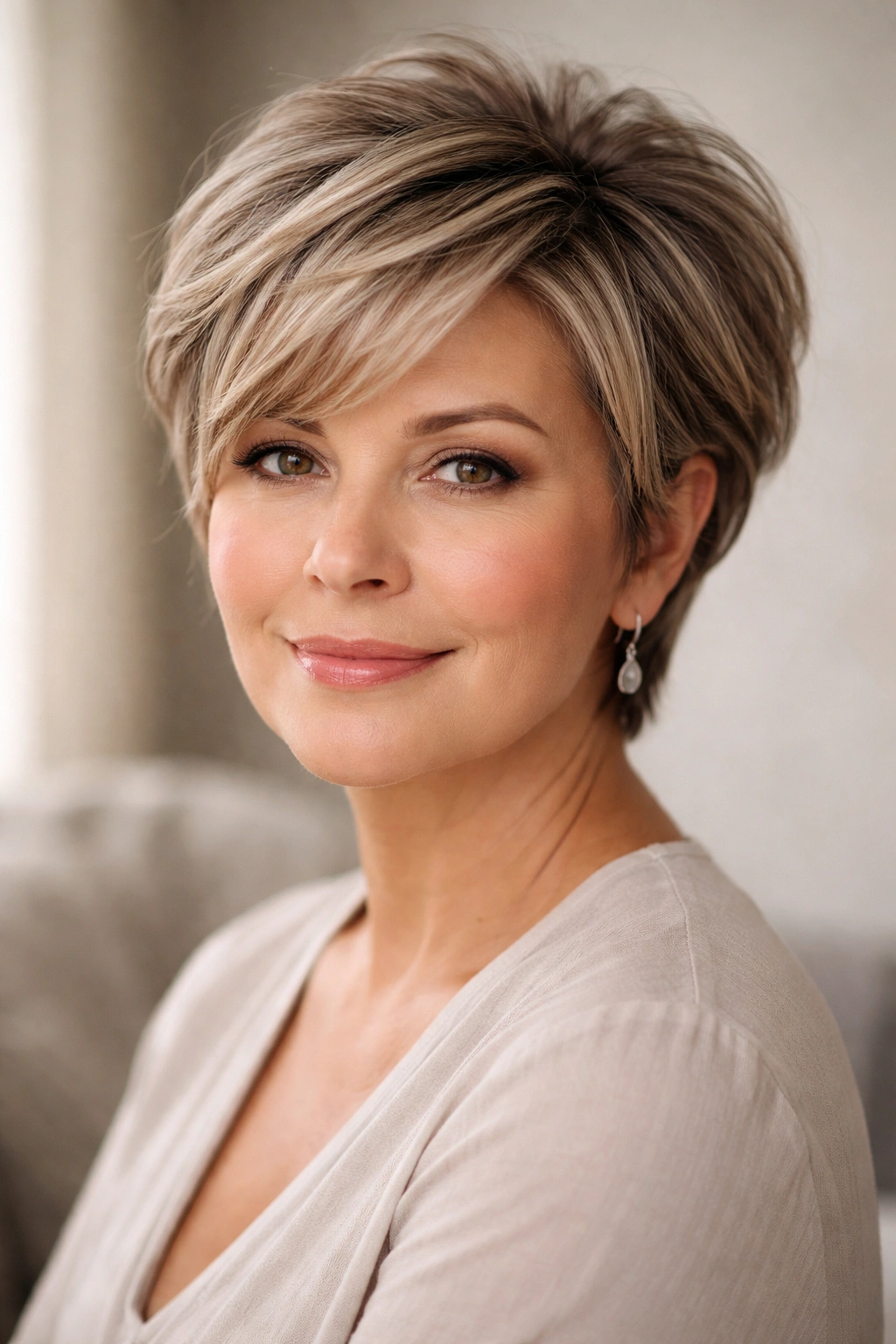
Round faces are wider at the cheekbones and fuller through the face overall, which means certain hairstyle techniques can either emphasize or minimize this natural shape. Understanding the “why” behind hairstyle recommendations helps you make confident decisions with your stylist and know what to ask for when you’re in the chair.
The principle is straightforward: vertical lines elongate, while horizontal lines widen. When a short hairstyle sits flat against the sides of a round face, it reinforces the width you already have naturally. The opposite happens when you build height at the crown, create movement away from the cheeks, or add texture that breaks up solid blocks of hair. Your goal is to create an optical illusion of slightly more length and narrowness—not through extreme styling, but through the actual architecture of the cut.
Texture matters tremendously over 50, when hair density may have decreased naturally. A cut with no layers or texture can look thin and limp, but strategic layering throughout creates the illusion of fullness while adding definition to your face shape. Layers also allow shorter hair to move and flow rather than sit in a heavy block.
Face-Flattering Cut Principles
- Longer lengths on top (at least 2-3 inches of height at the crown) create vertical proportion
- Layers throughout add movement and prevent flat, heavy appearance
- Side-swept bangs or side-parted styles draw the eye diagonally rather than straight across
- Shorter sides (undercut or tapered) create contrast and emphasize the longer top
- Texture breaks up solid color and adds dimension to finer hair
Why Blunt, Horizontal Cuts Don’t Serve Round Faces
- Straight across cuts at the cheekbone level emphasize maximum face width
- Solid blocks of hair with no movement sit close to the face
- Flat styling makes cheeks appear wider and fuller
- Lack of texture makes fine or medium-density hair look thin
- Horizontal lines work against the elongation you’re trying to achieve
Understanding Face Shape and Hair Proportion
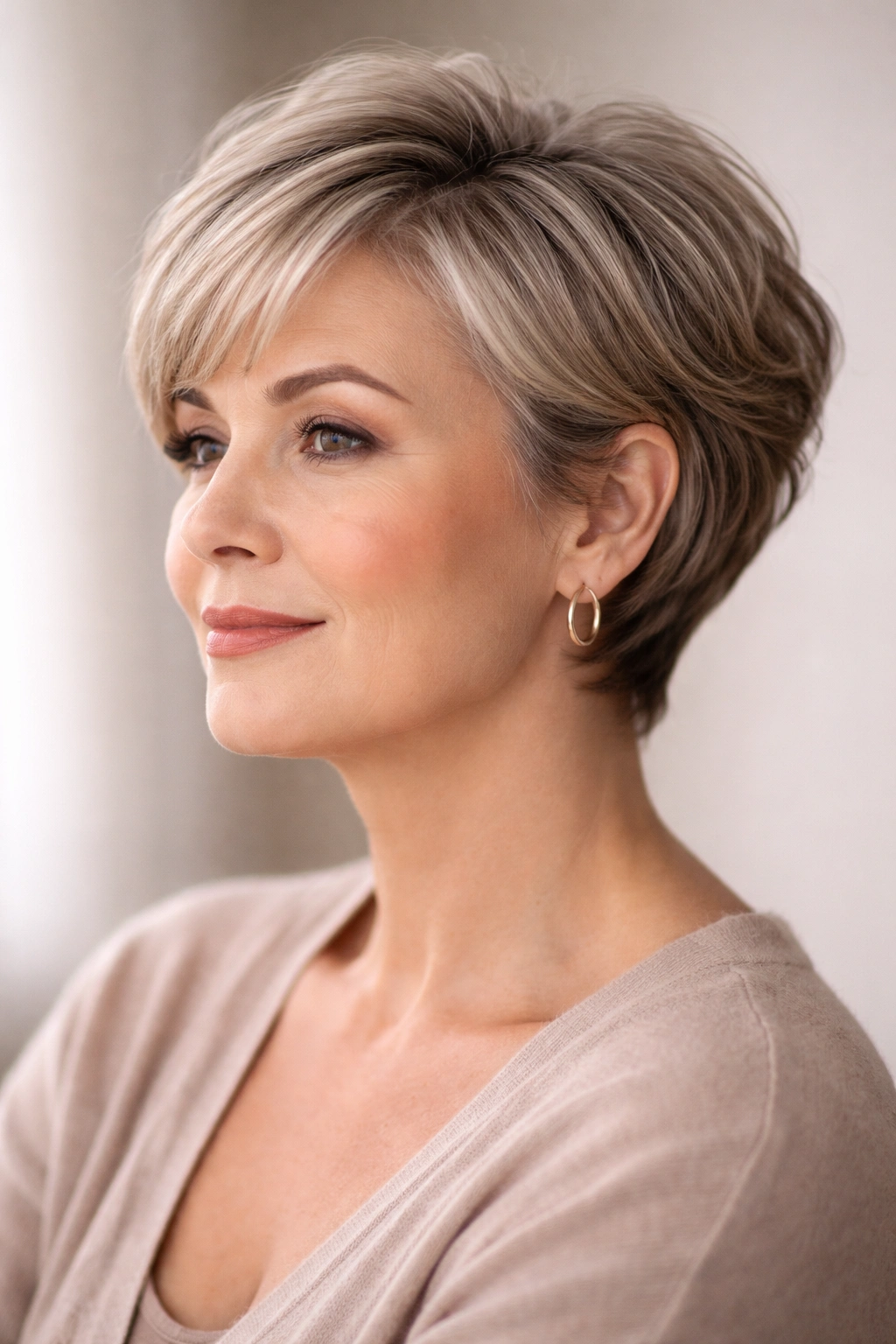
Before you commit to any hairstyle, it helps to understand how your specific face interacts with proportion and scale. Round faces come in many variations—some people have roundness mostly in the cheeks, others in the jawline, and many throughout. Your height, bone structure, neck length, and even ear size all play roles in which short hairstyles will feel most balanced on you.
A good haircut takes these factors into account. If you’re petite with a shorter neck, very short pixie cuts can overwhelm your frame. If you’re taller with a longer face underneath the roundness, you have more flexibility with length. If you have a fuller jawline, you might benefit from slightly longer layers that graze the jaw and draw attention downward. These aren’t hard rules—they’re starting points for conversation with your stylist.
Hair texture also influences how a cut will actually look on you. Fine hair needs different layering than thick, coarse hair. Wavy or curly hair creates natural texture and volume that straight hair won’t achieve without styling effort. Your natural gray hair color (or dyed color) will interact with different styles in distinct ways. A very short pixie might look edgy and modern on someone with thick, textured hair but could look sparse on someone with finer hair. That’s why seeing a stylist who specializes in your hair type and face shape makes a massive difference.
Key Factors Your Stylist Should Discuss With You
- Your natural hair texture and how you’re willing to style daily
- Whether you prefer low-maintenance cuts or ones that need regular styling
- Your neck length and overall body proportion
- Specific facial features you want to emphasize or de-emphasize
- How much gray is natural and whether you color it
- Your hair density and any fine or thinning areas
- How you prefer to wear your hair (parted, swept, textured, sleek)
1. The Textured Pixie With Volume on Top
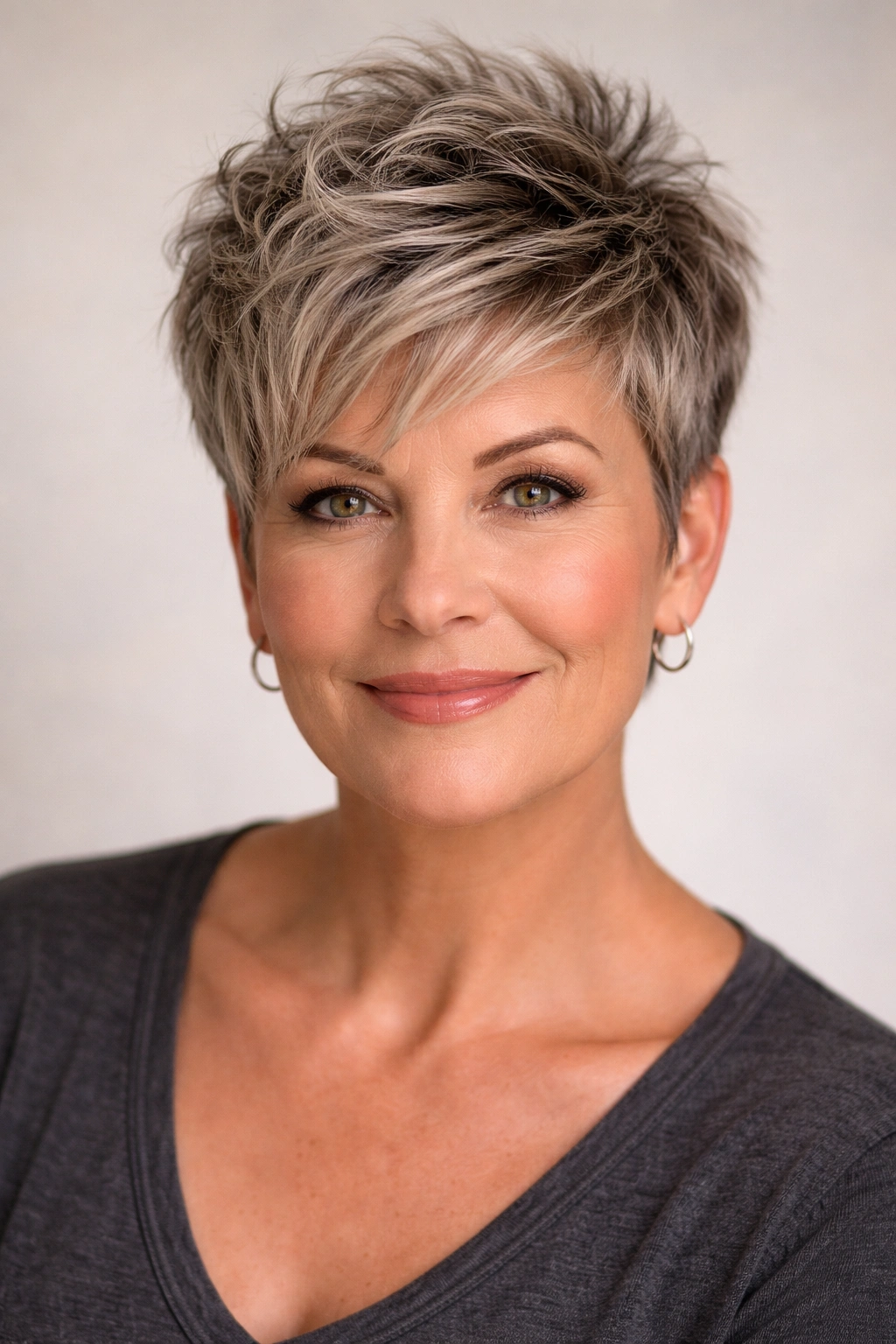
A textured pixie is perhaps the most flattering short style for round faces over 50, because it builds serious height at the crown while keeping the sides tapered tight. The height counteracts the width of a round face by creating vertical proportion, and the tapered sides eliminate bulk that would emphasize cheekbones.
The magic of this style lies in the texture, which is achieved through choppy layers throughout the top. Rather than a smooth, slicked-down pixie, imagine hair that’s tousled and separated, almost like you’ve just run your hands through it. This textured separation breaks up the solid appearance and looks incredibly modern and effortless. The sides stay very short—usually a fade or undercut—which creates dramatic contrast and makes the textured top appear even fuller and more dimensional.
Why It Works for Round Faces
- Crown height elongates the face proportionally
- Tapered sides minimize cheek width
- Choppy texture adds fullness without actual bulk
- Low-maintenance but looks intentional and polished
- Works beautifully with gray or silver hair
Best For
- Those comfortable with frequent trims (every 4-6 weeks to maintain the shape)
- People with medium to thick hair texture
- Anyone who loves a bold, statement-making style
- Those willing to use texturizing products for styling
Styling tip: Use a texturizing paste or pomade on damp hair, tousle with your fingers, and let it air dry for that effortless, piecey texture.
2. The Side-Swept Undercut Bob
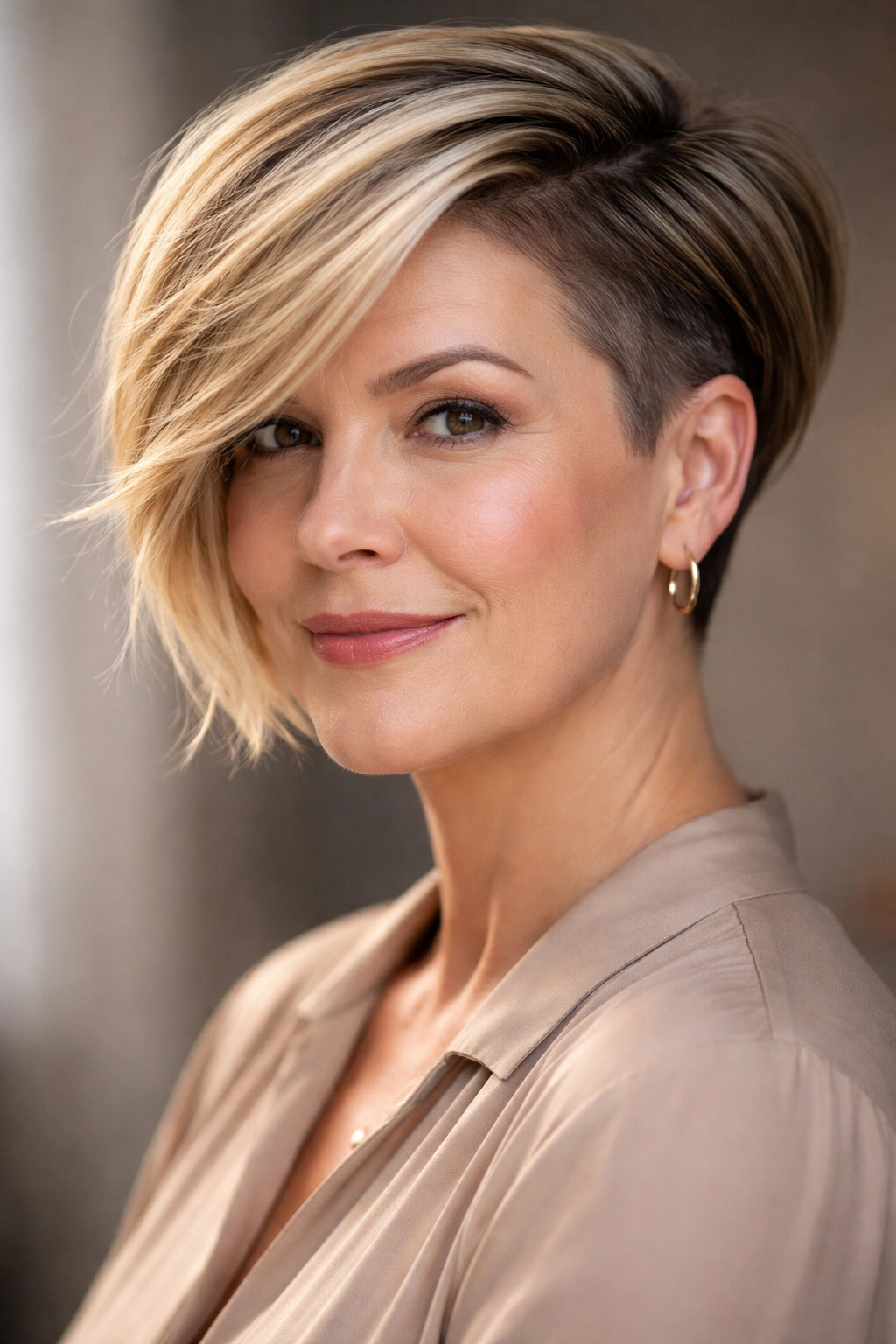
This style splits the difference between a very short pixie and a longer bob—it’s short enough to feel modern and manageable, but with enough length on top to frame the face beautifully. The genius of this cut is the side-swept styling combined with an undercut on one side, which creates asymmetry that’s incredibly flattering for round faces.
The longer pieces on top are layered and often extend down to the jawline or slightly below, creating vertical lines that elongate your face. One side is cut much shorter or even undercut (clippered very close to the scalp), which creates visual interest and prevents the style from sitting flat and heavy on the cheeks. When you sweep the longer pieces to one side, you create a diagonal line across the face—the opposite of a horizontal line, which is exactly what you want.
The undercut side actually shows the natural shape of your head and neck beautifully, which looks sophisticated and modern. It’s a style that photographs well, feels lighter and airier than a traditional short bob, and moves beautifully. At 50-plus, when you want something that looks intentional rather than just “short,” this delivers.
Why It Works for Round Faces
- Asymmetrical styling creates angles where none exist naturally
- Undercut side creates visual contrast and definition
- Longer pieces on top can be styled to frame and elongate
- Avoids the heavy, flat appearance of traditional short bobs
- Offers styling versatility—can be tousled or smoothed down
Best For
- Those with fairly regular trims (every 4-5 weeks)
- People with straight to wavy hair
- Anyone confident enough to pull off asymmetrical styling
- Those who want short hair but with more styling options than a traditional pixie
Pro tip: Ask your stylist to undercut just one side rather than both—this gives you the clean, modern look without committing to a fully undercut style.
3. The Choppy, Layered Crop
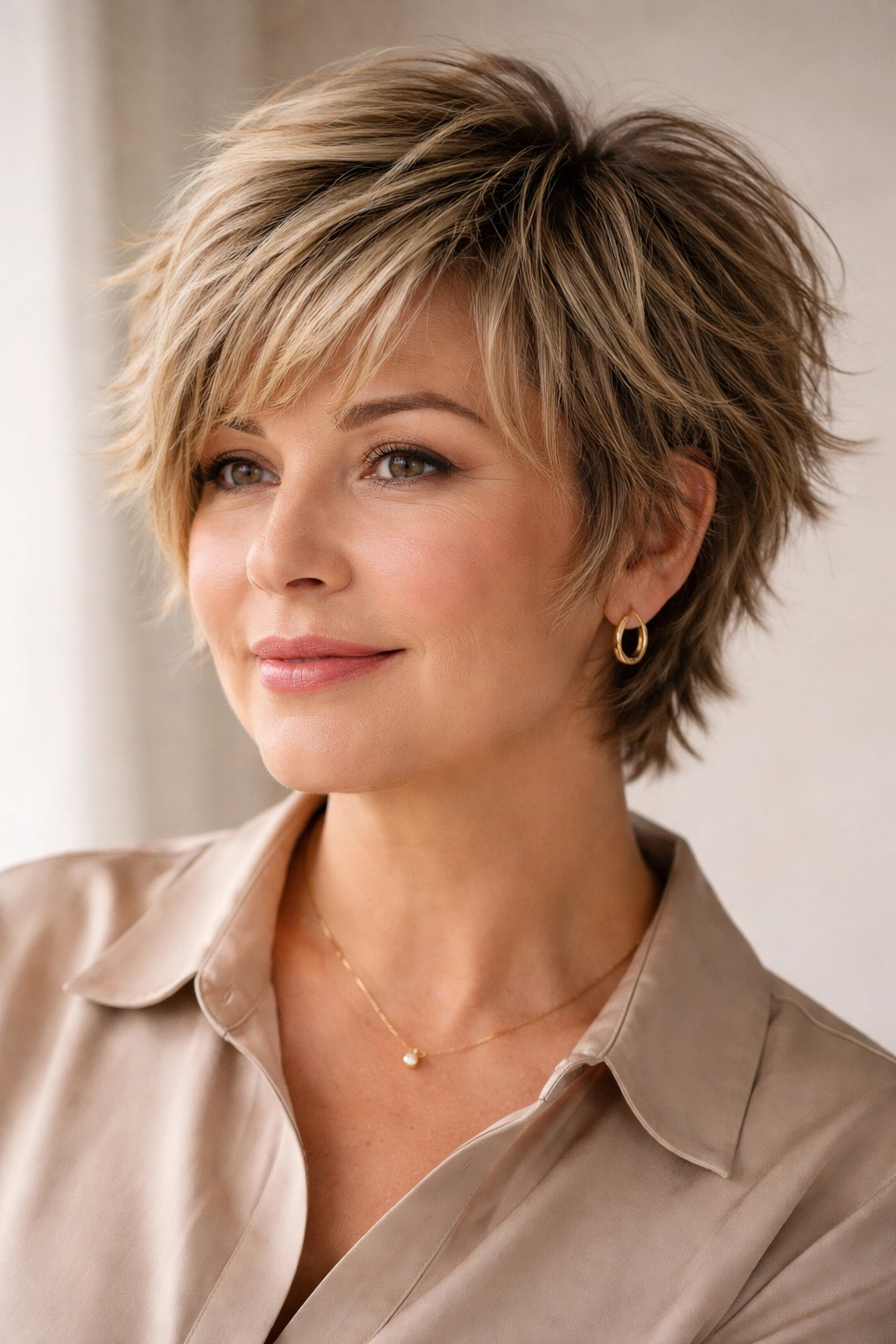
Layers are your best friend when you have a round face, and a choppy, layered crop maximizes this advantage. Unlike a smooth, blunt crop, a choppy version has layers throughout that create movement and texture—it literally looks alive and dimensional rather than like a cap sitting on your head.
This style typically sits at ear-level or slightly longer, with much shorter layers on top that create volume at the crown. The choppiness means hair falls at different lengths and angles, which breaks up the roundness of your face shape. It’s structured enough to look polished and intentional, but textured enough to feel modern and soft. The movement created by all those choppy layers means your hair shifts and changes as you move, which is infinitely more flattering than a stationary style.
For women over 50 with medium to thick hair, this style is absolutely gorgeous because those layers add tons of dimension and prevent the style from looking heavy. Even for finer hair, strategic layering (longer than you’d think) can create the illusion of fullness without thinning out the overall shape.
Why It Works for Round Faces
- Chop layers create angles that soften and define simultaneously
- Texture breaks up solid blocks of hair
- Movement prevents the style from emphasizing width
- Works beautifully with gray hair—choppiness adds dimension
- Feels youthful and modern without being trendy or dated
Best For
- Those with medium to thick hair texture
- People comfortable with some styling (a texturizing product brings out the best in this cut)
- Anyone who wants a style with personality and movement
- Those who can commit to regular maintenance (every 4-5 weeks)
Styling option: Apply a sea salt spray to damp hair and scrunch while air drying, or use a diffuser on your blow-dryer for enhanced texture.
4. The Sleek, Sharp Bob With Angle
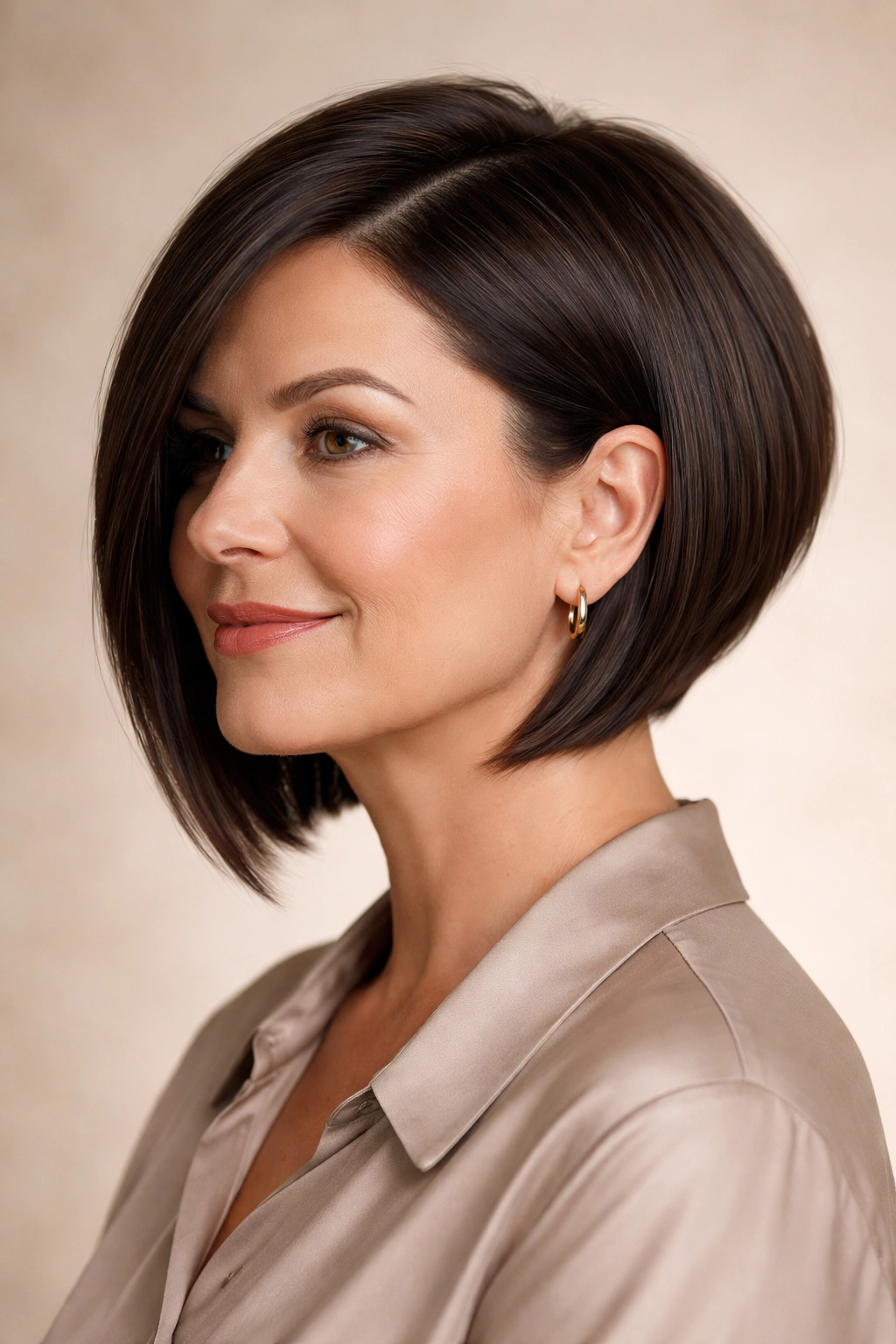
For those who prefer polished, less textured styles, a sharp, angled bob works beautifully for round faces when constructed thoughtfully. The key is the angle—the back is shorter and the front is longer, creating a diagonal line that elongates your face rather than emphasizing its roundness.
This isn’t a blunt bob that sits at one length all around. Instead, imagine a bob that’s quite short in the back (pixie-length at the nape) and gradually extends longer toward the face, finishing at or just below the jawline. This angle, when you have it shaped by someone who understands face shape, creates a visual lift and elongation. The sleekness means no wasted texture—your cut itself does the work of flattering your face rather than relying on tousled styling.
This style works exceptionally well if you have naturally straight hair or are willing to blow-dry straight. It photographs beautifully, looks sophisticated and intentional, and ages well. There’s something inherently chic about a well-executed angled bob, and it’s a style that’s been flattering round faces for decades because the geometry simply works.
Why It Works for Round Faces
- The angle creates diagonal lines, not horizontal ones
- Shorter back prevents bulk at the back of the head
- Longer front pieces frame the face and draw the eye down
- Polished, finished appearance that looks intentional
- Works beautifully with color—angles show dimension and movement of color
Best For
- Those with straight or naturally straight-ish hair
- People who blow-dry and style regularly
- Anyone who prefers polished, finished looks over texture
- Those comfortable with a bolder, more geometric style
Maintenance note: This style needs precision trims every 4-5 weeks to maintain the angle—let it grow out even slightly and the effect is lost.
5. The Textured, Tousled Shag
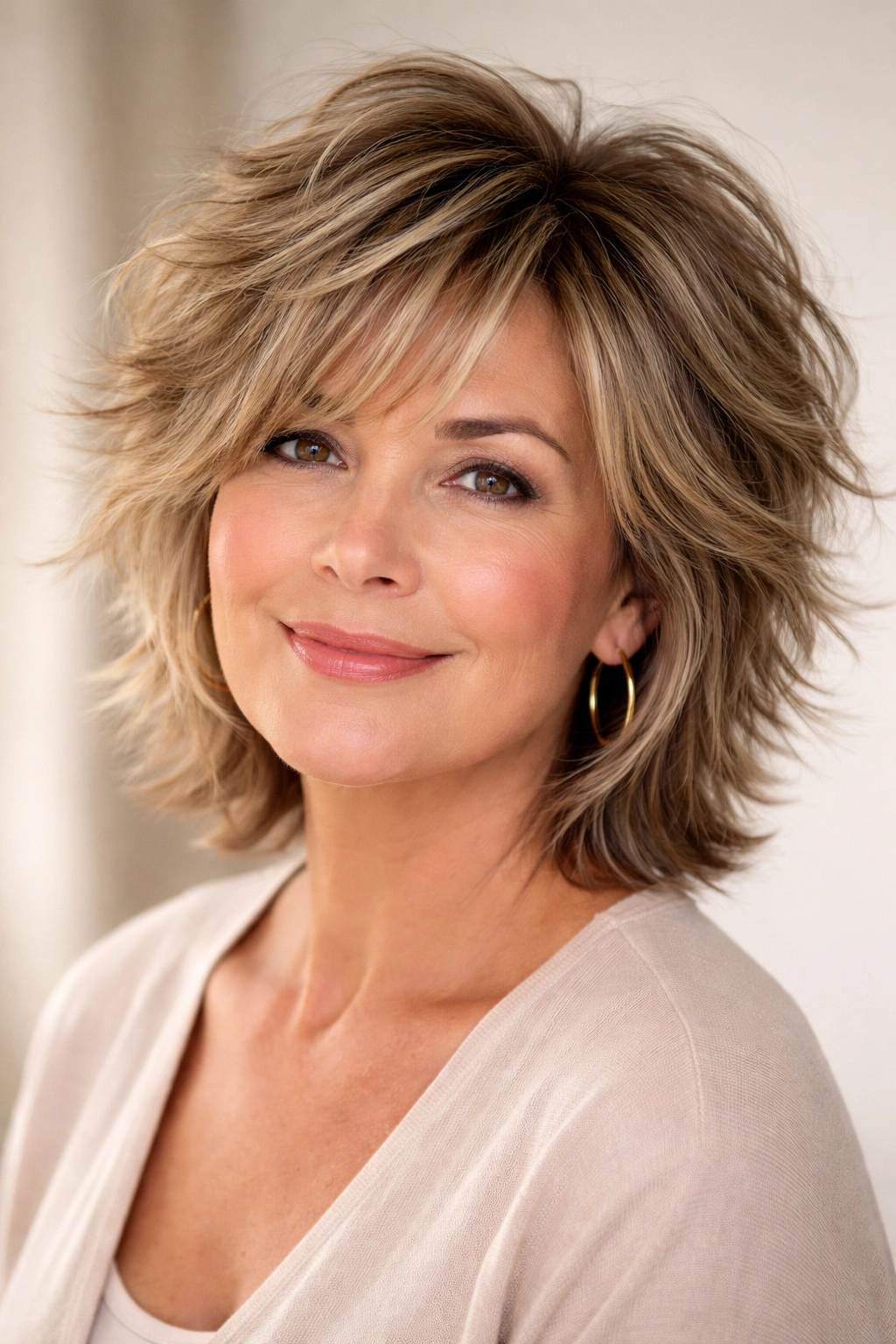
The shag haircut has made a triumphant comeback, and for good reason—it’s incredibly flattering for round faces, especially over 50. A modern shag is nothing like the ’70s version; it’s a sophisticated, choppy, layered style that moves beautifully and works with any hair type.
A shag has shorter layers throughout, creating lots of texture and movement. The back is typically a bit fuller and longer than a pixie, and the sides are layered so they can be swept back and away from the face. What makes a shag work so well for round faces is that all those choppy layers create visual interest and angles—they break up the smooth roundness and add dimension. When you style a shag with some texture and movement, it looks like you’ve got volume and shape, even if your hair has become finer over time.
The beauty of a modern shag is that it works with your hair texture rather than against it. A slight wave or curl is actually enhanced by a shag cut, making it perfect for those with naturally wavy or curly hair. But even straight hair looks great in a shag when it’s styled with texture and movement. This is a style that says you’re fashion-forward without trying too hard—it’s youthful and a bit edgy, but totally wearable at any age.
Why It Works for Round Faces
- Choppy layers throughout create angles and definition
- Movement and texture make round faces appear less heavy
- Works beautifully with wavy or curly hair
- Incredibly versatile—can be tousled or more controlled
- Perfect for blending gray because layers show dimension
Best For
- Those with wavy, curly, or textured hair
- People who like styling flexibility
- Anyone comfortable with a slightly edgy, modern aesthetic
- Those who want low-maintenance (dry shampoo is your friend)
Styling trick: Use a texturizing spray on damp hair, blow-dry with a diffuser attachment, then finger-comb to enhance the shag’s natural separation and movement.
6. The Soft, Feminine Pixie With Swept Bangs
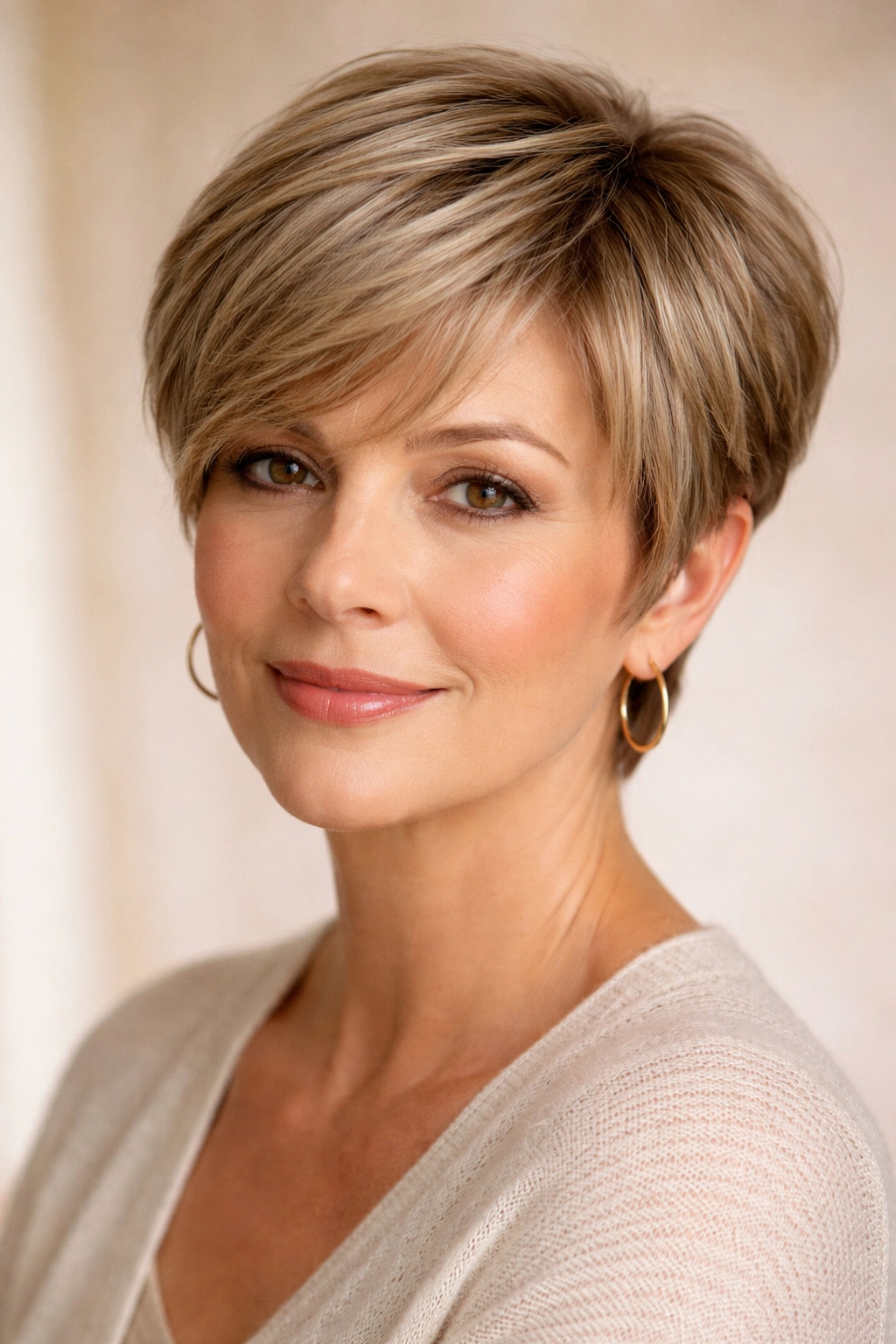
For a slightly softer take on the pixie, consider a version with gently swept bangs that frame the face rather than a blunt fringe. This style maintains all the benefits of a pixie—crown volume, tapered sides, easy maintenance—but with added femininity and face-framing capability.
Instead of the hair sitting straight up on top, it’s styled with a slight sweep or movement. The bangs begin further back on the head and are longer than traditional pixie bangs, allowing them to blend into the side length and sweep across the forehead and around the face. This creates a softness and frames your eyes and cheekbones beautifully. You’re not obscuring your face with heavy bangs; you’re creating gentle lines that draw attention upward and frame rather than hide.
This style works wonderfully for women over 50 because it’s youthful and modern without looking like you’re trying too hard to seem younger. The swept bangs add a gentle femininity that feels age-appropriate and elegant. It’s particularly flattering if you have any asymmetry in your face that you’d like to soften or if you want to emphasize your eyes rather than your overall face shape.
Why It Works for Round Faces
- Swept bangs create diagonal lines that elongate
- Frames eyes and brings focus upward
- Maintains pixie benefits while adding softness
- Swept styling creates movement away from cheeks
- Bridges the gap between very short and slightly longer styles
Best For
- Those with good facial symmetry or who want to emphasize eyes
- People comfortable with regular trims (every 4-6 weeks)
- Anyone who wants a youthful but sophisticated look
- Those willing to style the swept bangs with a little blow-dry
Styling essential: Keep a small round brush handy—use it to gently direct the bangs into a soft sweep while blow-drying for the best result.
7. The Disconnected Undercut With Length on Top
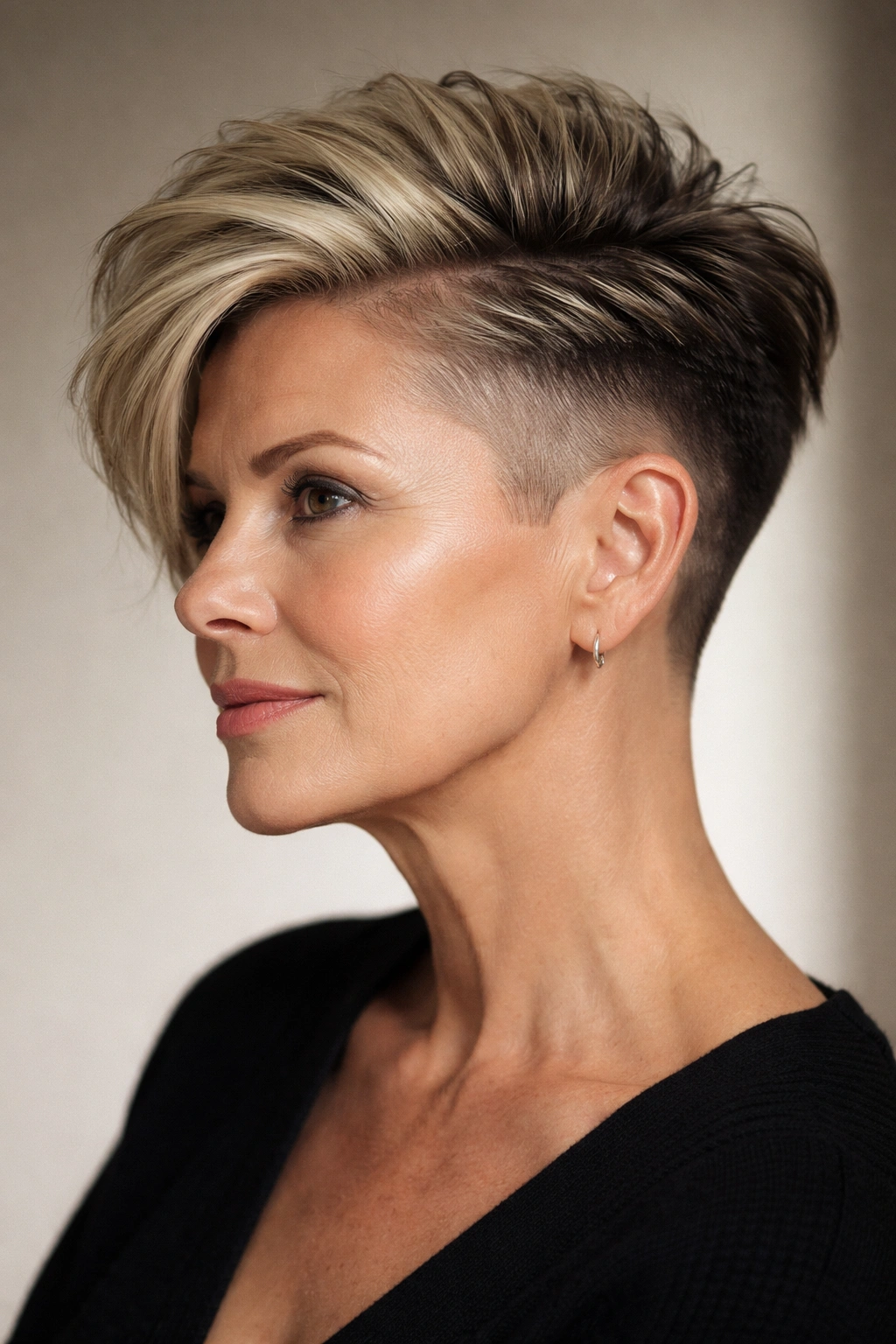
This style takes the concept of contrast to the extreme—there’s a dramatic difference between very short sides (often clippered to stubble-short) and noticeably longer layers on top. The “disconnected” aspect means there’s no gradual fade; it’s a clear separation between the undercut sides and the longer top, creating maximum visual impact.
The longer top is where you get all your styling versatility and face-framing potential. The hair on top can be 2-3 inches longer than the undercut sides, creating serious height at the crown and the ability to sweep and style the top pieces around your face. This dramatic contrast is intensely flattering for round faces because the visual weight is all on top and the sides are essentially invisible—you’re emphasizing the smallest part of your head and de-emphasizing the widest part.
This is a bold, confident style choice that says you’re not afraid of taking risks with your appearance. It’s become increasingly popular for women of all ages, including those over 50 who want something that feels modern and statement-making. The disconnected undercut works particularly well if you have any facial features you want to emphasize—your eyes, cheekbones, or jawline all become more prominent when they’re not surrounded by volume.
Why It Works for Round Faces
- Extreme contrast minimizes the appearance of face width
- All visual weight on top elongates the face
- Undercut sides are nearly invisible, creating the illusion of a narrower face
- Allows endless styling options with the longer top
- Makes a powerful statement about confidence and personal style
Best For
- Those truly comfortable with a bold, statement-making look
- People with thicker, more textured hair on top
- Anyone who can commit to maintenance (undercut regrowth is visible, needs touching up every 2-3 weeks)
- Those who want to turn heads and feel completely unique
Bold styling choice: This works best with darker or silver hair where the undercut creates clear contrast.
8. The Grown-Out Pixie or Pixie Bob Hybrid
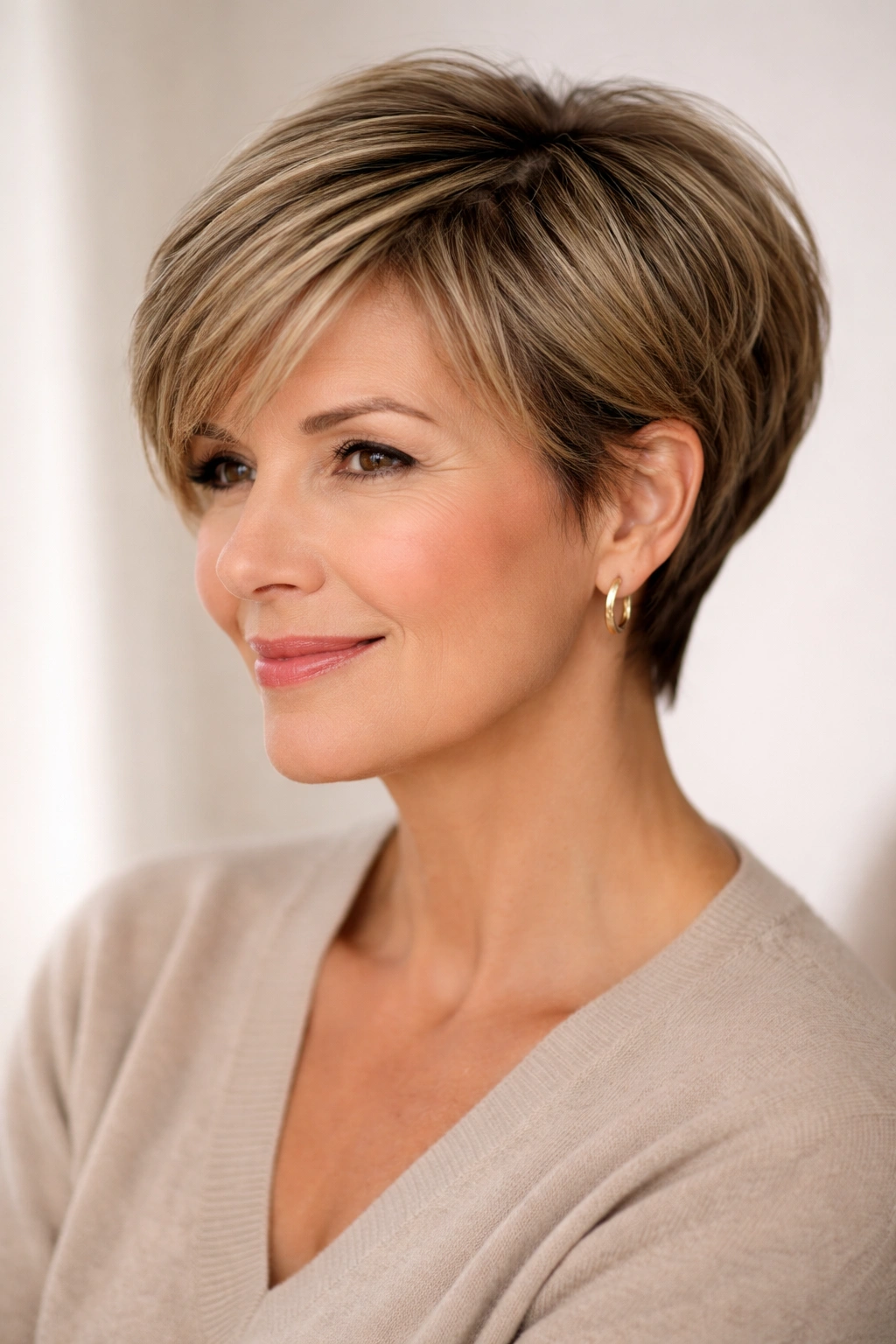
Not every round-face person wants a true pixie or a true bob—sometimes the sweet spot is something in between. A grown-out pixie, sometimes called a pixie bob, is essentially a pixie cut that’s been left to grow for a few weeks or months, creating a style that’s longer than a pixie but shorter than a traditional bob.
This hybrid cut has the tapered sides and crown volume of a pixie but with slightly more length throughout, especially toward the front and around the face. It sits somewhere between 1.5 and 2.5 inches in length overall, creating a very flattering middle ground. The beauty of this style is that it’s incredibly versatile—you can style it tousled and textured one day and sleek and smooth the next. It also has a built-in “grow-out phase” that’s actually attractive, which means you don’t have to get trims quite as frequently as you would with a true pixie.
For women over 50 with round faces, this style is perfect because it gives you the benefits of short hair without committing to something super short. You get the manageability, the modern aesthetic, and the face-flattering shape, but with more styling flexibility. It’s particularly nice if you’re not quite ready to go fully short or if you’re testing the waters with shorter cuts for the first time.
Why It Works for Round Faces
- Provides balance between very short and moderate length
- Crown height and tapered sides create proportion
- More styling flexibility than a true pixie
- The grow-out phase is still attractive
- Less frequent trims needed than a true pixie
Best For
- Those transitioning to shorter hair
- People who want versatility in styling options
- Anyone who prefers not getting trims more than every 5-6 weeks
- Those who like having texture and length variation in their hair
Versatility tip: Use a flat iron to sleek this out for a polished look, or scrunch texture spray into damp hair for a more tousled appearance.
9. The Asymmetrical Textured Crop
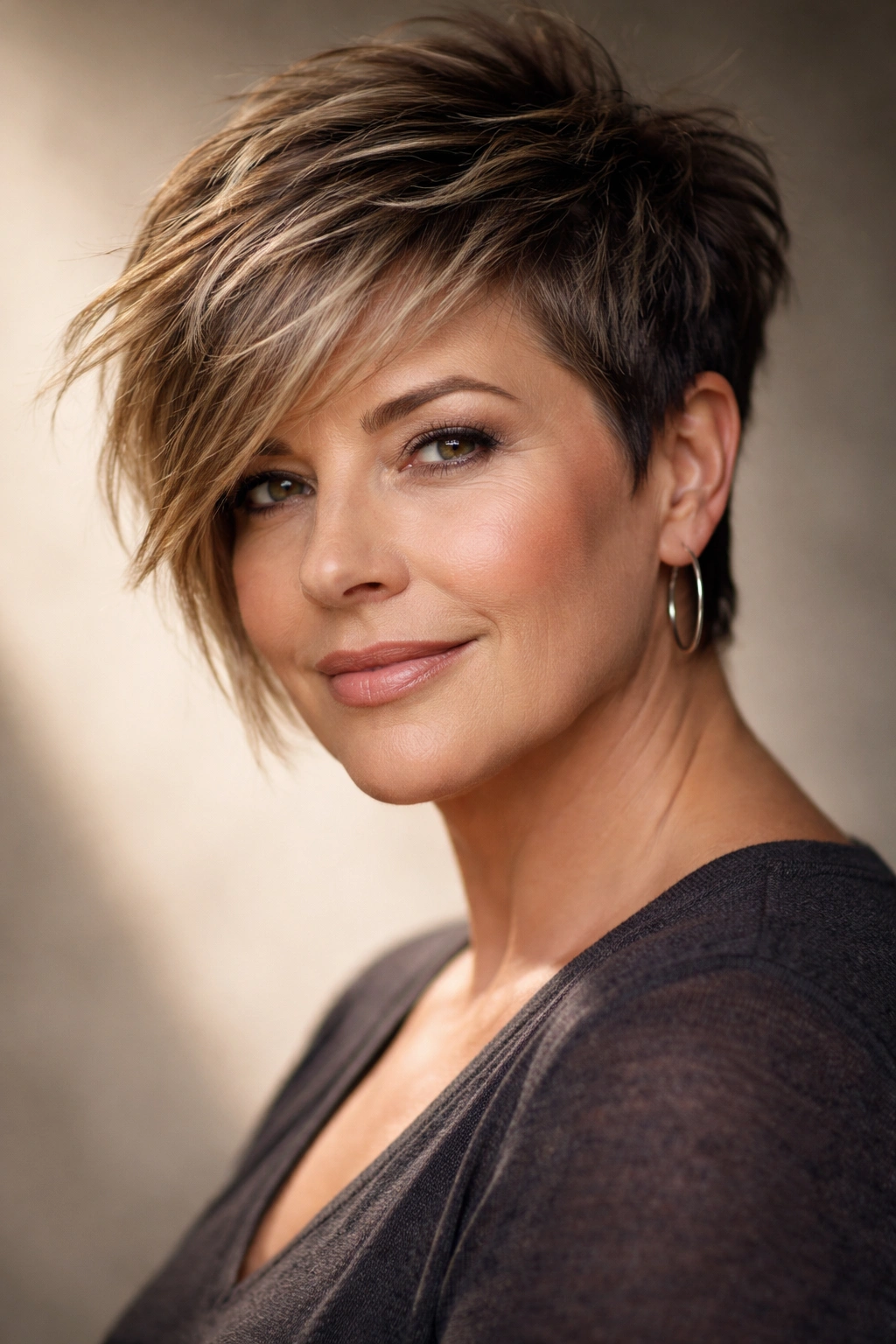
Taking asymmetry a step further than the undercut bob, an asymmetrical textured crop has significantly different lengths on either side of the head, combined with chopped, layered texture throughout. One side might be pixie-short while the other extends to the cheekbone or longer, creating a dramatic angle that’s undeniably flattering for round faces.
The asymmetry means your face is never viewed from straight-on in a symmetrical way—one side is longer and heavier, visually pulling the eye and creating visual interest. Combined with choppy texture, this style is impossibly dimensional and modern. It says you’re confident enough to wear your hair in a way that’s clearly intentional and somewhat sculptural. The texture prevents the style from looking severe or harsh; instead, it feels soft and movement-based despite the dramatic shape.
This style absolutely requires a stylist who understands both your face shape and how to execute textured, asymmetrical cuts beautifully. It’s not a style to attempt with an average haircut—you need someone with vision and skill. But when it’s done right, it’s one of the most flattering short styles available for round faces, and it photographs beautifully.
Why It Works for Round Faces
- Asymmetry creates angles and prevents straight-on roundness
- Texture adds softness to bold shape
- Longer side can frame and elongate the face
- Incredibly modern and statement-making
- Shows confidence and personal style
Best For
- Those with thicker, textured hair
- People who can access a truly skilled stylist
- Anyone confident in their personal style and not afraid of dramatic looks
- Those willing to get trims frequently to maintain the asymmetry (every 4 weeks)
Word of caution: This style only works if executed with precision—find a stylist you trust completely before committing to this cut.
10. The Feathered, Textured Short Bob
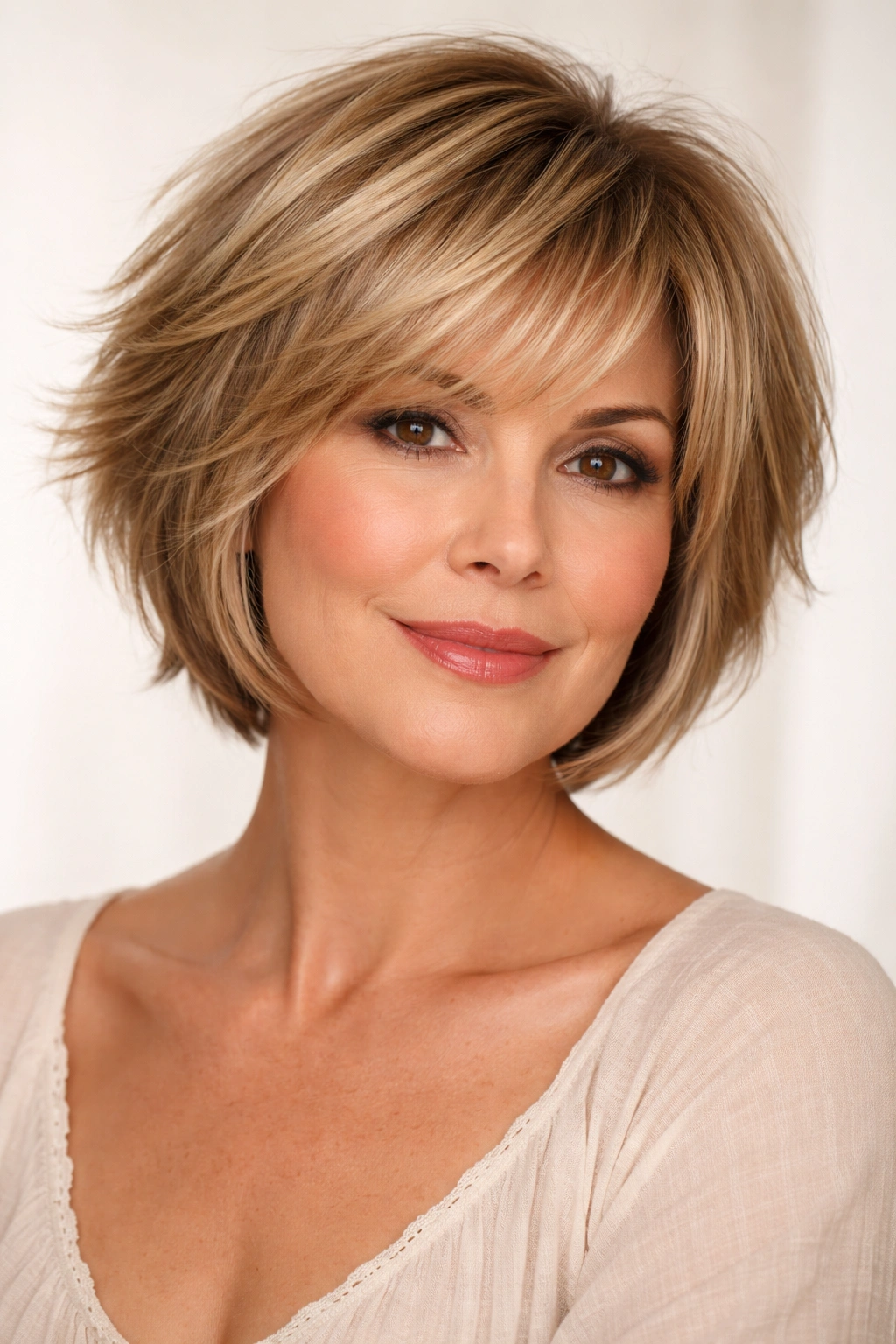
A feathered short bob splits the difference between a longer bob and a pixie, featuring lots of layering and texture throughout that creates a soft, feathered effect. Rather than blunt or too structured, this style has movement and separation in the layers—it’s a 1990s revival done in a modern, sophisticated way.
The layers are subtle and numerous rather than chunky, creating a feathered effect where the hair appears to separate and move naturally. This style is incredibly flattering for round faces because the layers break up any flatness or heaviness, especially around the cheekbones and jaw. It’s one of the most forgiving short styles for round faces because the layers work to create softness and dimension simultaneously.
The length typically sits somewhere between ear-length and chin-length, giving you enough hair to work with while keeping things solidly in “short hair” territory. The beauty of the feathered approach is that it works with any hair texture, from straight to curly, because the layers are designed to look good whether they’re sleek or tousled.
Why It Works for Round Faces
- Subtle layers create texture without bulk
- Feathering prevents flat appearance
- Length allows gentle framing of the face
- Works beautifully with gray hair
- Soft and sophisticated without being fussy
Best For
- Those who want short hair but with some length
- People who appreciate subtle texture over bold choppiness
- Anyone with fine or medium-density hair
- Those who prefer a refined, polished aesthetic
Styling note: This style naturally looks good with minimal effort, though a light texturizing product enhances the feathered effect.
11. The Volume-Focused, Layered Pixie Crop

For those who loved their hair when it was fuller but have noticed thinning over the years, a volume-focused pixie crop is engineered specifically to create the maximum illusion of thickness and fullness. This isn’t a trick or magic—it’s strategic layering and cut architecture that makes finer or thinner hair appear dramatically fuller.
The key to this style is longer layers on top (at least 2-3 inches for lift and movement) combined with very short, close-to-the-scalp sides. The contrast creates the optical illusion of volume, and the longer layers on top actually create actual volume through lift and separation. Each layer is cut at a slight angle, which allows them to intersect and create more apparent fullness than the actual amount of hair you have.
This style requires a stylist who understands how to cut for fine hair specifically—it’s not the same as cutting thick hair short. It’s about using the cut itself to create the effect of fullness rather than relying on styling products or techniques. When done right, this style is genuinely transformative for women over 50 who’ve experienced age-related hair thinning.
Why It Works for Round Faces
- Creates visual fullness through strategic layering
- Height on top elongates face shape
- Short sides emphasize the smaller part of your head
- Works beautifully with fine or thinning hair
- Minimal styling needed for maximum effect
Best For
- Those with fine or thinning hair
- People concerned about hair fullness over time
- Anyone who wants a style engineered for their specific hair texture
- Those who want maximum impact with minimal styling effort
Expert tip: Ask your stylist to avoid layers that are too short on top—longer layers create more actual volume than choppy, short layers do.
12. The Soft, Layered Rounded Bob
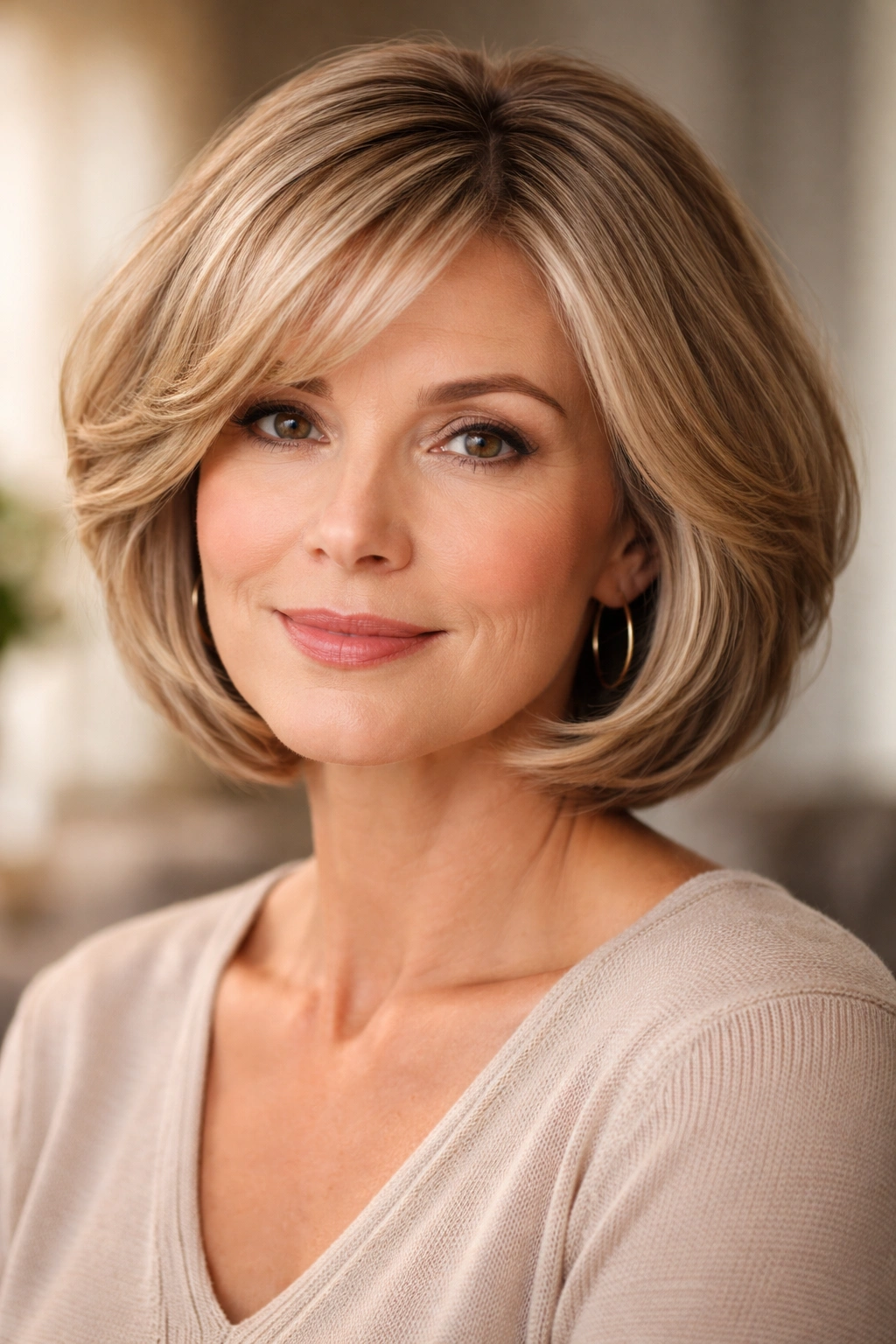
Closing out this collection is a style that proves you don’t need an edgy, modern cut to flatter a round face—sometimes a refined, softly rounded bob with strategic layering works beautifully. This style is longer and fuller than some of the other options here, sitting around chin-length or slightly longer, with layers throughout that prevent it from becoming a heavy, blunt blob of hair.
The “rounded” aspect refers to the overall shape being slightly curved and soft rather than angular or sharp. The layers ensure the style has movement and dimension rather than sitting flat. The length gives you enough hair to work with for various styling options, from sleek and polished to tousled and soft. This is the style choice for those who want short hair without looking too edgy or statement-making.
What makes this bob work for round faces is that the layers are most pronounced toward the face and crown, creating visual interest and preventing the style from emphasizing cheekbone width. The slightly longer length and softer shape make this style feel elegant and age-appropriate without looking dated or matronly. It’s a style that women over 50 can absolutely own with confidence.
Why It Works for Round Faces
- Layers throughout prevent flat, heavy appearance
- Chin-length creates some face-framing without elongating excessively
- Soft rounded shape feels refined and sophisticated
- Length allows styling versatility
- Works beautifully with color and gray blending
Best For
- Those who want short hair but with a more refined aesthetic
- People who prefer softness over edge
- Anyone who wants versatility in how they style their hair
- Those who appreciate elegant, timeless looks over trendy cuts
Styling flexibility: This style can be blow-dried smooth for a polished look or scrunched with texture spray for a softer, more casual appearance.
Styling Tips That Make Every Short Hairstyle Work Better

The right cut is only part of the equation—how you style it makes an enormous difference, especially for round faces. Even the most flattering cut can look flat and unflattering if it’s not styled thoughtfully. The good news is that most of these styles don’t require extensive daily styling, but they do benefit from a few key techniques.
Crown volume is your constant companion when you have a round face. Whether you’re air-drying or blow-drying, you want to encourage height and lift at the crown and back of your head. This might mean blow-drying your roots upward while your head is upside-down, using a volumizing mousse or spray on damp roots, or simply finger-styling to encourage separation and height. Even 10 minutes invested in creating crown volume transforms how your short hairstyle sits on your round face.
Side-parting is almost always more flattering than a center part for round faces. A center part creates a vertical line straight down the middle of your face, which emphasizes symmetry and roundness. A side part (especially a deep side part) creates a diagonal line and draws the eye horizontally across the width of your face in a more flattering way. Experiment with parting your hair on different sides to see which feels most flattering.
Texture is your ally. Whether that texture comes naturally from your hair type or you create it with styling products, texture breaks up the smooth roundness of your face. A texturizing spray, sea salt spray, or styling paste can completely transform a smooth, sleek cut into something with movement and dimension. Apply these products to damp hair and scrunch or tousle to activate the texture.
Movement away from your face is the golden rule. Avoid styles that sit flat and close to your cheeks and jaw. Instead, encourage your hair to move backward and away from your face, exposing your face and creating a frame rather than a frame that clings to your contours. This might mean using a blow-dryer to direct hair away from your face, or styling with your fingers in a way that creates separation and air around your face.
Texture and Layers: The Technical Foundation

Understanding texture and layers isn’t just about aesthetics—it’s about the actual engineering of your haircut. A stylist who truly understands how to cut for round faces designs layers that serve specific purposes: creating height, adding movement, preventing bulk, and creating dimension.
Layers should generally be longer toward the front and sides (where they frame your face) and shorter throughout the back and crown (where they create lift). This graduated approach means the longest layers can be styled to frame and elongate your face, while shorter layers underneath create the lift and movement that prevent flatness. Avoid layers that are too choppy and short all over; this can actually make your hair look sparse and emphasize roundness rather than flatter it.
The angle of layers matters tremendously. Layers cut at an outward angle (pointing away from your head) create movement and separation. Layers cut at an inward angle (pointing toward your head) create closeness to the scalp and can make hair sit heavier. A skilled stylist for round faces uses outward-angled layers to encourage movement away from your face.
Texture as a cut design feature (not just styling) is created by cutting layers at different lengths with intentional variation. A texturized cut has hair falling at many different lengths simultaneously, which creates natural separation and dimension without any styling product needed. This is different from a smooth, evenly-layered cut where all the layers are roughly the same length and simply create volume rather than texture.
For women over 50 with fine or thinning hair, understanding this distinction is crucial. A heavily textured cut with very short, choppy layers might make fine hair look thinner. A more subtle layered cut with longer layers creates the illusion of fullness without compromising density. This is a conversation to have with your stylist based on your specific hair texture and density.
Color Choices That Enhance Your Round Face Shape

Your hair color interacts with your face shape and facial features in ways you might not have considered. For round faces, certain color choices actually contribute to the flattering or unflattering nature of your overall look.
Lighter colors and highlights create the illusion of dimension and break up solid color blocks that might emphasize roundness. A single-tone, solid color can make your face look flatter and wider because there are no light and dark areas to create visual interest. Highlights, lowlights, or dimensional color (like balayage, babylights, or lived-in color) create variations in light and shadow that add dimension not just to your hair but to how your face appears in relation to your hair.
Grays or silvery tones are absolutely stunning on many women over 50, but solid gray can sometimes emphasize face width if there’s no dimension or variation. A blended gray (keeping some darker lowlights or richer tones mixed in) or a shimmery silver tone creates more visual interest than flat gray.
Warmer tones—golds, coppers, rich browns—tend to bring warmth to your face and can make rounder faces appear softer and more youthful. Cooler tones—ash blondes, cool brunettes, platinum—can be incredibly flattering too, but they benefit from dimension and variation rather than a flat, solid color.
The relationship between your hair color and your skin tone matters for overall harmony. A color that doesn’t complement your undertones can make you look tired or washed-out, which makes your face shape more noticeable. If you’re unsure what colors suit you best, ask your stylist for color recommendations based on your skin undertone. A professional colorist can make an enormous difference.
Common Styling Mistakes That Make Round Faces Look Wider

Even the most flattering haircut can look unflattering if you’re styling it in ways that work against your face shape. Being aware of these common mistakes helps you avoid them and get maximum flattery from your short haircut.
Extreme smoothness without texture is the enemy. A smooth, sleek short hairstyle with no texture, no waves, no movement can actually emphasize the roundness of your face because there’s nothing to break up the smooth contours. If you prefer sleek styling, incorporate a side part or directional blow-dry that creates movement away from your face, rather than a smooth, centered style.
Centering your hair directly on your face emphasizes symmetry and roundness. Avoid parting your hair in the center or styling it so it frames your face equally on both sides. Always opt for a deeper side part or asymmetrical styling that creates angles rather than symmetry.
Flattening the crown eliminates one of your best tools for creating proportion. If you style your short hair smooth and flat on top, you’re losing the opportunity to create height and vertical proportion. Always encourage some height and lift at the crown, even if you prefer the sides smooth and close to your head.
Wearing your hair too short all over can look sparse and emphasize your face. While some people love very short pixies, they’re not universally flattering for round faces. Generally, keeping slightly more length on top (at least 2 inches) compared to the sides helps create better proportion.
Avoiding styling altogether can make even the most flattering cut look less than its best. Short hair over 50 that’s been freshly cut looks fantastic, but as it grows out and you stop styling it, it can lose shape and become less flattering. A quick 5-minute styling with a blow-dryer and your fingers, or the application of a texturizing product, makes a significant difference.
How to Find and Work With a Stylist for Your Round Face
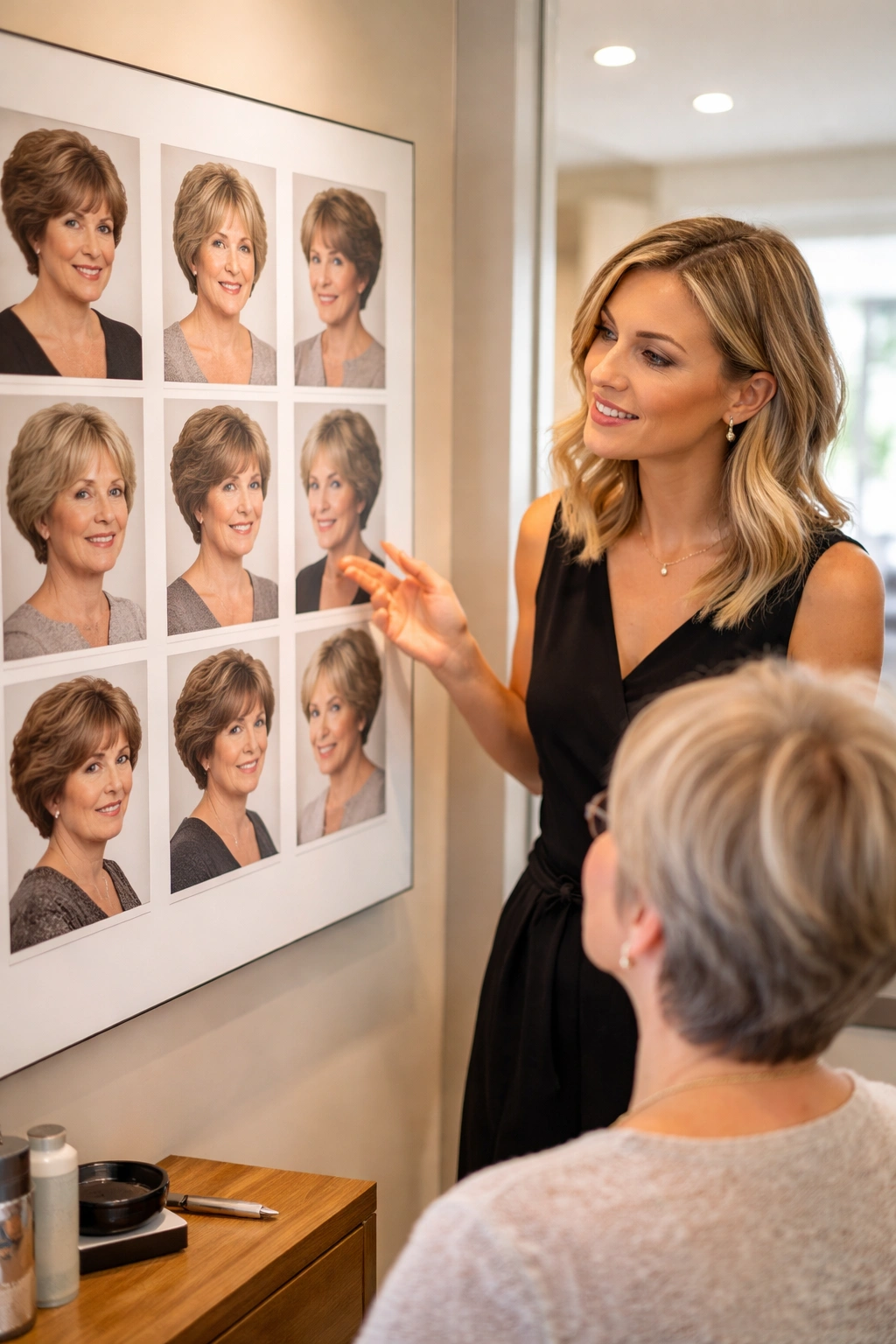
Finding the right stylist is perhaps the most important factor in getting a flattering short haircut for your round face. Not every stylist understands face shape, and not every stylist has experience with older clients or fine/thinning hair. Taking time to find someone who does is worth the effort.
Start by looking at before-and-after photos in your stylist’s portfolio, specifically looking for clients with round face shapes and hair texture similar to yours. Does their work show an understanding of proportion and face shape? Do the cuts have texture and movement? Do their clients look youthful and confident? A good stylist’s portfolio should speak volumes about their skill and eye.
Don’t hesitate to have a consultation before committing to a full cut. Many stylists offer free or low-cost consultations where you can discuss your face shape, hair texture, lifestyle, and styling preferences. During this consultation, pay attention to whether the stylist asks you detailed questions and listens carefully, or whether they rush through and assume they know what’s best. A stylist who takes time to understand you is going to deliver better results.
Bring references. Rather than showing your stylist a celebrity photo and saying “I want this,” instead bring photos of people with similar face shapes and hair texture wearing styles you like. Explain why you like them (the crown volume, the texture, the asymmetry, etc.) rather than expecting your stylist to interpret a photo of someone with a completely different face shape and hair type.
Be clear about your styling preferences and maintenance commitment. Can you commit to trims every 4-5 weeks, or do you need a style that looks good growing out over 8 weeks? Are you willing to blow-dry and style daily, or do you need something low-maintenance? Will you use styling products? All of these factors influence what style will work best for your life, and a good stylist will ask these questions.
After your cut, ask your stylist to show you how to style it. Many stylists assume clients know how to recreate the look at home, but actually having them demonstrate or guide you through the process is invaluable. Watch how they create height at the crown, where they direct your hair to flow, what products they use, and in what order. Don’t be shy about asking them to do it again if you didn’t quite catch it.
Final Thoughts
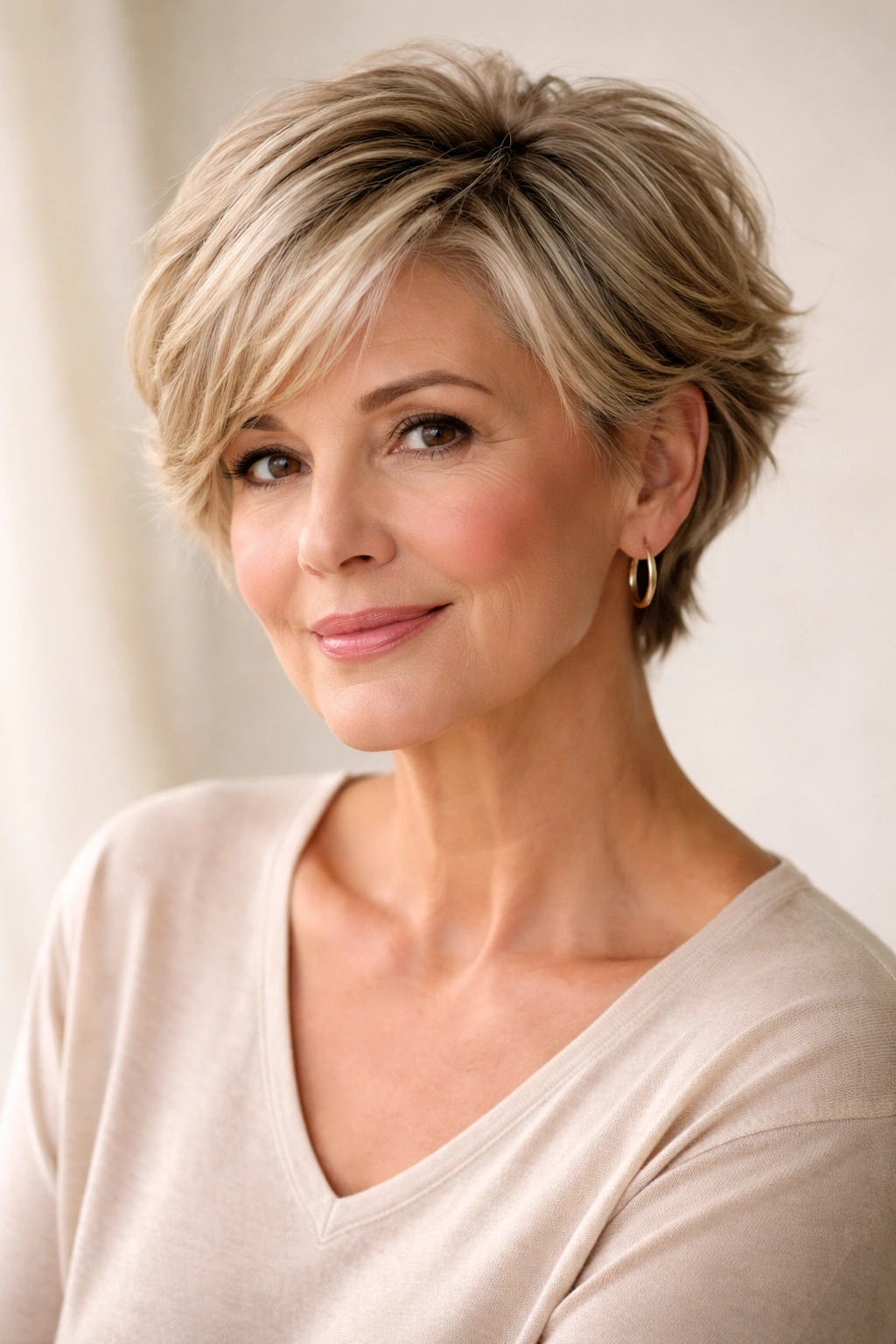
Finding the perfect short hairstyle for your round face over 50 is absolutely achievable—you just need to understand the principles that make certain styles flattering and find a stylist who shares that understanding. The styles in this guide all work beautifully for round faces because they share key features: they create height and proportion, they emphasize movement and texture over smoothness, and they encourage your hair to frame your face rather than cling to it.
The truth is that your round face shape is not a limitation; it’s actually an advantage when you work with it intelligently. Soft, curved facial features are beautiful, and the right short hairstyle enhances that beauty while creating proportion and visual interest. You get to choose whether your style emphasizes softness with a feathered layered cut, brings boldness with a statement-making undercut or shag, or splits the difference with something refined and elegant.
Start by identifying which of these styles resonates with you visually and aligns with your lifestyle and styling preferences. Then find a stylist who has experience with that style and with cutting for round faces and mature hair. Go into your appointment prepared with specific reference photos, honest information about your hair texture and maintenance commitment, and openness to your stylist’s professional recommendations. Trust the process, and be patient with yourself as you learn to style your new cut in the way that works best for you.
Your short hair is an opportunity to feel confident, modern, and intentional about your appearance. Done right, it’s a style choice that transforms not just how you look but how you feel.
