



The shag haircut has made an undeniable comeback, and for good reason—it’s one of the most versatile, flattering styles out there. Unlike one-size-fits-all cuts, a shag works for almost everyone, but the magic is in the customization. The layers, texture, and overall proportion need to match your specific hair type and face shape to look genuinely stunning rather than just… choppy.
Here’s what most people get wrong: they see a shag they love on someone else and ask for that exact cut, then wonder why it doesn’t look the same on them. The difference comes down to how the layers interact with your natural hair texture and how the proportions flatter your facial structure. A shag that’s choppy and piece-y might be perfect for someone with fine, straight hair but could look scraggly on thick, curly strands. Similarly, layers that add width might be ideal for an oblong face but could overwhelm a round one.
The good news? You don’t have to guess. By understanding how shag styles work with different hair types and face shapes, you can walk into your stylist’s chair knowing exactly what will actually suit you. We’ve pulled together 20 distinct shag variations, each explained for its specific hair type and face shape advantages. Whether you’re working with fine, curly, thick, or textured hair—and whether your face is round, oval, square, heart-shaped, or oblong—you’ll find options that genuinely work for your features.
1. The Classic Choppy Shag for Straight Hair and Oval Faces
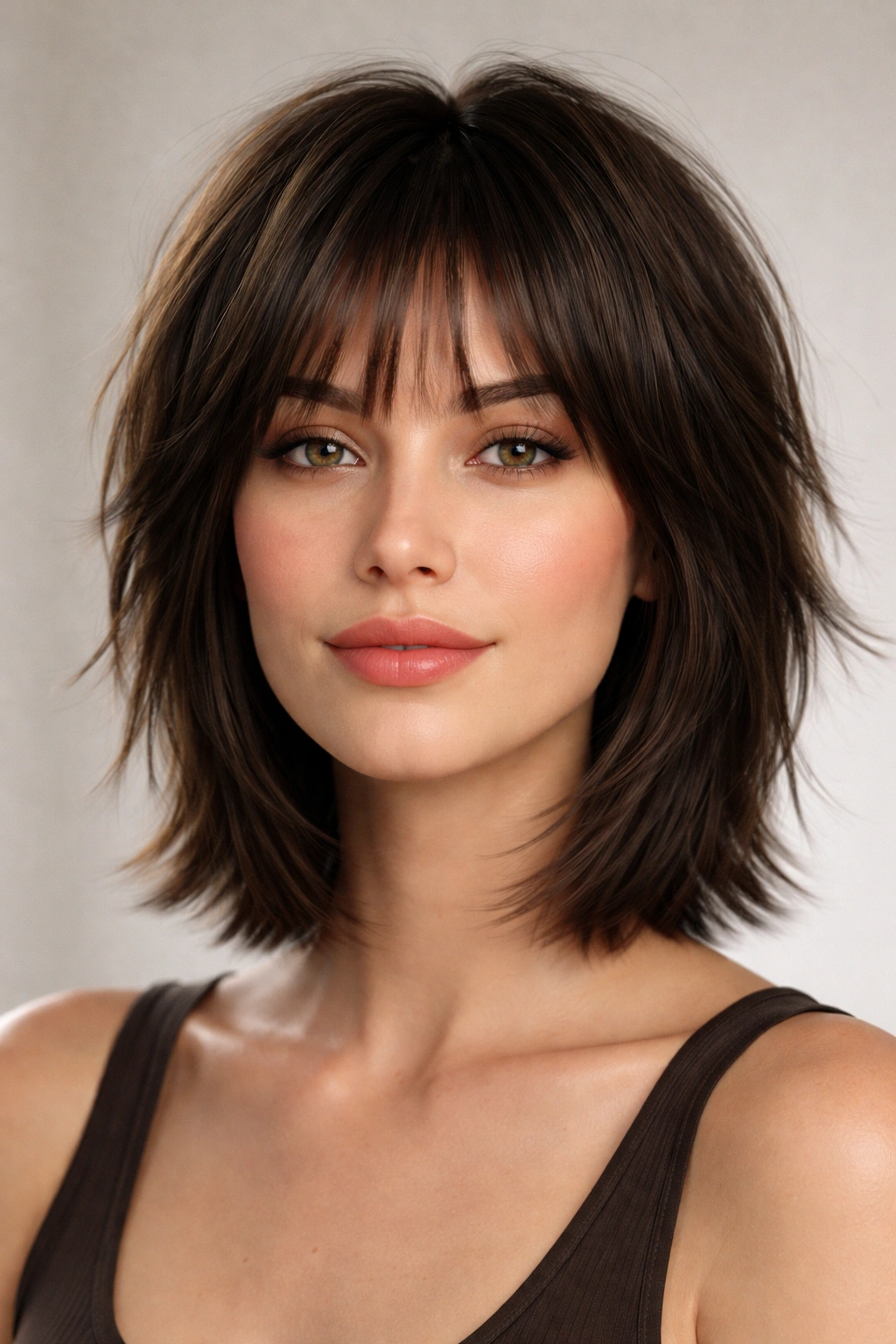
This is the foundational shag that started the whole trend—short, layered throughout, with plenty of choppy texture and volume at the crown. It falls somewhere between the length of a pixie and a lob, typically hitting around chin-length, with shorter layers on top creating that signature piece-y, tousled texture that defined the shag from the start.
Why It Works for Straight Hair and Oval Faces
Straight hair shows off choppy layers beautifully because each strand catches light differently, creating natural movement and depth without the layers appearing to disappear. Oval faces are the golden ratio of facial proportions—pretty much any hairstyle flatters them—but this shag especially enhances the natural symmetry by adding volume around the crown while keeping the face frame relatively close. The choppy front layers just barely brush the jawline, which emphasizes the subtle bone structure without drawing too much attention to width or length.
What Makes This Cut Work Best
- Layer placement: Shorter layers (2-3 inches) sit on top for height and movement; longer layers create a connected length in the back
- Styling ease: Blow-dry with a round brush to flip layers out at the ends, or let air-dry for tousled texture
- Best maintained with: Regular trims every 4-6 weeks to keep the choppy edges clean and defined
- Styling product: Light texture spray or dry shampoo keeps layers separated and piece-y
Pro tip: If your straight hair is naturally fine or limp, ask your stylist for shorter, more aggressive layers on top—the increased volume will prevent the style from falling flat.
2. The Modern Shag with Curtain Bangs for Round Faces
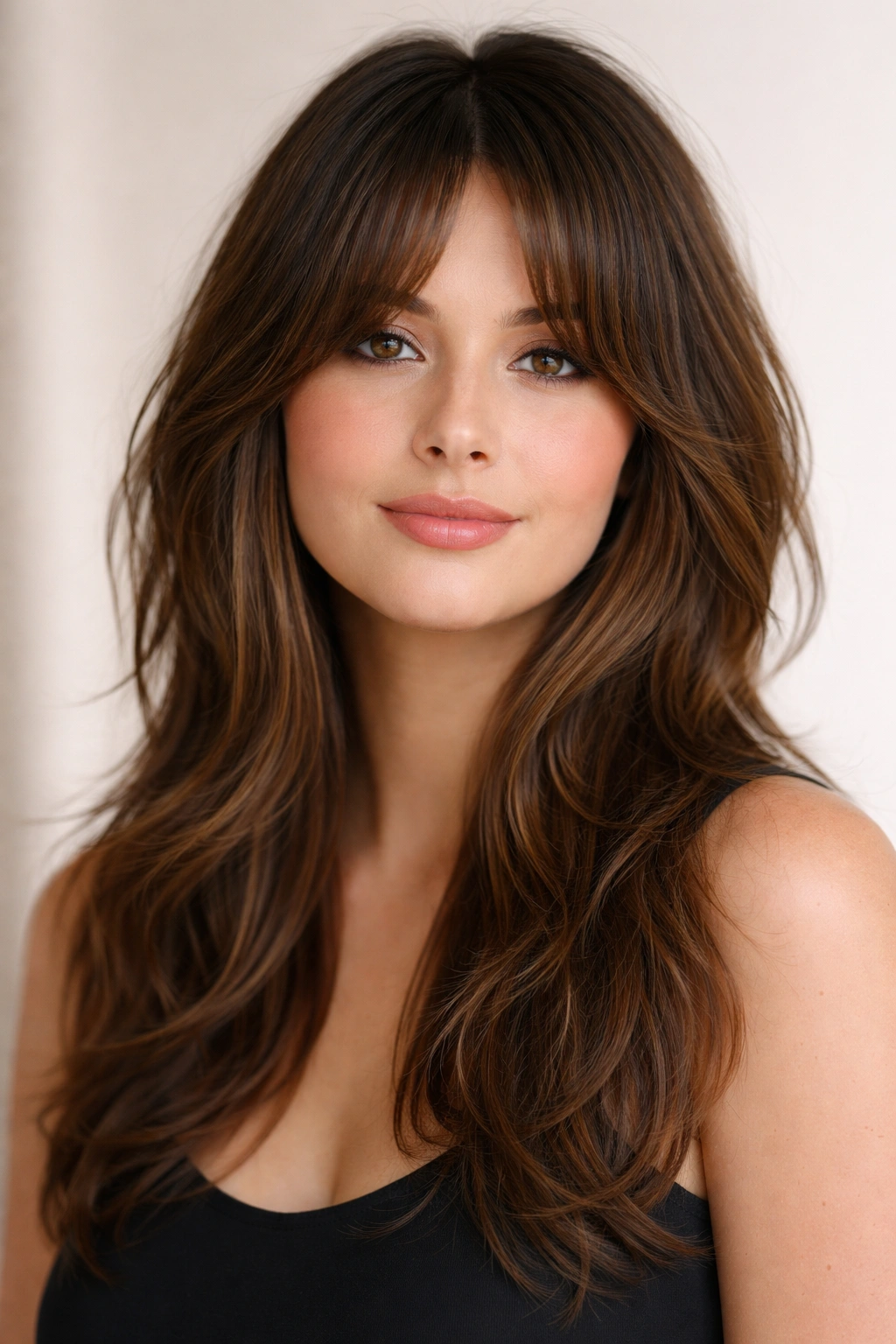
This variation softens a round face by framing it with longer, face-grazing layers and subtle curtain bangs that part down the middle. The bangs are longer than traditional shag bangs—they hit around the cheekbones—and blend seamlessly with the front layers rather than sitting as a separate, blunt piece.
Why It Works for Round Faces and Medium-Textured Hair
Round faces benefit from vertical lines that elongate and create angles. The long, face-framing layers of this cut draw the eye downward, making the face appear longer and narrower. The center-parted curtain bangs add that vertical element while also creating shadow and dimension across the cheekbones. Medium-textured hair (not quite wavy, not quite straight) takes to this style beautifully because the layers encourage natural texture without requiring waves that don’t exist or fighting against flatness.
What Makes This Cut Work Best
- Bang placement: Curtain bangs should hit at or just below the cheekbones and blend into the longer front layers
- Length variation: Keep the very front pieces longer than mid-length layers to avoid a harsh line
- Styling technique: Part in the center and sweep one side back slightly; the bangs will naturally frame your face
- Texture building: Use a texturizing paste or light pomade on damp hair before blow-drying to enhance natural waves
Worth knowing: The success of this cut depends heavily on how smoothly the bangs blend with the rest of the layers—ask your stylist to ensure there’s no distinct line between the bangs and the front sides.
3. The Textured Shag for Curly Hair and Heart-Shaped Faces
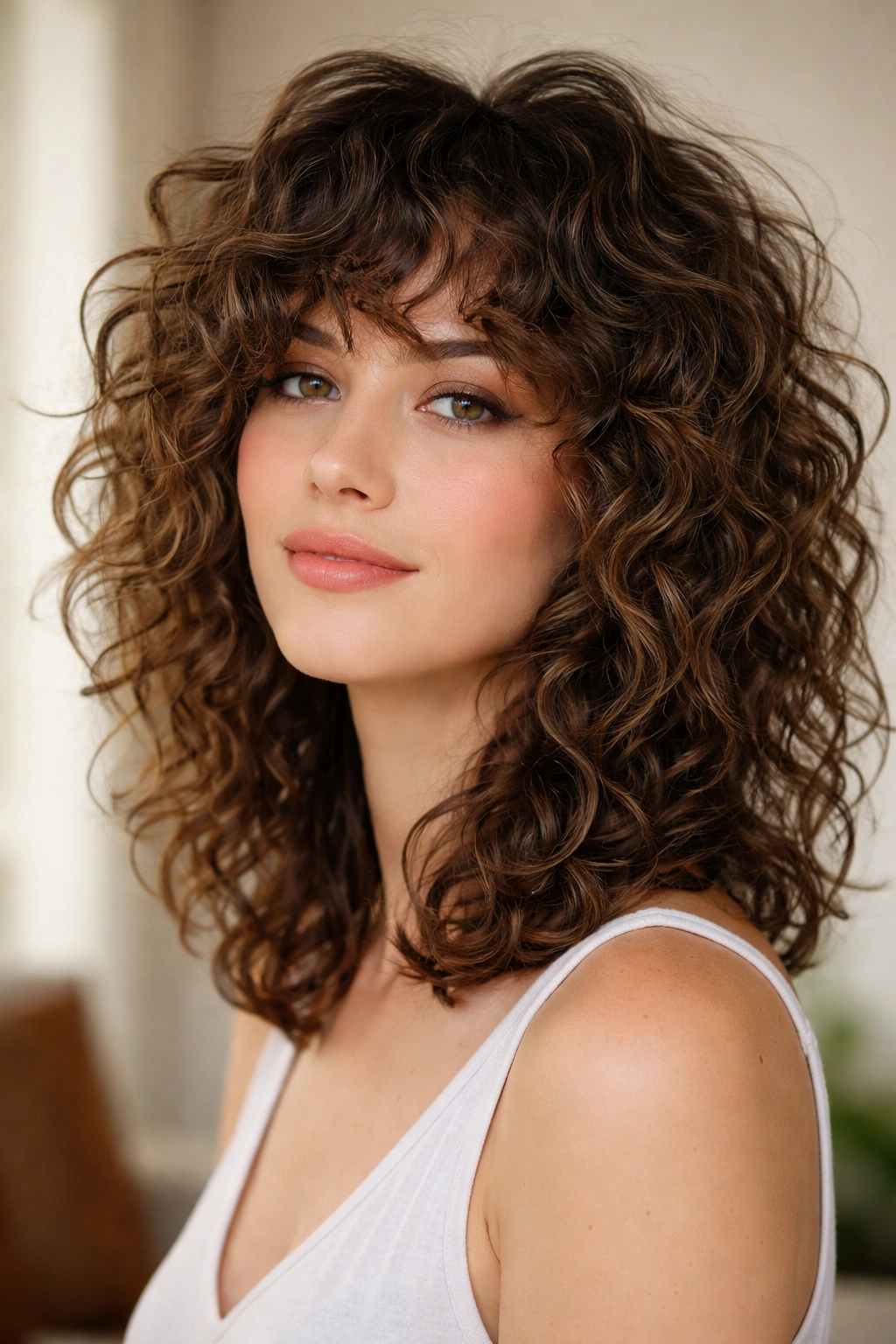
This shag leans into curl texture rather than fighting it, with shorter layers that actually enhance curl definition and bounce. It’s longer in the back (shoulder-length or just past) and significantly shorter on top, with the layers positioned to distribute curls evenly rather than creating a pouf at the crown.
Why It Works for Curly Hair and Heart-Shaped Faces
Heart-shaped faces (wider at the forehead and temples, narrower at the chin) need volume and texture lower down to balance the upper face. This shag delivers that by keeping the back fuller while the shorter top layers add movement without bulk. Curly hair is heavy, and thick layers can clump curls together, making them look dull. Shorter, more strategic layers allow each curl to express itself individually, creating definition rather than density.
What Makes This Cut Work Best
- Layer frequency: Layers every inch or so, rather than sparse layers that can look awkward on curly hair
- Curl-cutting technique: Ask your stylist to use dry-cutting methods on curly hair so they can see how curls actually fall when shaped
- Styling method: Apply leave-in conditioner to soaking-wet hair, use a diffuser attachment on your dryer, and scrunch upward to encourage curl definition
- Maintenance: Curly hair needs moisture; deep condition weekly and refresh curls between washes with a curl-reactivating spray
Insider note: If your curls vary in pattern (some tighter, some looser), ask your stylist for custom layering that accounts for those variations—what works for uniform curls might need tweaking for mixed textures.
4. The Long Shag with Minimal Layers for Thick, Straight Hair
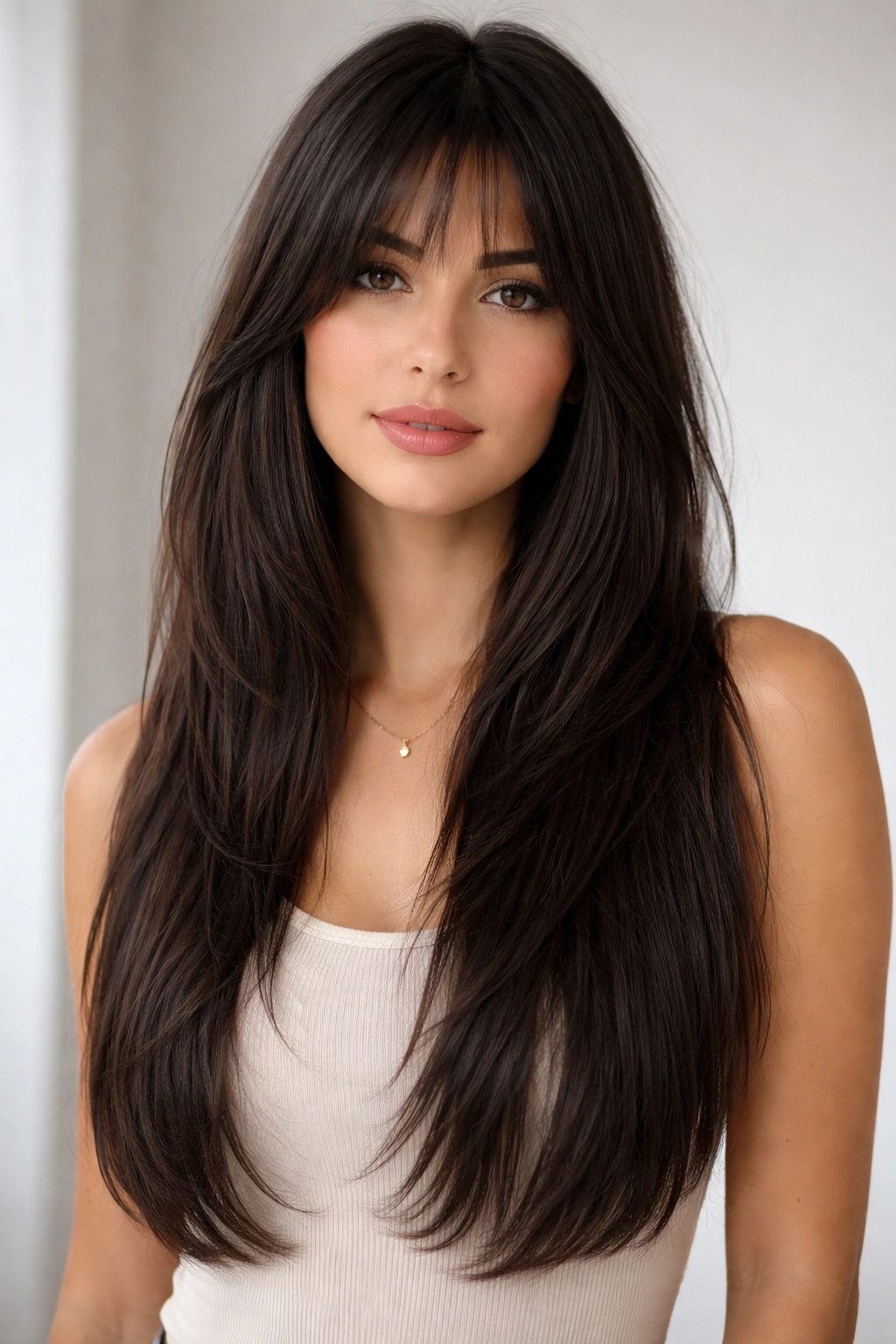
This is a more subtle take on the shag, maintaining length (usually bra-strap length or longer) while adding strategic layers that add movement without removing bulk. The layers are less aggressive than a classic choppy shag—placed to create flow and reduce weight rather than create choppiness.
Why It Works for Thick, Straight Hair and Square Faces
Square faces (equal width and length with defined jawline) benefit from softer lines that interrupt the angular geometry. This shag’s longer, flowing layers create curved lines that contrast the straight edges of a square face. Thick, straight hair often gets weighed down by length, but this cut’s minimal yet strategic layers reduce weight while maintaining the length people with thick hair often want. The layers catch light along the strands rather than creating choppy texture.
What Makes This Cut Work Best
- Layer depth: Layers should remove bulk without creating visible chop marks; think blended rather than stacked
- Front frame: Longer front pieces (longer than the center layers) create a soft frame around the face
- Blunt cut: A slight blunt cut on the ends prevents the heavy hair from looking scraggly and keeps lines clean
- Styling approach: Blow-dry straight with a paddle brush, then curl the ends outward for movement
Pro tip: Thick hair can handle a razor cut, which creates sharper layers and reduces density more effectively than scissors alone.
5. The Feathered Shag for Fine Hair and Oblong Faces
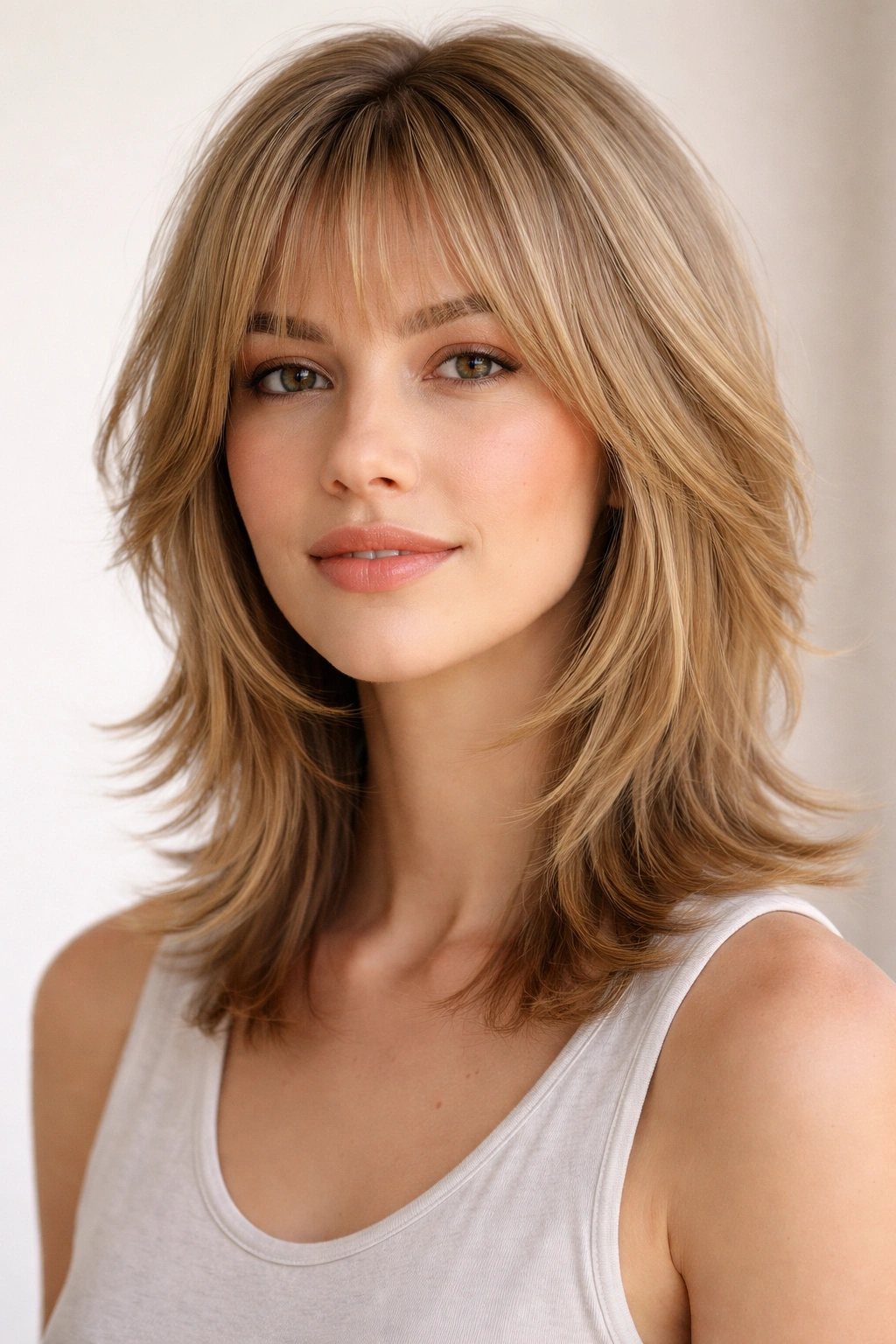
This style emphasizes feathered, wispy layers that create the illusion of fullness on fine hair without the weight of blunt layers. It’s cut to flip and separate at the ends rather than chunky and deliberate, creating an ethereal quality rather than structural definition.
Why It Works for Fine Hair and Oblong Faces
Oblong faces (longer than wide with a balanced jawline) need width, not length. This feathered shag sits shorter overall and angles inward slightly, creating the impression of width across the cheekbones and temples. Fine hair benefits from layers that actually separate and show texture rather than chunky layers that flatten and cling together. Feathered ends create movement and the illusion of volume on hair that naturally lacks density.
What Makes This Cut Work Best
- Feathering technique: Layers are cut to flip outward and feather at the ends, creating wispy rather than choppy texture
- Overall length: Keeps hair shorter (chin-length to just below) to prevent fine hair from looking thin and stringy
- Styling: Blow-dry with a round brush, flipping the brush outward to encourage the feathered ends to separate
- Volume at crown: Shorter layers on top create crown height and compensate for lack of natural density
Worth knowing: Fine hair shows every imperfection in a cut, so regular trims (every 4-6 weeks) are essential to keep the feathered effect looking intentional rather than grown-out.
6. The Shag Lob for Wavy Hair and Oval Faces
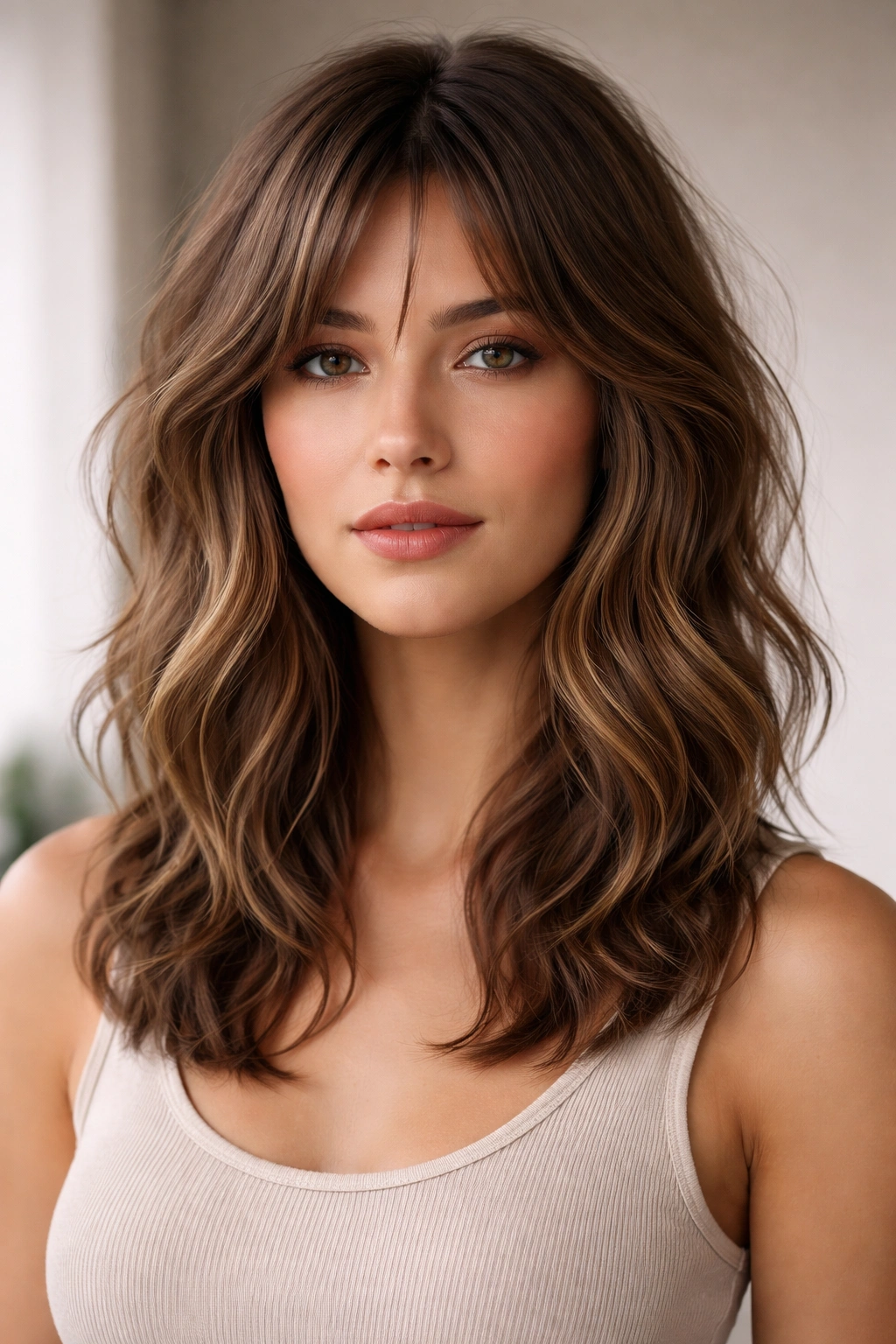
This is a longer interpretation of the shag (hitting around collarbone length) with waves baked into the shape. Rather than relying on choppy texture, this cut embraces natural or styled waves and uses layers to enhance them throughout the length.
Why It Works for Wavy Hair and Oval Faces
Wavy hair naturally has texture and movement, and a shag lob plays into that strength rather than fighting it. The longer length prevents waves from looking awkward or overly voluminous, while strategic layers add definition to the wave pattern. Oval faces remain the ideal canvas, and a longer shag lob is supremely flattering because it maintains facial proportions while adding movement and interest.
What Makes This Cut Work Best
- Wave-enhancing layers: Layers placed specifically to encourage wave definition throughout the length, not just on top
- Length consistency: Longer front layers blend into longer back length, creating a connected, flowing shape rather than a stark length difference
- Styling routine: Add product to damp hair (mousse, curl cream, or wave cream), use a diffuser on low-medium heat, and scrunch upward as it dries
- Refresh method: Between washes, use a salt spray or wave-reactivating product on damp hair and let air-dry or diffuse
Pro tip: If your waves are inconsistent, ask your stylist to cut more strategically layered sections in areas where waves are tighter or less defined.
7. The Shag with Side-Swept Layers for Heart-Shaped Faces and Fine Hair
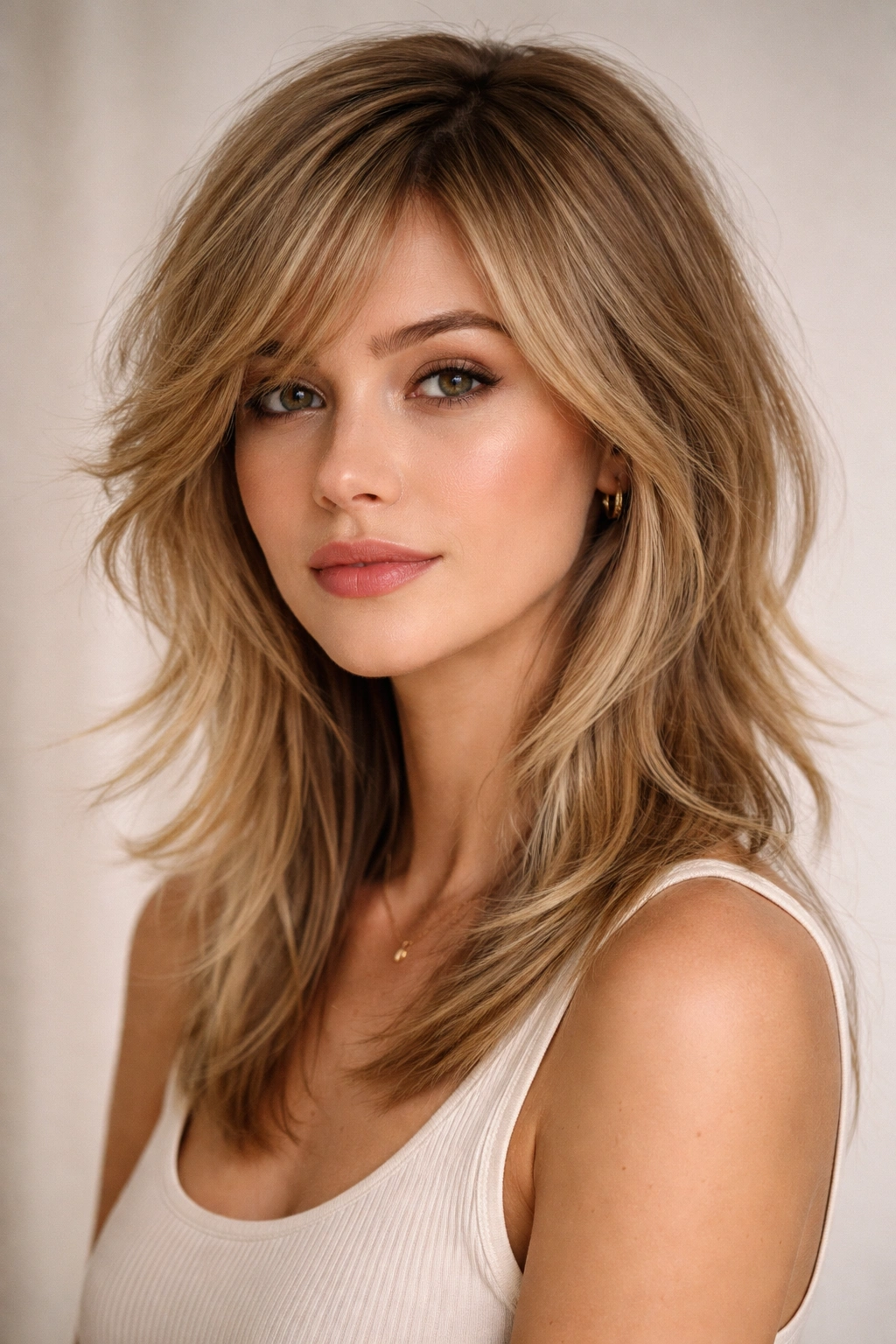
This variation sweeps the longer front layers to one side in an asymmetrical fashion, creating visual interest while keeping the cut lighter overall. The layers are feathered and less aggressive, suitable for fine hair but with enough movement to show style intent.
Why It Works for Heart-Shaped Faces and Fine Hair
Heart-shaped faces need to draw attention downward and away from the wider forehead. An asymmetrical side-sweep does exactly that—the longer pieces sweep across, drawing the eye sideways rather than straight to the temples. Fine hair benefits from asymmetry because it creates the illusion of density through visual interest rather than actual volume. The side-sweep also hides the finer sections of hair that might otherwise look thin.
What Makes This Cut Work Best
- Asymmetrical cut: One side is noticeably longer and sweeps forward; the other is shorter and tucks behind the ear
- Textured layers: Feathered throughout to compensate for fine hair and add movement
- Styling: Blow-dry the longer side over and across; use a texture spray to make fine pieces hold their shape
- Directional flow: The asymmetry should feel intentional, not like one side is longer by accident
Insider note: Side-swept shags work best when styled away from the face regularly—if you usually pull hair back, this isn’t the style for you, as it loses its defining feature.
8. The Shag with Texture Underlayers for Thick, Curly Hair
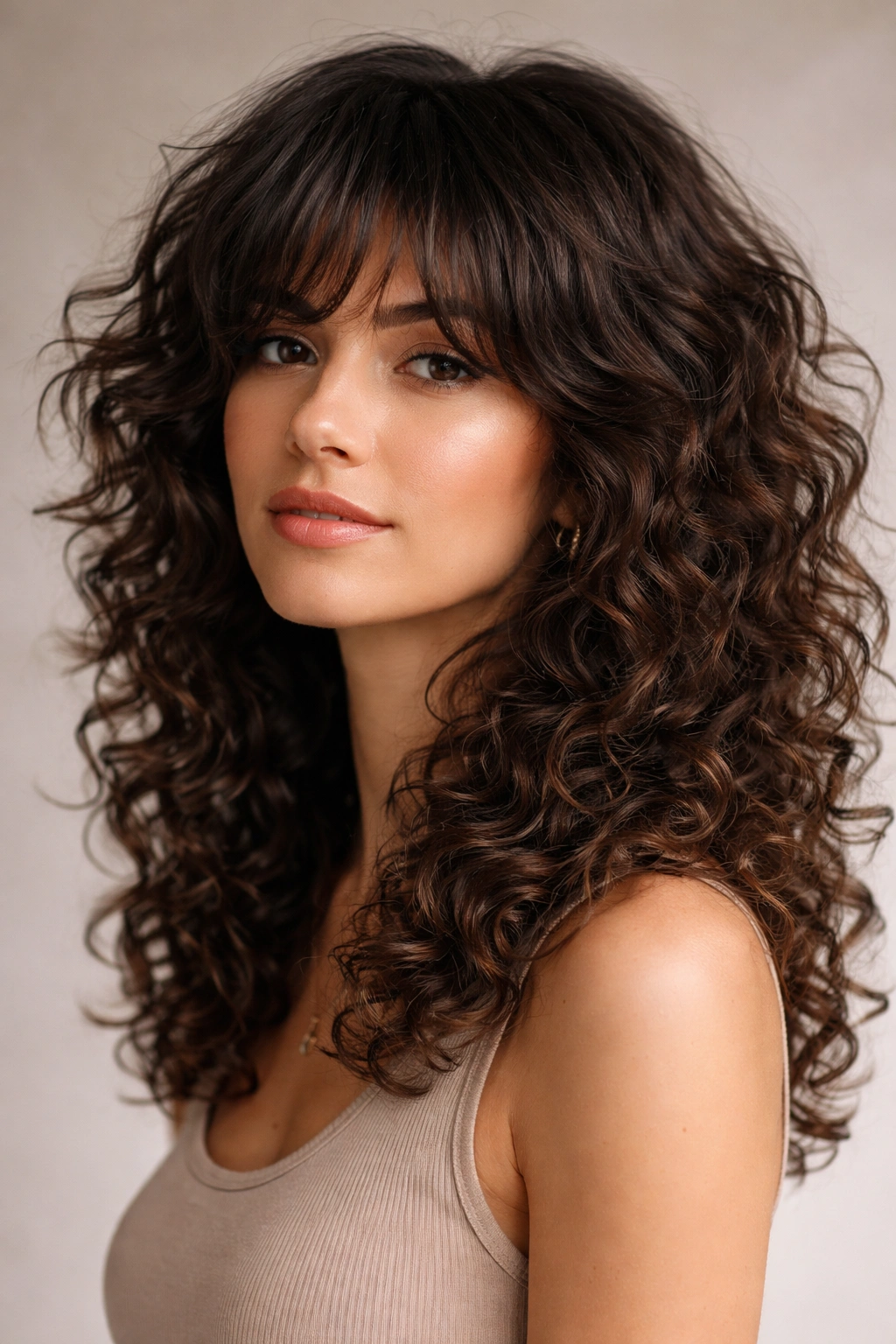
This cut uses hidden texture layers underneath while keeping the surface smooth, creating definition without bulk. It’s a strategic approach for people with thick, curly hair who want the shag look but find traditional shags too voluminous.
Why It Works for Thick, Curly Hair and Square Faces
Square faces need softness, and this shag delivers it through the smoother surface while maintaining texture underneath. Thick, curly hair can look overwhelming with aggressive external layers; this approach removes weight internally where it’s less visible, creating movement and definition while maintaining a relatively contained silhouette. The layers are cut when hair is dry (for curly hair) so the stylist can see exactly where density sits.
What Makes This Cut Work Best
- Dry-cut technique: Essential for curly hair; the stylist cuts into the curl pattern to see exactly where to remove weight
- Hidden layers: Shorter layers exist underneath the longer surface, creating internal texture and movement
- Curl definition: More defined curls emerge without the shag looking choppy or sparse
- Styling: Use curl-defining creams and diffuse-dry to encourage curl separation and pattern
Pro tip: This approach requires a stylist experienced with curly hair—the dry-cutting method is crucial for success.
9. The Shag with Disconnected Layers for Straight Hair and Rectangle Faces
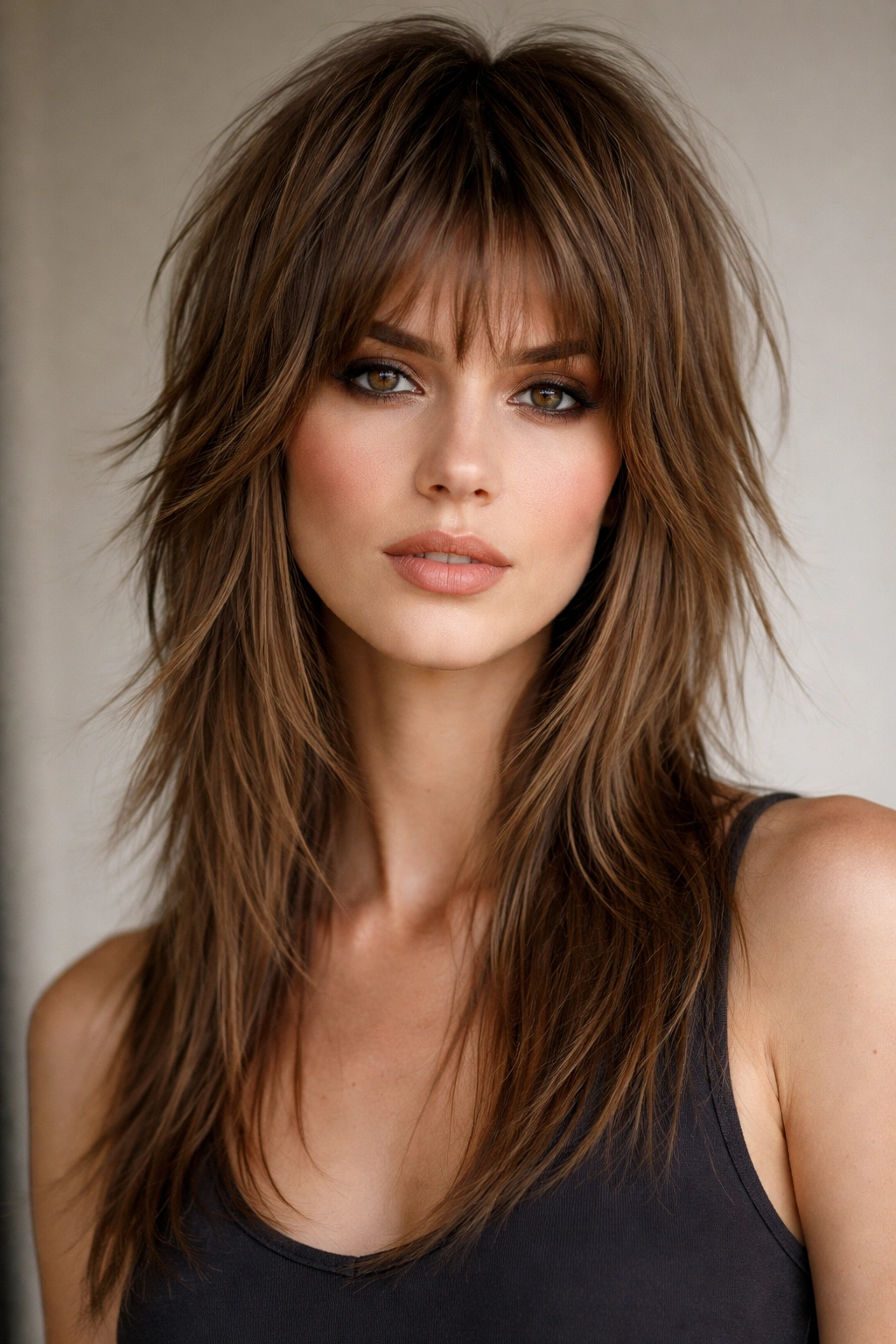
This is a more editorial version of the shag where layers are intentionally disconnected rather than blended—each layer sits separately without flowing into the next. It creates a bold, modern look that emphasizes the choppy texture.
Why It Works for Straight Hair and Rectangle Faces
Rectangle or oblong faces benefit from styles that add width and break up length. The disconnected layers of this cut create horizontal lines that interrupt the vertical length, making the face appear wider and shorter. Straight hair shows the disconnected layers beautifully—each layer is distinct, catching light independently and creating visual texture and interest.
What Makes This Cut Work Best
- Intentional disconnection: Layers don’t blend; they’re cut to sit distinctly above or below each other
- Varied lengths: Top layers much shorter, middle layers mid-length, bottom layers longer—creating clear visual separation
- Styling for definition: Use texture spray or dry shampoo to enhance the separated, piece-y look; don’t blend the layers together
- Color enhancement: This cut works especially well with subtle color variations or dimensional coloring that highlights each layer
Worth knowing: This is a bolder, more editorial style—it’s less “classic” and more “fashion-forward.” It requires commitment to maintaining the intentional disconnection through styling.
10. The Soft, Face-Framing Shag for Fine, Straight Hair
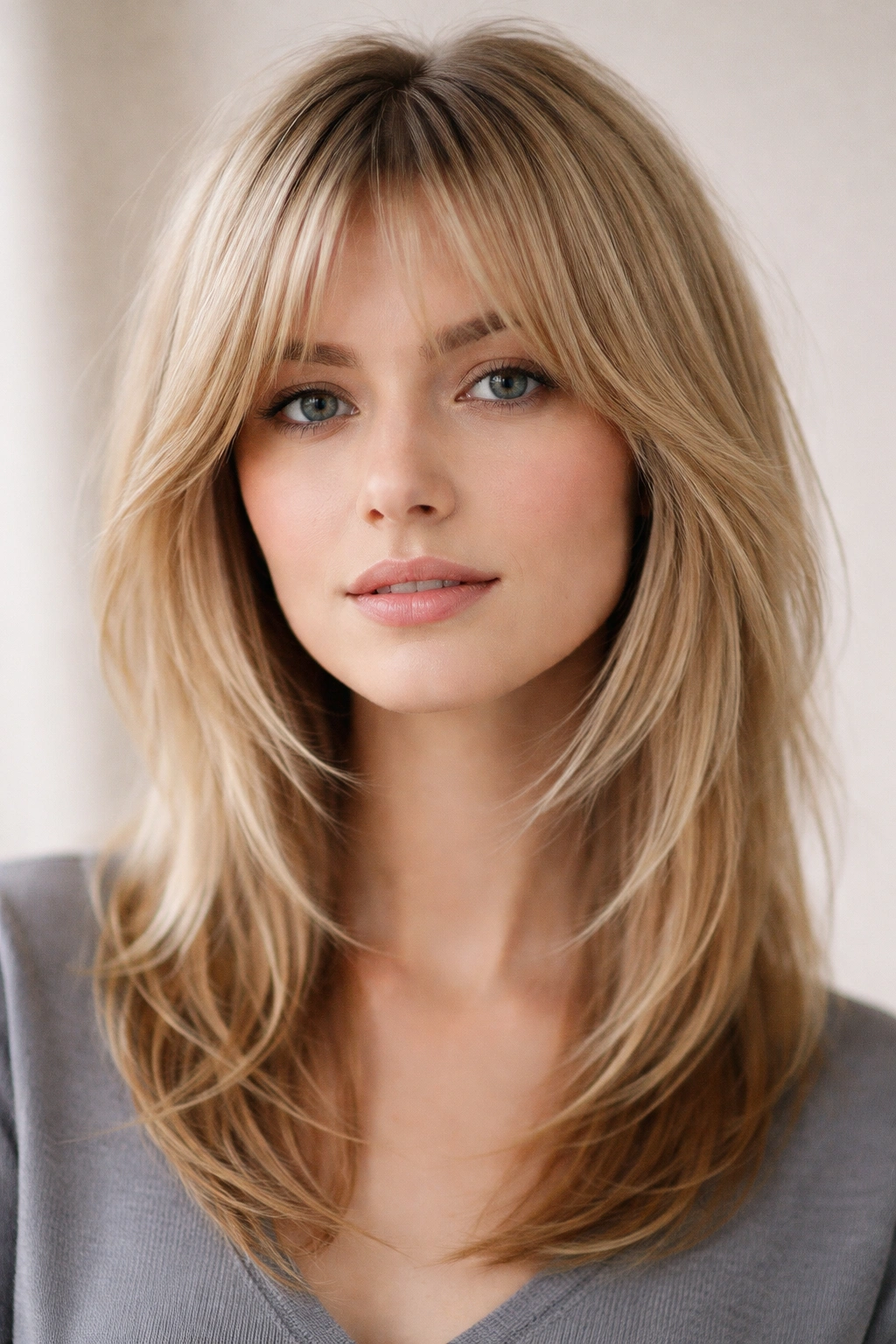
This shag softens the face with delicate layers that graze the cheekbones and jaw without removing too much length. It’s gentle and feminine, with feathered rather than choppy ends and strategic framing rather than aggressive texture.
Why It Works for Fine, Straight Hair and Round Faces
Round faces need vertical lines and length to appear more elongated. This shag’s soft, face-framing layers create those lines while the delicate quality prevents them from looking severe. Fine, straight hair risks looking flat with too many or too-short layers, but this gentle approach adds movement and framing without overwhelming the hair’s natural texture.
What Makes This Cut Work Best
- Strategic face-framing: Layers specifically placed around the cheekbones and jawline, not choppy throughout
- Feathering over choppy texture: Ends are feathered upward rather than cut blunt, creating wispy movement
- Minimal top layers: Keep the crown length relatively intact to avoid looking too thin; focus framing layers on the face perimeter
- Styling ease: Blow-dry straight or curl the ends slightly under; minimal styling required to maintain the look
Insider note: This is an excellent shag for people with fine, straight hair who want “movement” without sacrificing the appearance of thickness.
11. The Shag with Longer Bangs for Curly Hair and Square Faces
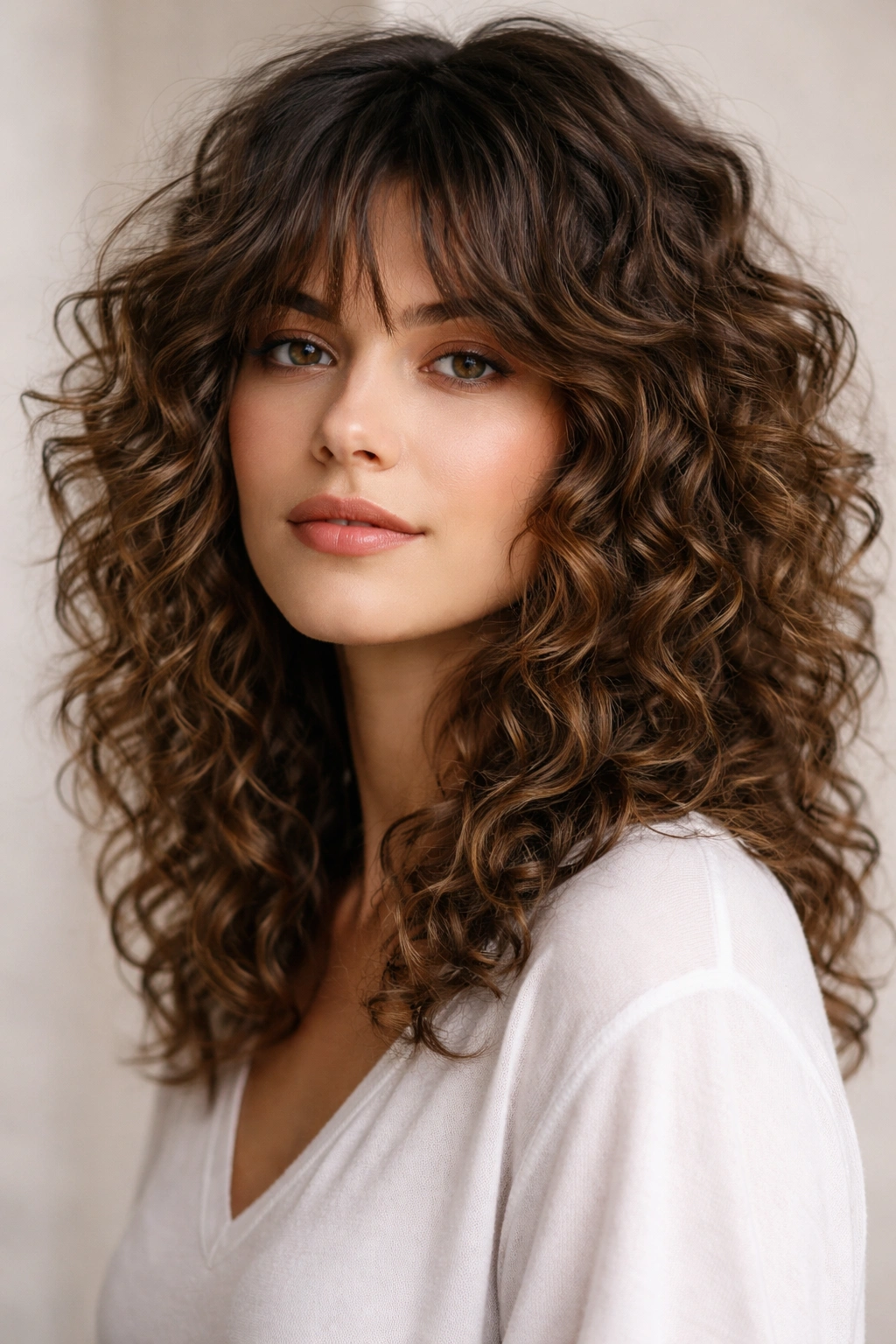
Rather than traditional shag bangs, this cut uses longer, curved bangs that nearly match the front layer length. The bangs curve around the face and blend seamlessly into the framing layers, softening a square jawline through gentle curves.
Why It Works for Curly Hair and Square Faces
Square faces (with prominent jawlines and temples) are softened by curved lines rather than straight ones. The curved bangs of this style create those curves while the seamless blend with the rest of the shag prevents the bangs from looking separate. Curly hair often looks overwhelming with traditional blunt bangs, but longer, curved bangs work with the curl texture rather than against it.
What Makes This Cut Work Best
- Bang curvature: Bangs are curved rather than straight, creating a gentle frame around the face
- Blend-in: Bangs transition seamlessly into the longer front layers; there’s no distinct line
- Curl-specific cutting: Cut on dry hair so the stylist can see how the curls sit and shape accordingly
- Styling: Apply product to wet hair, and the curls will naturally follow the curved shape when diffuse-dried
Pro tip: Ask your stylist to cut the bangs slightly longer than you think you want them—they’ll appear shorter once the curls are dry and settled.
12. The Shag with Razored Texture for Thick Hair and Heart-Shaped Faces
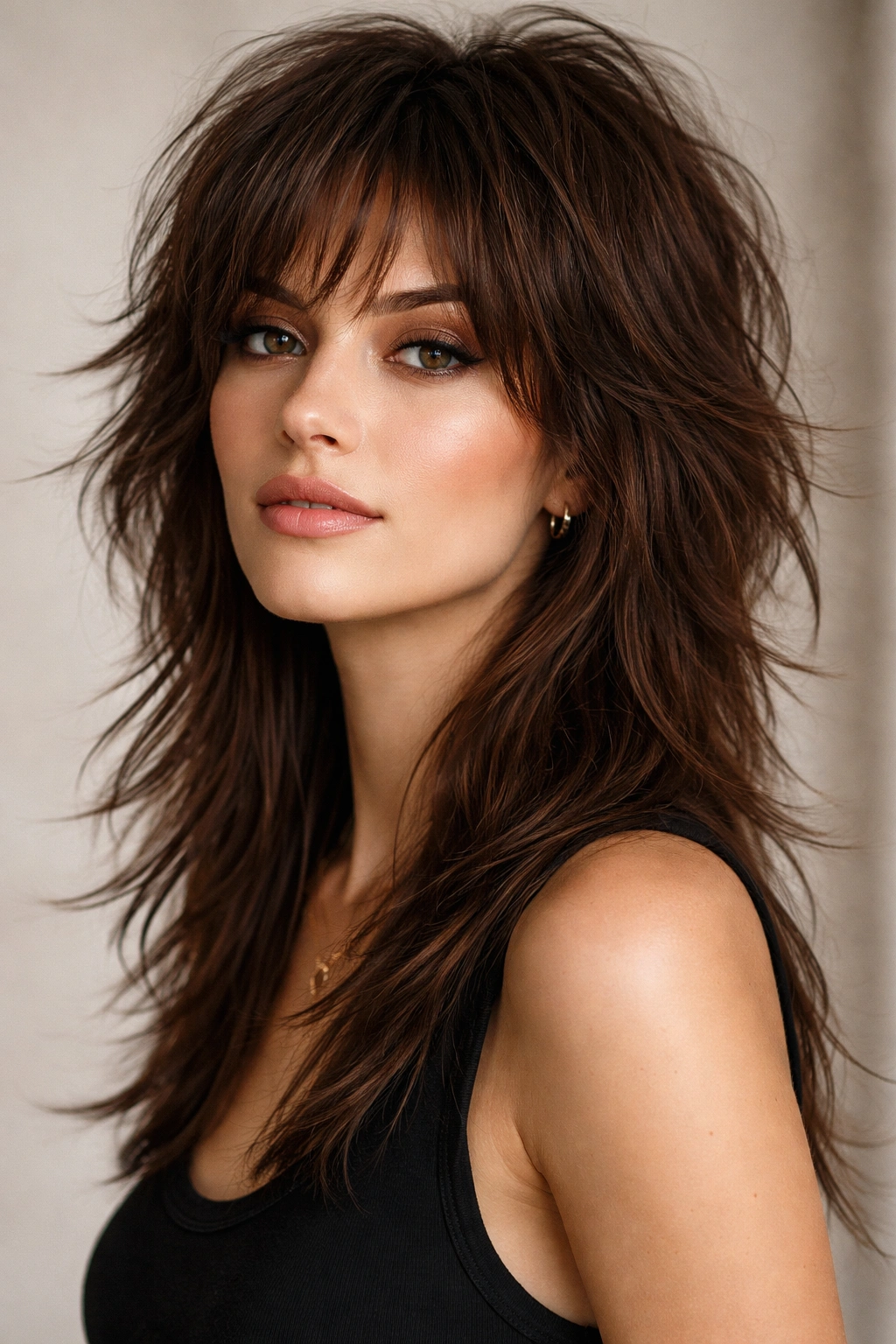
This cut uses razor-cutting rather than scissor-cutting throughout, which creates a sharper, more textured effect even on thick hair. The razor removes weight and creates definition that scissors alone might not achieve on dense hair.
Why It Works for Thick Hair and Heart-Shaped Faces
Heart-shaped faces need texture and movement lower on the face to balance a wider forehead. This razored shag creates that movement and visual interest throughout, which helps distribute focus downward. Thick hair often requires aggressive cutting to create visible texture and movement; razoring accomplishes this better than scissors for dense hair.
What Makes This Cut Work Best
- Razor technique: Done throughout the cut, not just on ends—this requires a skilled stylist
- Sharp texture: Creates defined, piece-y texture even on hair that might normally look chunky with layers
- Weight removal: The razor naturally removes more weight than scissors, essential for thick hair
- Styling: Use texture paste or pomade on slightly damp hair to enhance the defined pieces
Worth knowing: Razor cuts require maintenance; since they create sharper edges, they grow out less gracefully than scissor cuts.
13. The Shag with Volume Layers for Fine Hair and Long Face Shapes
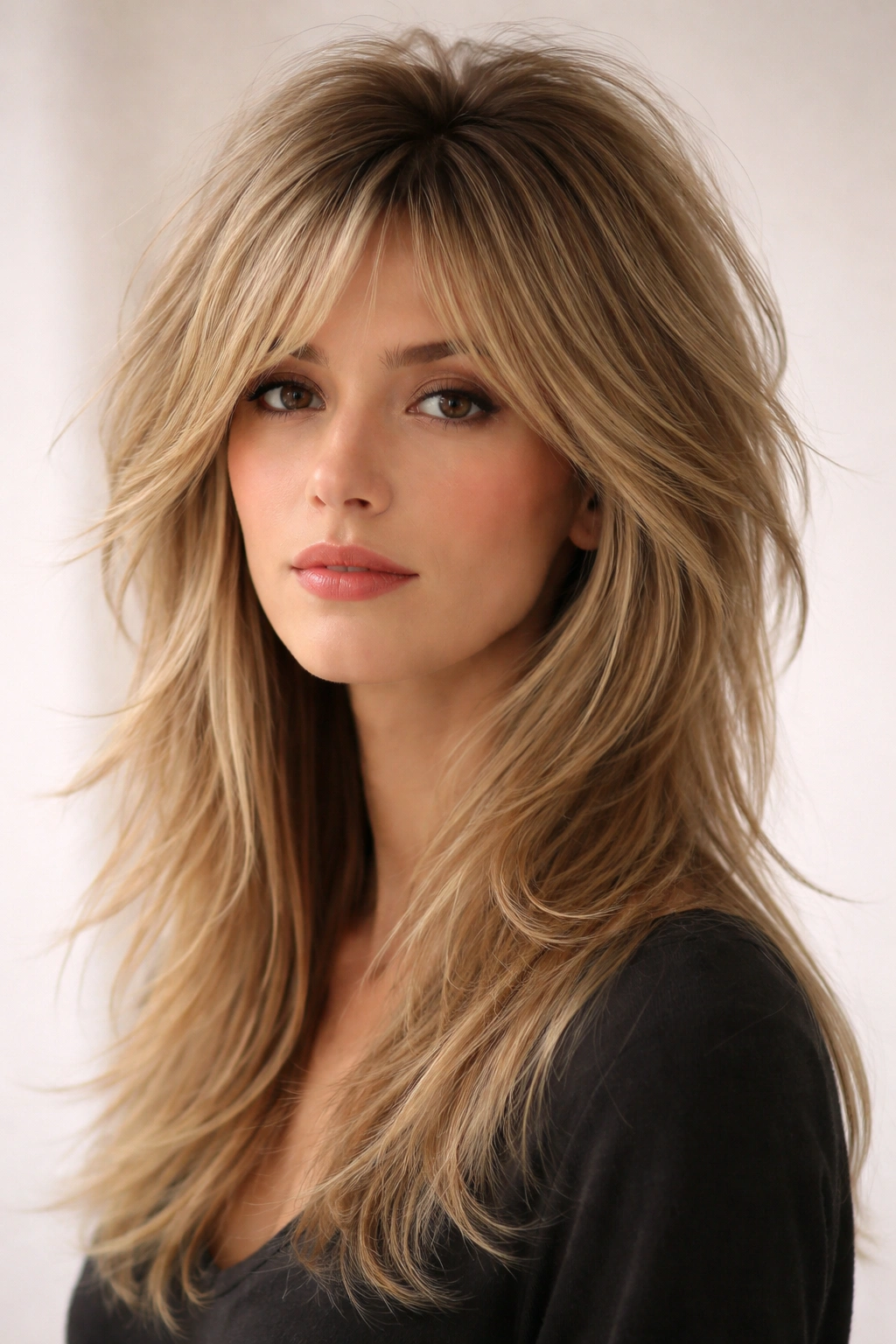
This style prioritizes height and width-creating layers that sit strategically to add fullness throughout. The layers are denser on top and gradually longer toward the back, creating volume without weight.
Why It Works for Fine Hair and Long Face Shapes
Long or oblong faces need width, and this shag delivers through strategically placed volume layers. Rather than layers that make fine hair look even thinner, these layers are positioned to create the illusion of fullness and density. The denser layering on top also creates crown height, which makes the face appear shorter and wider.
What Makes This Cut Work Best
- Crown density: More layers in the crown area to create maximum height and fullness
- Strategic spacing: Layers are not evenly distributed; they’re closer together on top, further apart lower down
- Blow-dry method: Blow-dry from root to tip with a round brush, focusing on lifting at the crown to maximize volume
- Product: Use a volumizing mousse on damp hair and dry shampoo to boost texture and separation
Pro tip: Have your stylist show you how to blow-dry and style this cut—proper technique is essential for achieving the volume it’s designed for.
14. The Shag with Longer Length and Minimal Choppy Layers for Wavy Hair
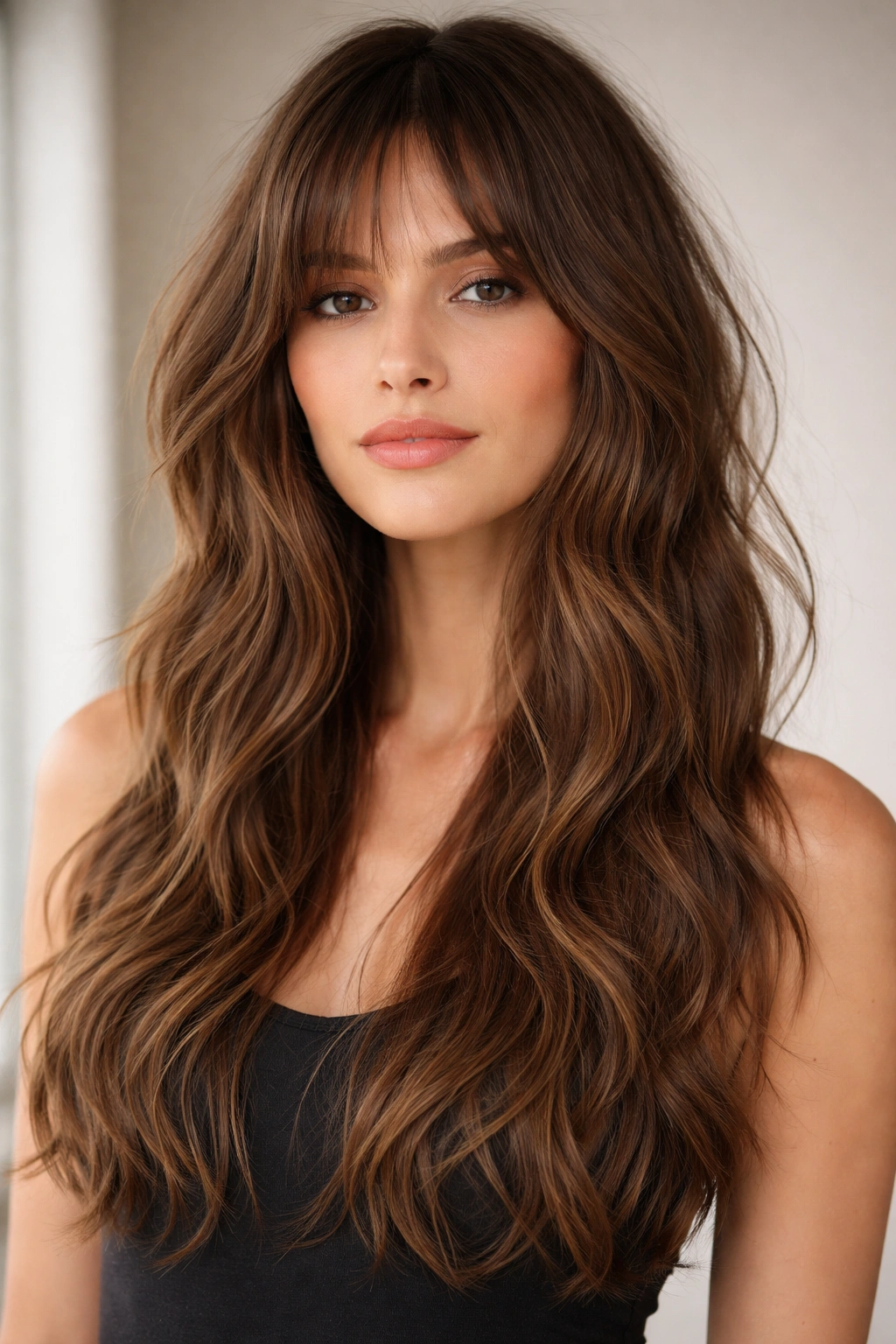
This is a barely-there shag for people who like the vibe of the style but prefer longer hair. The choppy layers are minimal and subtle, used more for movement encouragement than texture creation.
Why It Works for Wavy Hair and Oval Faces
Wavy hair already has natural movement and texture, so aggressive layers can overwhelm it. This gentler version uses minimal layers to enhance natural waves rather than create artificial texture. Oval faces remain perfectly balanced with longer hair, and the subtle shag layers add interest without dramatically changing the silhouette.
What Makes This Cut Work Best
- Layer subtlety: Layers exist but aren’t visually dominant; they’re more about encouraging wave movement
- Long length: Typically mid-back or longer, with the shag elements being understated rather than obvious
- Wave-enhancing styling: Apply product to damp hair and let waves air-dry or use a diffuser for natural movement
- Low maintenance: This cut doesn’t require aggressive styling; it works with natural waves
Insider note: This is ideal for people who love the shag aesthetic but have worn longer hair for years and don’t want a drastic change.
15. The Shag with Asymmetrical Back Layers for Thick, Curly Hair
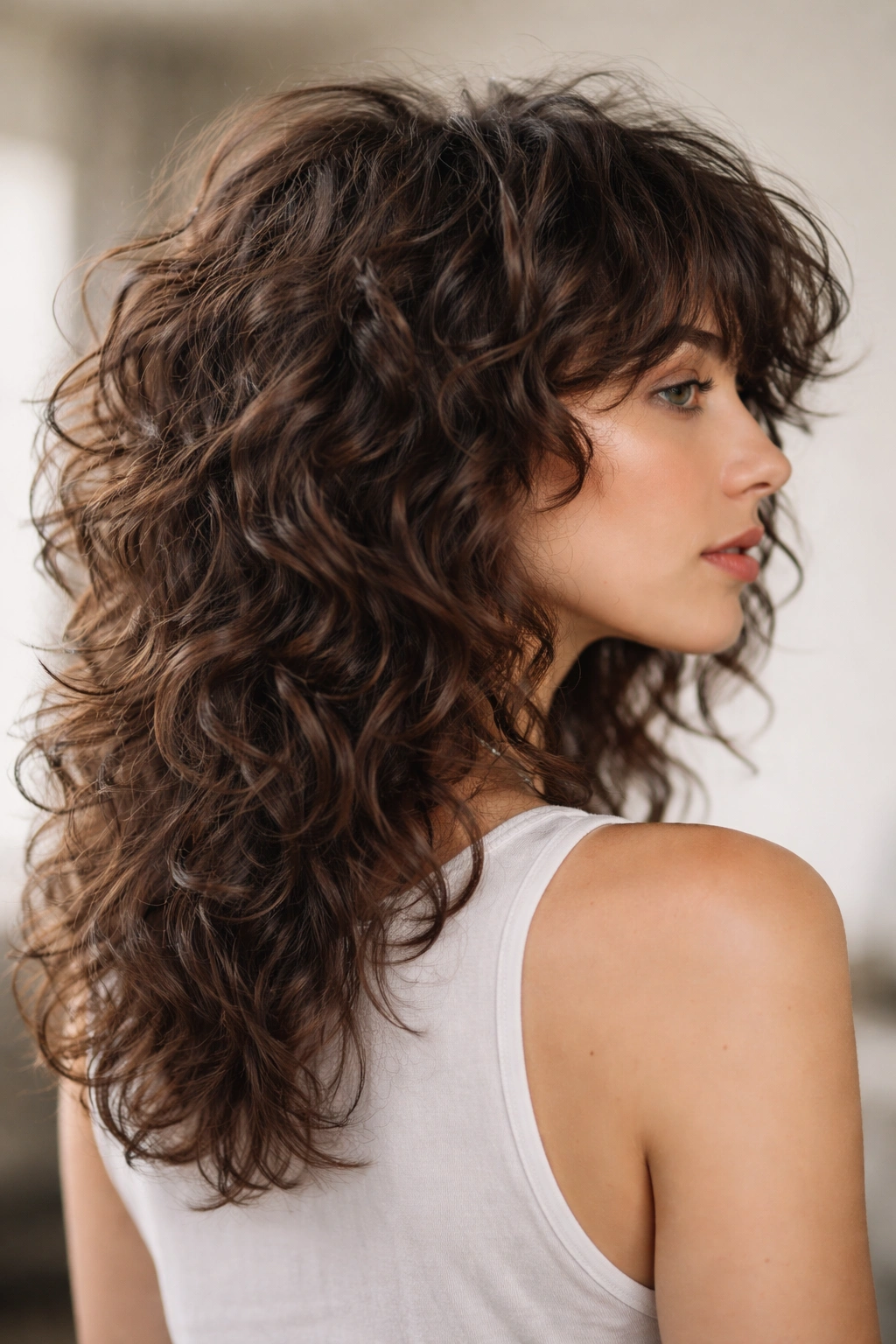
This variation keeps the front relatively balanced while creating asymmetry in the back layers—one side is shorter and texture-heavy, the other longer and looser. It’s a creative interpretation that works specifically for curly hair.
Why It Works for Thick, Curly Hair and Oval Faces
This asymmetrical approach uses the back’s varying lengths to create movement and visual interest without the front-heavy structure of traditional shags. Thick, curly hair looks balanced with this approach because the curls provide their own visual interest—the asymmetry in cut adds style detail without overwhelming density. Oval faces can carry any proportion, and this artistic interpretation offers a unique alternative to conventional shags.
What Makes This Cut Work Best
- Asymmetrical back: One side of the back is significantly shorter than the other
- Balanced front: The front remains relatively balanced, keeping the face frame symmetrical while the back is artistic
- Dry cutting: Essential for curly hair; the stylist cuts on dry curls to understand the texture and flow
- Embrace the asymmetry: Style with intention; don’t try to make it symmetrical
Pro tip: This is a bold, artistic choice that requires confidence to wear. It works best for people excited about a statement-making style.
16. The Shag with Subtle Highlights for Straight Hair and Rectangular Faces
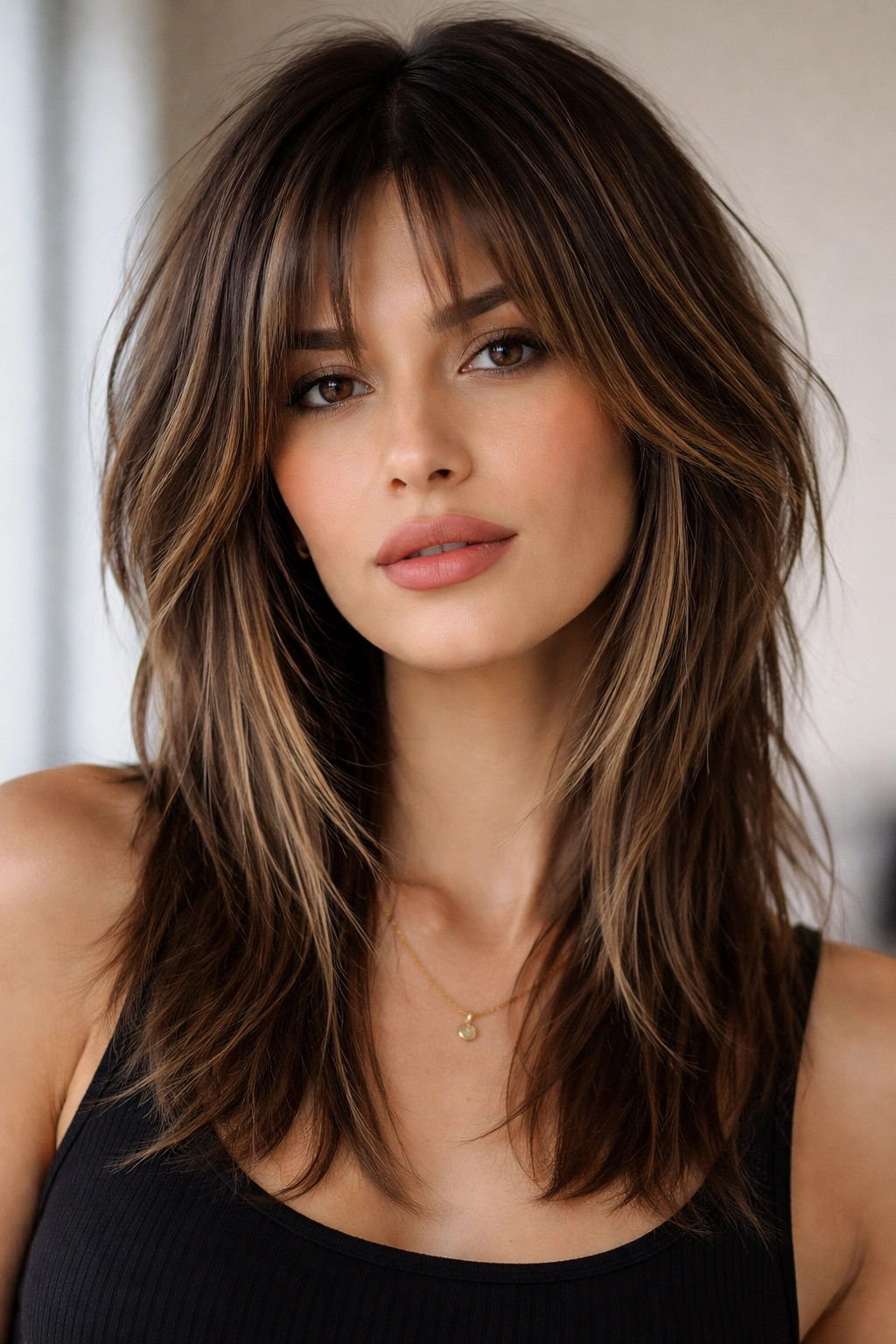
This cut pairs a classic shag structure with strategic color placement—lighter highlights on the choppy top layers and around the face frame, darker color at the roots for dimension. The color work enhances the texture of the cut itself.
Why It Works for Straight Hair and Rectangular Faces
Rectangular faces need width and the interruption of strong vertical lines. The combination of choppy layers and highlighting creates visual texture that breaks up length. Straight hair shows highlights beautifully through the individual strands; the layers of a shag become even more defined with subtle color variation.
What Makes This Cut Work Best
- Highlight placement: Focus on top layers, around the face, and through the mid-lengths to enhance texture
- Root dimension: Darker roots ground the lighter layers and create instant depth
- Contrast level: Subtle enough to feel natural; obvious enough to enhance the shag structure
- Styling: Blow-dry with a round brush to flip layers outward, allowing highlights to catch light
Worth knowing: This is a maintenance-intensive option—highlights require root touch-ups every 6-8 weeks and the cut every 4-6 weeks.
17. The Shag with Choppy Bangs for Curly Hair and Heart-Shaped Faces
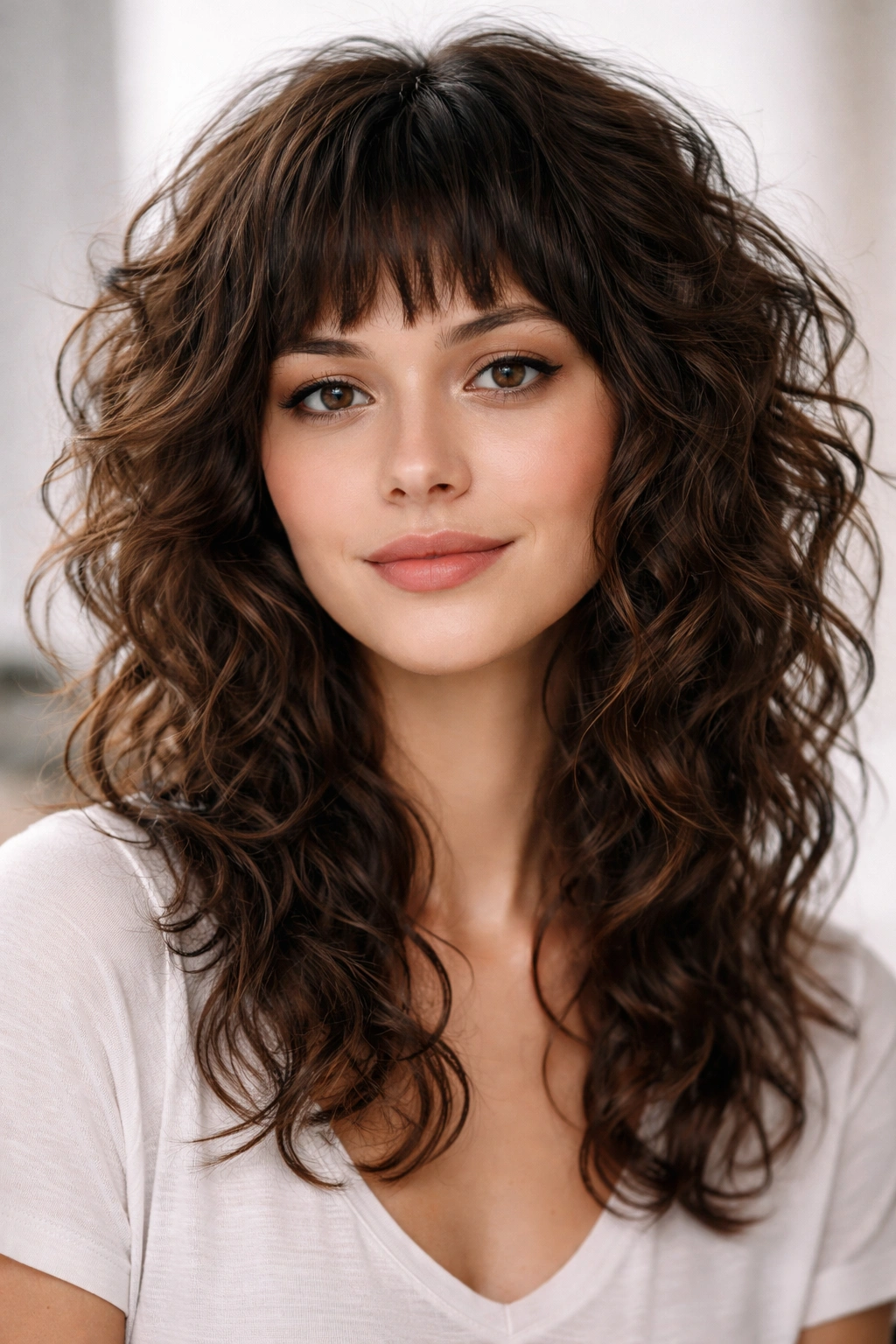
This shag features distinctly choppy, shorter bangs (shorter than traditional shag bangs) that are cut blunt and sit separately from the longer front layers. The bangs are a statement piece, intentionally distinct from the rest of the cut.
Why It Works for Curly Hair and Heart-Shaped Faces
Heart-shaped faces have a wide forehead and narrower chin. Choppy bangs that sit high on the forehead draw focus to the eyes and cheekbones rather than the wider temples. Curly hair actually suits choppy bangs beautifully because the curls add softness and movement to what might otherwise feel harsh. The bangs sit above most of the curl density, so they work with the texture rather than fighting it.
What Makes This Cut Work Best
- Bang bluntness: Cut blunt and intentionally short; they’re a distinct element rather than blended
- Separation: A clear visual line between the bangs and the longer layers below creates impact
- Curl accommodation: The stylist should recognize that curls will add fullness; cut bangs slightly shorter than expected
- Styling: Bangs curl with the rest of your hair; style them that way rather than trying to straighten them
Insider note: Choppy bangs require maintenance—trims every 3-4 weeks keep them looking intentional rather than grown-out.
18. The Shag with Layered Undercut for Thick Hair and Square Faces
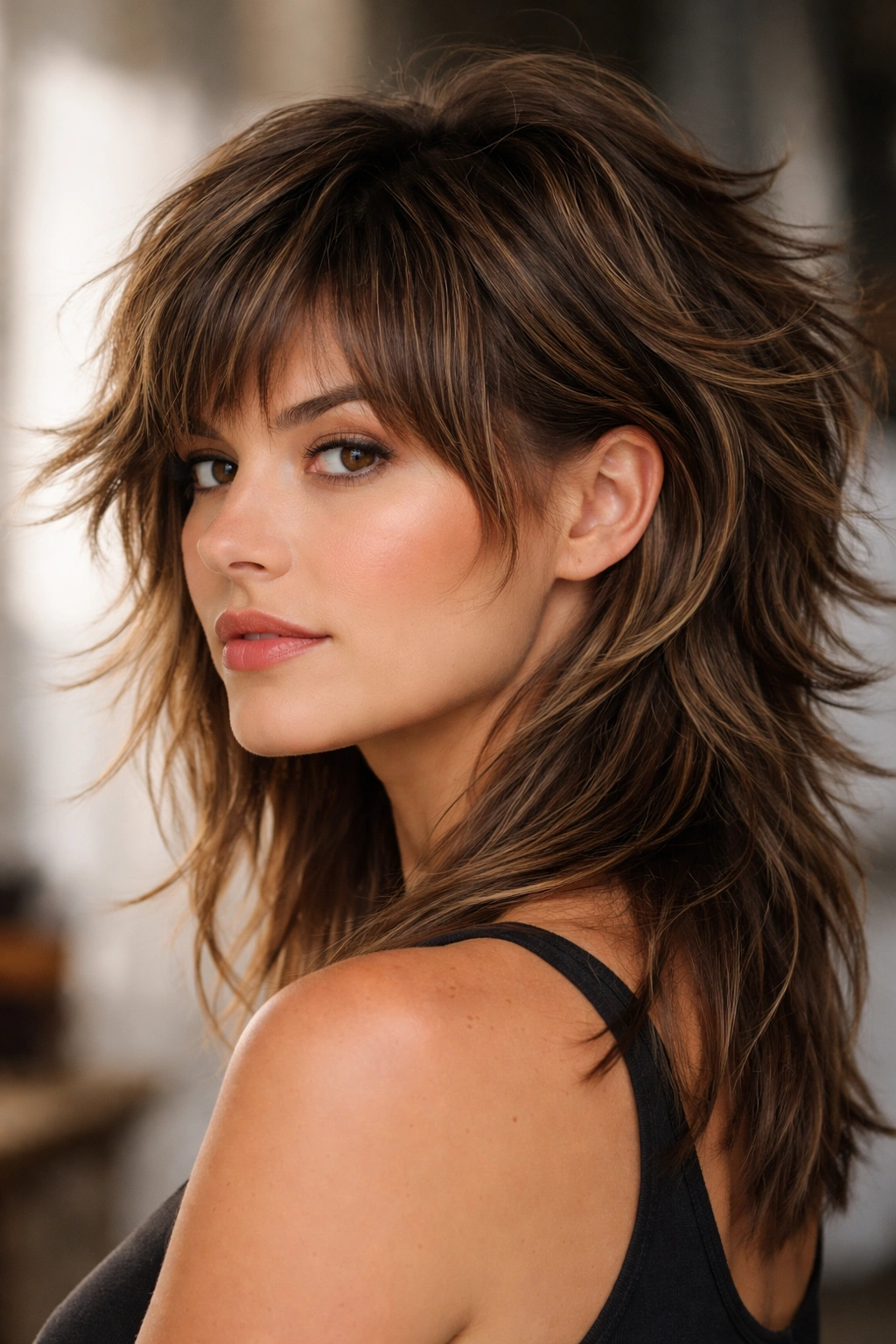
This modern interpretation features an undercut (shorter layers hidden underneath) combined with longer layers on top that are textured and choppy. The contrast between the structured top and the lighter undercut creates dimension.
Why It Works for Thick Hair and Square Faces
Square faces benefit from softness, and the choppy top layers provide that while the undercut reduces bulk without removing the flattering length. Thick hair is notoriously difficult to texture, but the combination of visible choppy layers and an underneath undercut removes strategic density while maintaining volume where it matters. The undercut also creates movement as hair shifts and separates.
What Makes This Cut Work Best
- Visible top layers: Choppy, textured, and definitely noticeable—these are the style statement
- Hidden undercut: Shorter underneath, revealed when you move or tie hair up, adding an element of surprise
- Styling variation: Can look sharp with the undercut visible, or softer when worn with the longer layers over top
- Maintenance: Both the visible layers and undercut require maintenance; aim for trims every 4-6 weeks
Pro tip: This cut works especially well for people who sometimes style their hair up or back—the undercut adds interest when revealed.
19. The Shag with Textured Ends for Wavy Hair and Round Faces
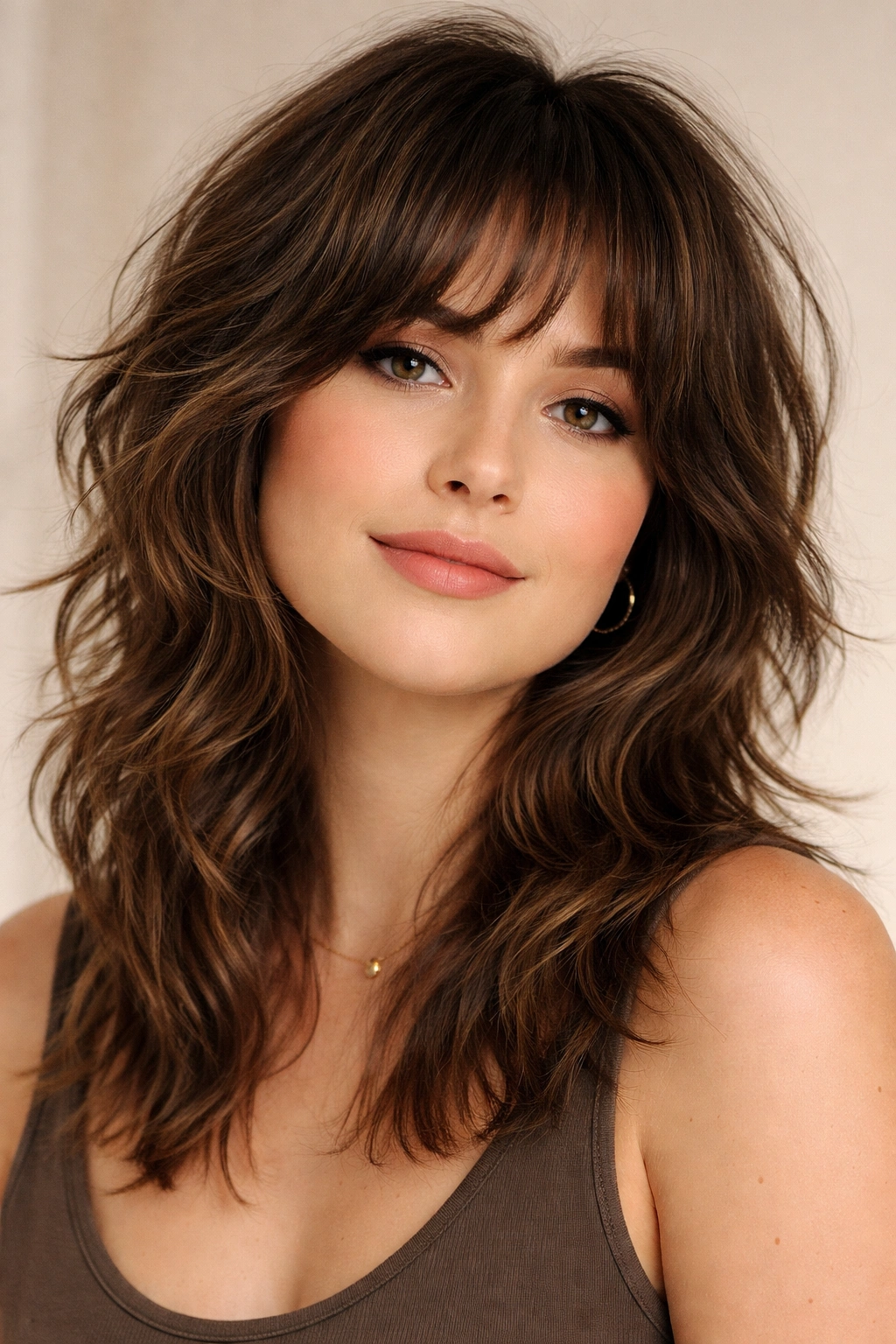
This style uses point-cutting or texturizing techniques on the ends of layers to create jagged, deliberately textured edges rather than feathered or blunt ones. The texture is intentional and visual, creating a modern, lived-in aesthetic.
Why It Works for Wavy Hair and Round Faces
Round faces benefit from choppy texture and movement that creates angles. The textured ends of this shag do exactly that—they create visual irregularity that counteracts the softness of round facial proportions. Wavy hair takes to textured ends beautifully; the natural wave pattern works with the cut texture rather than fighting it, creating movement that looks intentional and effortless.
What Makes This Cut Work Best
- Point-cutting technique: The stylist uses point-cutting to create jagged texture on layer ends rather than feathering or blunt cuts
- Visual texture: The ends look deliberately textured, not ragged or poorly cut—there’s a difference
- Wave enhancement: The texture works with natural waves to create movement and separation
- Styling: Minimal effort required—waves naturally settle into the textured layers
Worth knowing: This textured approach is edgier and more modern than feathered or blunt-ended shags—it’s a style choice that signals confidence.
20. The Shag with Blended Layers for Fine, Curly Hair and Oblong Faces
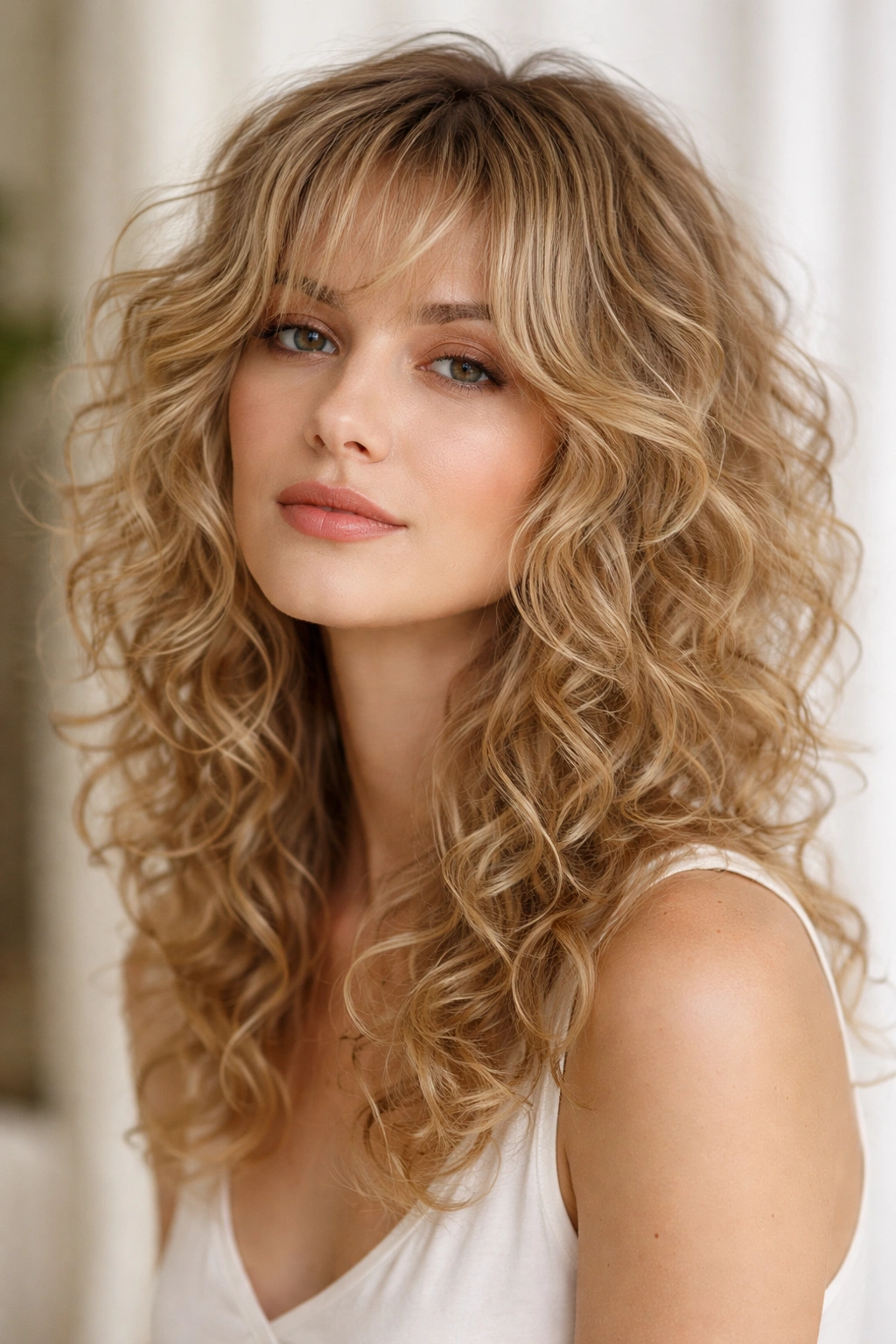
This final option uses blended rather than choppy layers, where each layer flows into the next rather than sitting distinctly separate. It’s softer and more connected while still being a textured shag. This approach works specifically for fine, curly hair, where choppy layers can look disconnected and sparse.
Why It Works for Fine, Curly Hair and Oblong Faces
Oblong faces need width, and this shag creates that through strategic layer placement that adds fullness around the cheekbones and temples. Fine, curly hair looks fuller with blended layers because the curls connect through each layer rather than sitting as disconnected pieces. The blended approach prevents fine curls from looking separated and thin while still offering the movement and texture that make shags appealing.
What Makes This Cut Work Best
- Blended layer transitions: Layers flow from one to the next rather than having distinct separations
- Curl-respecting cut: Dry-cut on curly hair so the stylist understands where curls naturally sit and connect
- Fullness through curl pattern: Let the natural curl pattern create fullness rather than relying on choppy layers
- Styling approach: Apply product to wet hair and diffuse-dry to encourage curls to settle into the blended shape
Insider note: This is the most flattering shag option for fine, curly hair—it offers movement and style without the risk of looking sparse or disconnected.
Final Thoughts
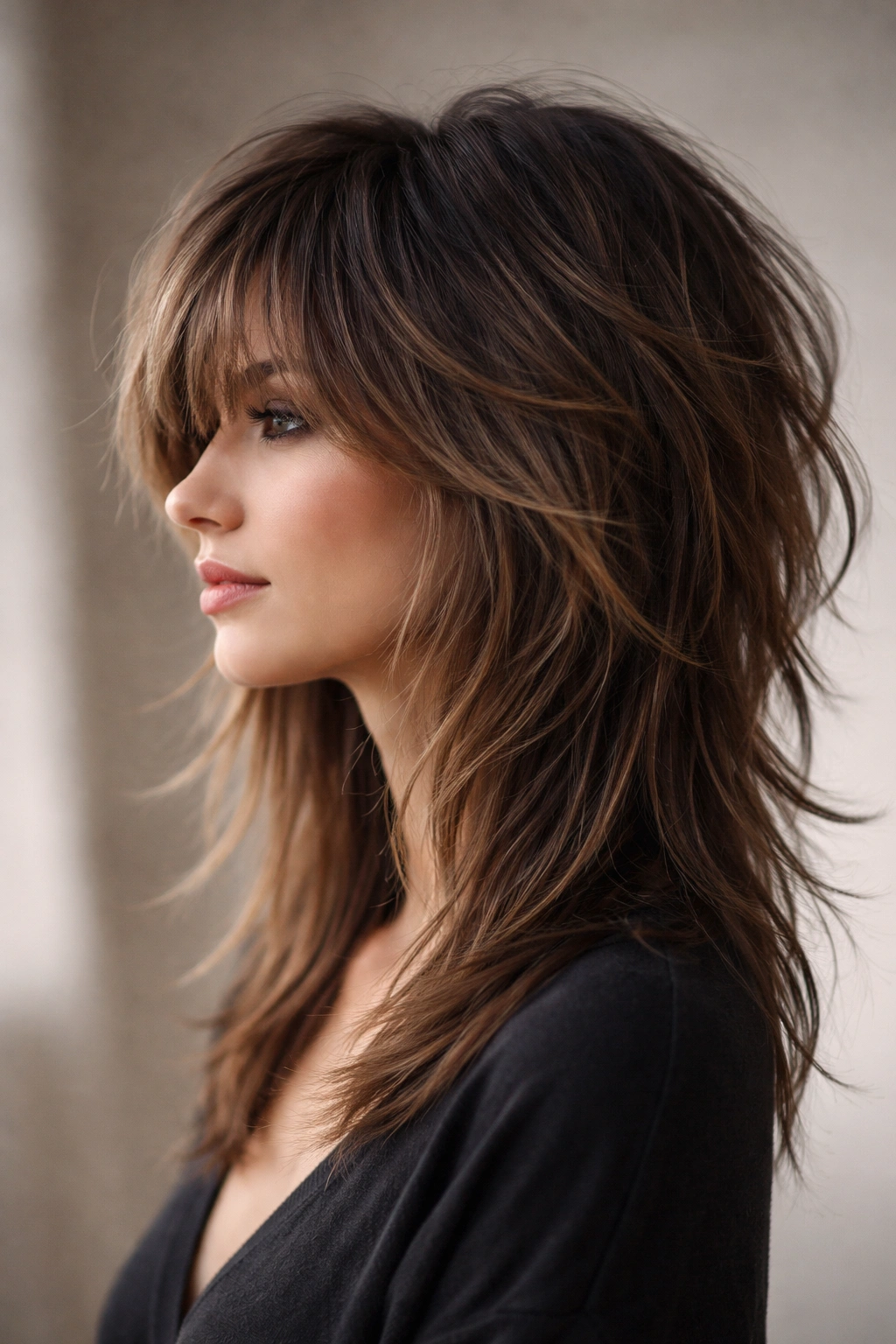
The beauty of the shag is that it’s genuinely customizable—with twenty different variations, the odds are strong that you’ll find one perfectly suited to your hair type and face shape. The key is being specific with your stylist about which version you’re drawn to and why it appeals to you, then trusting their expertise to customize it further based on what they see in person.
Remember that the shag you see on someone else might need tweaking to work for your hair’s specific texture, density, and your face’s unique proportions. The best shag is the one that works with your natural hair rather than against it, requires styling that fits your lifestyle, and makes you feel confident when you catch your reflection. Once you find the right version, you’ll understand exactly why this classic cut has earned its comeback—it’s endlessly flattering when it’s right for you.
